FAA-H-8083-25C · Source PDF page 45
Aeronautical Decision-Making
Assessing Risk · PHAK page 2-6
Searchable transcription
Risk
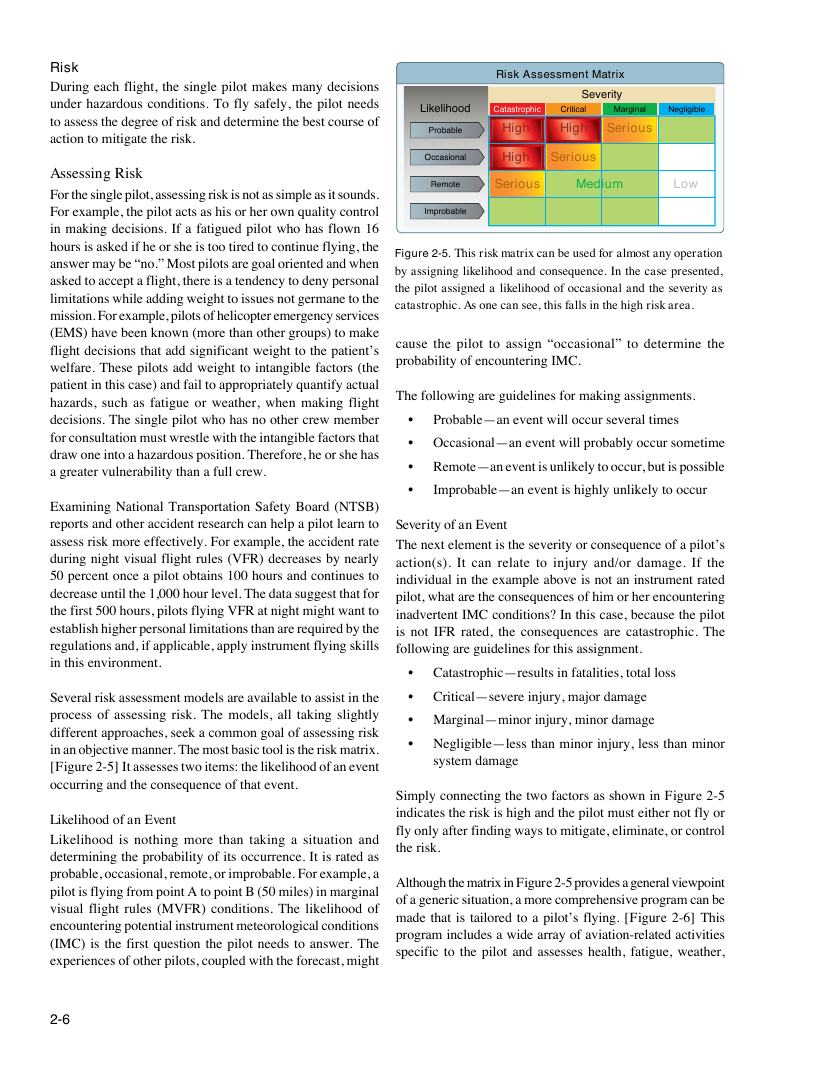
Risk Assessment Matrix
During each flight, the single pilot makes many decisions
Severity
under hazardous conditions. To fly safely, the pilot needs
Likelihood Catastrophic Critical Marginal Negligible
to assess the degree of risk and determine the best course of
Probable High High Serious
action to mitigate the risk.
Occasional High Serious
Assessing Risk
Remote Serious Medium Low
For the single pilot, assessing risk is not as simple as it sounds.
For example, the pilot acts as his or her own quality control Improbable
in making decisions. If a fatigued pilot who has flown 16
hours is asked if he or she is too tired to continue flying, the
Figure 2-5. This risk matrix can be used for almost any operation
answer may be “no.” Most pilots are goal oriented and when
by assigning likelihood and consequence. In the case presented,
asked to accept a flight, there is a tendency to deny personal
the pilot assigned a likelihood of occasional and the severity as
limitations while adding weight to issues not germane to the
catastrophic. As one can see, this falls in the high risk area.
mission. For example, pilots of helicopter emergency services
(EMS) have been known (more than other groups) to make
cause the pilot to assign “occasional” to determine the
flight decisions that add significant weight to the patient’s
probability of encountering IMC.
welfare. These pilots add weight to intangible factors (the
patient in this case) and fail to appropriately quantify actual
The following are guidelines for making assignments.
hazards, such as fatigue or weather, when making flight
decisions. The single pilot who has no other crew member • Probable—an event will occur several times
for consultation must wrestle with the intangible factors that
• Occasional—an event will probably occur sometime
draw one into a hazardous position. Therefore, he or she has
• Remote—an event is unlikely to occur, but is possible
a greater vulnerability than a full crew.
• Improbable—an event is highly unlikely to occur
Examining National Transportation Safety Board (NTSB)
reports and other accident research can help a pilot learn to Severity of an Event
assess risk more effectively. For example, the accident rate The next element is the severity or consequence of a pilot’s
during night visual flight rules (VFR) decreases by nearly action(s). It can relate to injury and/or damage. If the
50 percent once a pilot obtains 100 hours and continues to individual in the example above is not an instrument rated
decrease until the 1,000 hour level. The data suggest that for pilot, what are the consequences of him or her encountering
the first 500 hours, pilots flying VFR at night might want to inadvertent IMC conditions? In this case, because the pilot
establish higher personal limitations than are required by the is not IFR rated, the consequences are catastrophic. The
regulations and, if applicable, apply instrument flying skills following are guidelines for this assignment.
in this environment.
• Catastrophic—results in fatalities, total loss
Several risk assessment models are available to assist in the • Critical—severe injury, major damage
process of assessing risk. The models, all taking slightly
• Marginal—minor injury, minor damage
different approaches, seek a common goal of assessing risk
• Negligible—less than minor injury, less than minor
in an objective manner. The most basic tool is the risk matrix.
system damage
[Figure 2-5] It assesses two items: the likelihood of an event
occurring and the consequence of that event.
Simply connecting the two factors as shown in Figure 2-5
indicates the risk is high and the pilot must either not fly or
Likelihood of an Event
fly only after finding ways to mitigate, eliminate, or control
Likelihood is nothing more than taking a situation and
the risk.
determining the probability of its occurrence. It is rated as
probable, occasional, remote, or improbable. For example, a
Although the matrix in Figure 2-5 provides a general viewpoint
pilot is flying from point A to point B (50 miles) in marginal
of a generic situation, a more comprehensive program can be
visual flight rules (MVFR) conditions. The likelihood of
made that is tailored to a pilot’s flying. [Figure 2-6] This
encountering potential instrument meteorological conditions
program includes a wide array of aviation-related activities
(IMC) is the first question the pilot needs to answer. The
specific to the pilot and assesses health, fatigue, weather,
experiences of other pilots, coupled with the forecast, might
2-6