FAA-H-8083-25C · Source PDF page 119
Aerodynamics of Flight
Aerodynamic Forces in Flight Maneuvers · PHAK page 5-22
Searchable transcription
Level flight Medium banked turn Steeply banked turn
Horizontal
component Centrifugal
force
5-22
component Vertical
Centrifugal
force
Horizontal
R component e
s u lta
n
t
lo
a
d
component Vertical
R
e su
lta n t
lo
a
d
Lift
T T o
o
ta
l
lift
ta
l lift
Weight Weight Weight
design is necessary to obtain the best results from these two In comparison, the rectangular wing has a tendency to stall
conflicting conditions. first at the wing root and provides adequate stall warning,
adequate aileron effectiveness, and is usually quite stable.
The second means of changing the planform is by tapering It is, therefore, favored in the design of low cost, low speed
(decreasing the length of chord from the root to the tip of the airplanes.
wing). In general, tapering causes a decrease in drag (most
effective at high speeds) and an increase in lift. There is also Aerodynamic Forces in Flight Maneuvers
a structural benefit due to a saving in weight of the wing.
Forces in Turns
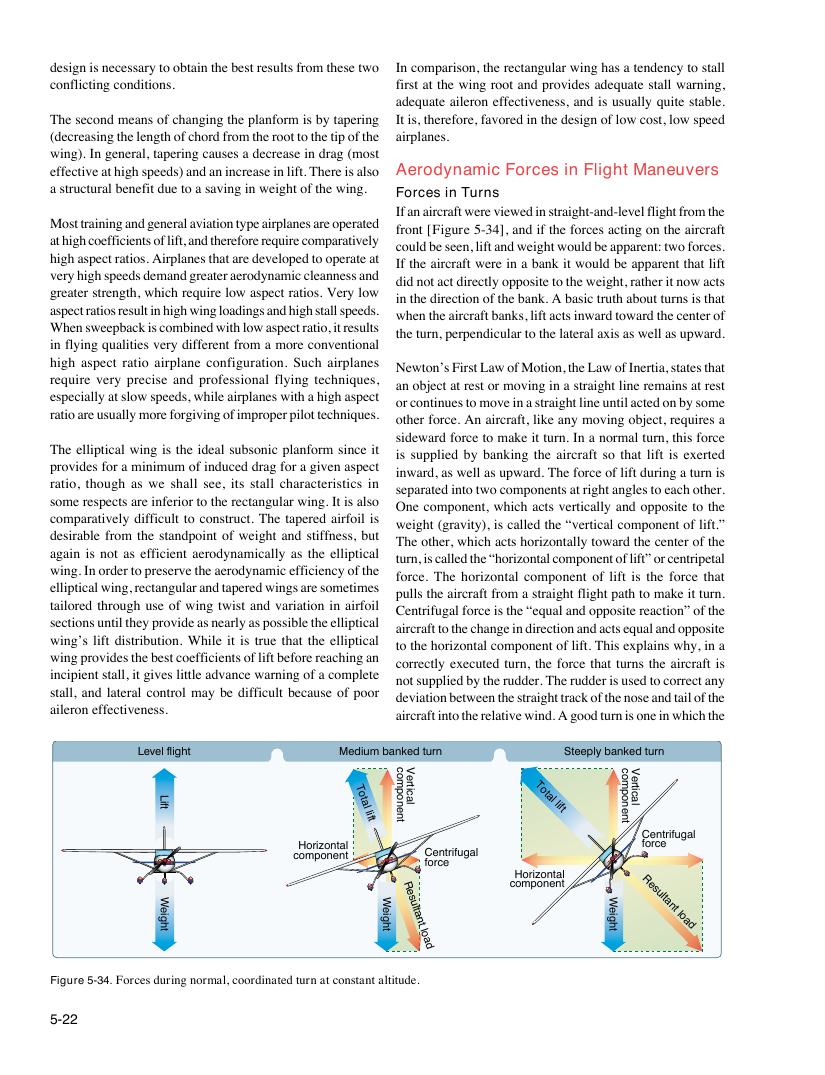
If an aircraft were viewed in straight-and-level flight from the
Most training and general aviation type airplanes are operated
front [Figure 5-34], and if the forces acting on the aircraft
at high coefficients of lift, and therefore require comparatively
could be seen, lift and weight would be apparent: two forces.
high aspect ratios. Airplanes that are developed to operate at
If the aircraft were in a bank it would be apparent that lift
very high speeds demand greater aerodynamic cleanness and
did not act directly opposite to the weight, rather it now acts
greater strength, which require low aspect ratios. Very low
in the direction of the bank. A basic truth about turns is that
aspect ratios result in high wing loadings and high stall speeds.
when the aircraft banks, lift acts inward toward the center of
When sweepback is combined with low aspect ratio, it results
the turn, perpendicular to the lateral axis as well as upward.
in flying qualities very different from a more conventional
high aspect ratio airplane configuration. Such airplanes
Newton’s First Law of Motion, the Law of Inertia, states that
require very precise and professional flying techniques,
an object at rest or moving in a straight line remains at rest
especially at slow speeds, while airplanes with a high aspect
or continues to move in a straight line until acted on by some
ratio are usually more forgiving of improper pilot techniques.
other force. An aircraft, like any moving object, requires a
sideward force to make it turn. In a normal turn, this force
The elliptical wing is the ideal subsonic planform since it
is supplied by banking the aircraft so that lift is exerted
provides for a minimum of induced drag for a given aspect
inward, as well as upward. The force of lift during a turn is
ratio, though as we shall see, its stall characteristics in
separated into two components at right angles to each other.
some respects are inferior to the rectangular wing. It is also
One component, which acts vertically and opposite to the
comparatively difficult to construct. The tapered airfoil is
weight (gravity), is called the “vertical component of lift.”
desirable from the standpoint of weight and stiffness, but
The other, which acts horizontally toward the center of the
again is not as efficient aerodynamically as the elliptical
turn, is called the “horizontal component of lift” or centripetal
wing. In order to preserve the aerodynamic efficiency of the
force. The horizontal component of lift is the force that
elliptical wing, rectangular and tapered wings are sometimes
pulls the aircraft from a straight flight path to make it turn.
tailored through use of wing twist and variation in airfoil
Centrifugal force is the “equal and opposite reaction” of the
sections until they provide as nearly as possible the elliptical
aircraft to the change in direction and acts equal and opposite
wing’s lift distribution. While it is true that the elliptical
to the horizontal component of lift. This explains why, in a
wing provides the best coefficients of lift before reaching an
correctly executed turn, the force that turns the aircraft is
incipient stall, it gives little advance warning of a complete
not supplied by the rudder. The rudder is used to correct any
stall, and lateral control may be difficult because of poor
deviation between the straight track of the nose and tail of the
aileron effectiveness.
aircraft into the relative wind. A good turn is one in which the
Figure 5-34. Forces during normal, coordinated turn at constant altitude.