FAA-H-8083-25C · Source PDF page 166
Aircraft Systems
Adjustable-Pitch Propeller · PHAK page 7-6
Searchable transcription
density (higher density altitude) decreases the power output will increase or decrease as appropriate, with changes in
of the engine. As altitude changes, the position of the throttle airspeed and propeller load. For example, once a specific
must be changed to maintain the same rpm. As altitude is rpm has been selected, if aircraft speed decreases enough to
increased, the throttle must be opened further to indicate the rotate the propeller blades until they contact the low pitch
same rpm as at a lower altitude. stop, any further decrease in airspeed will cause engine rpm
to decrease the same way as if a fixed-pitch propeller were
Adjustable-Pitch Propeller installed. The same holds true when an aircraft equipped with
The adjustable-pitch propeller was the forerunner of the a constant-speed propeller accelerates to a faster airspeed. As
constant-speed propeller. It is a propeller with blades whose the aircraft accelerates, the propeller blade angle increases to
pitch can be adjusted on the ground with the engine not maintain the selected rpm until the high pitch stop is reached.
running, but which cannot be adjusted in flight. It is also Once this occurs, the blade angle cannot increase any further
referred to as a ground adjustable propeller. By the 1930s, and engine rpm increases.
pioneer aviation inventors were laying the ground work for
automatic pitch-change mechanisms, which is why the term On aircraft equipped with a constant-speed propeller, power
sometimes refers to modern constant-speed propellers that output is controlled by the throttle and indicated by a manifold
are adjustable in flight. pressure gauge. The gauge measures the absolute pressure of
the fuel-air mixture inside the intake manifold and is more
The first adjustable-pitch propeller systems provided only two correctly a measure of manifold absolute pressure (MAP). At
pitch settings: low and high. Today, most adjustable-pitch a constant rpm and altitude, the amount of power produced
propeller systems are capable of a range of pitch settings. is directly related to the fuel-air mixture being delivered to
the combustion chamber. As the throttle setting is increased,
A constant-speed propeller is a controllable-pitch propeller more fuel and air flows to the engine and MAP increases.
whose pitch is automatically varied in flight by a governor When the engine is not running, the manifold pressure gauge
maintaining constant rpm despite varying air loads. It is the indicates ambient air pressure (i.e., 29.92 inches mercury
most common type of adjustable-pitch propeller. The main (29.92 "Hg)). When the engine is started, the manifold
advantage of a constant-speed propeller is that it converts pressure indication decreases to a value less than ambient
a high percentage of brake horsepower (BHP) into thrust pressure (i.e., idle at 12 "Hg). Engine failure or power loss
horsepower (THP) over a wide range of rpm and airspeed is indicated on the manifold gauge as an increase in manifold
combinations. A constant-speed propeller is more efficient pressure to a value corresponding to the ambient air pressure
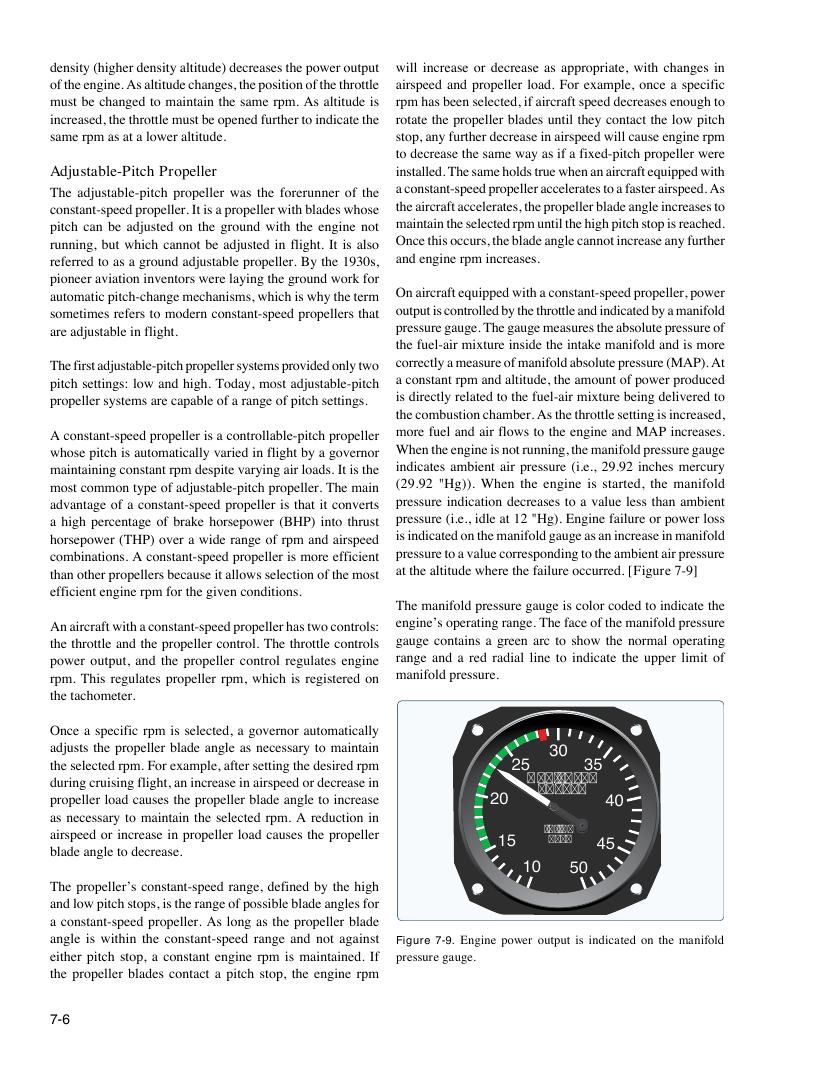
than other propellers because it allows selection of the most at the altitude where the failure occurred. [Figure 7-9]
efficient engine rpm for the given conditions.
The manifold pressure gauge is color coded to indicate the
An aircraft with a constant-speed propeller has two controls: engine’s operating range. The face of the manifold pressure
the throttle and the propeller control. The throttle controls gauge contains a green arc to show the normal operating
power output, and the propeller control regulates engine range and a red radial line to indicate the upper limit of
rpm. This regulates propeller rpm, which is registered on manifold pressure.
the tachometer.
Once a specific rpm is selected, a governor automatically
adjusts the propeller blade angle as necessary to maintain 3300
the selected rpm. For example, after setting the desired rpm 2255 3355
during cruising flight, an increase in airspeed or decrease in MANIFOLD
PRESS
propeller load causes the propeller blade angle to increase 2200 4400
as necessary to maintain the selected rpm. A reduction in
airspeed or increase in propeller load causes the propeller IN Hg
1155 ALg. 4455
blade angle to decrease.
1100 5500
The propeller’s constant-speed range, defined by the high
and low pitch stops, is the range of possible blade angles for
a constant-speed propeller. As long as the propeller blade
angle is within the constant-speed range and not against Figure 7-9. Engine power output is indicated on the manifold
either pitch stop, a constant engine rpm is maintained. If pressure gauge.
the propeller blades contact a pitch stop, the engine rpm
7-6