FAA-H-8083-25C · Source PDF page 246
Weight and Balance
Balance, Stability, and Center of Gravity · PHAK page 10-2
Searchable transcription
Effects of Weight change that takes place. As fuel is used, an aircraft becomes
Any item aboard an aircraft that increases the total weight is lighter and performance is improved.
undesirable for performance. Manufacturers attempt to make
an aircraft as light as possible without sacrificing strength Changes of fixed equipment have a major effect upon the
or safety. weight of an aircraft. The installation of extra radios or
instruments, as well as repairs or modifications, may also
The pilot should always be aware of the consequences of affect the weight of an aircraft.
overloading. An overloaded aircraft may not be able to leave
the ground, or if it does become airborne, it may exhibit Balance, Stability, and Center of Gravity
unexpected and unusually poor flight characteristics. If not Balance refers to the location of the CG of an aircraft, and is
properly loaded, the initial indication of poor performance important to stability and safety in flight. The CG is a point
usually takes place during takeoff. at which the aircraft would balance if it were suspended at
that point.
Excessive weight reduces the flight performance in almost
every respect. For example, the most important performance The primary concern in balancing an aircraft is the fore
deficiencies of an overloaded aircraft are: and aft location of the CG along the longitudinal axis. The
• Higher takeoff speed CG is not necessarily a fixed point; its location depends on
the distribution of weight in the aircraft. As variable load
• Longer takeoff run
items are shifted or expended, there is a resultant shift in
• Reduced rate and angle of climb CG location. The distance between the forward and back
limits for the position of the center for gravity or CG range
• Lower maximum altitude
is certified for an aircraft by the manufacturer. The pilot
• Shorter range
should realize that if the CG is displaced too far forward
• Reduced cruising speed on the longitudinal axis, a nose-heavy condition will
result. Conversely, if the CG is displaced too far aft on the
• Reduced maneuverability
longitudinal axis, a tail heavy condition results. It is possible
• Higher stalling speed
that the pilot could not control the aircraft if the CG location
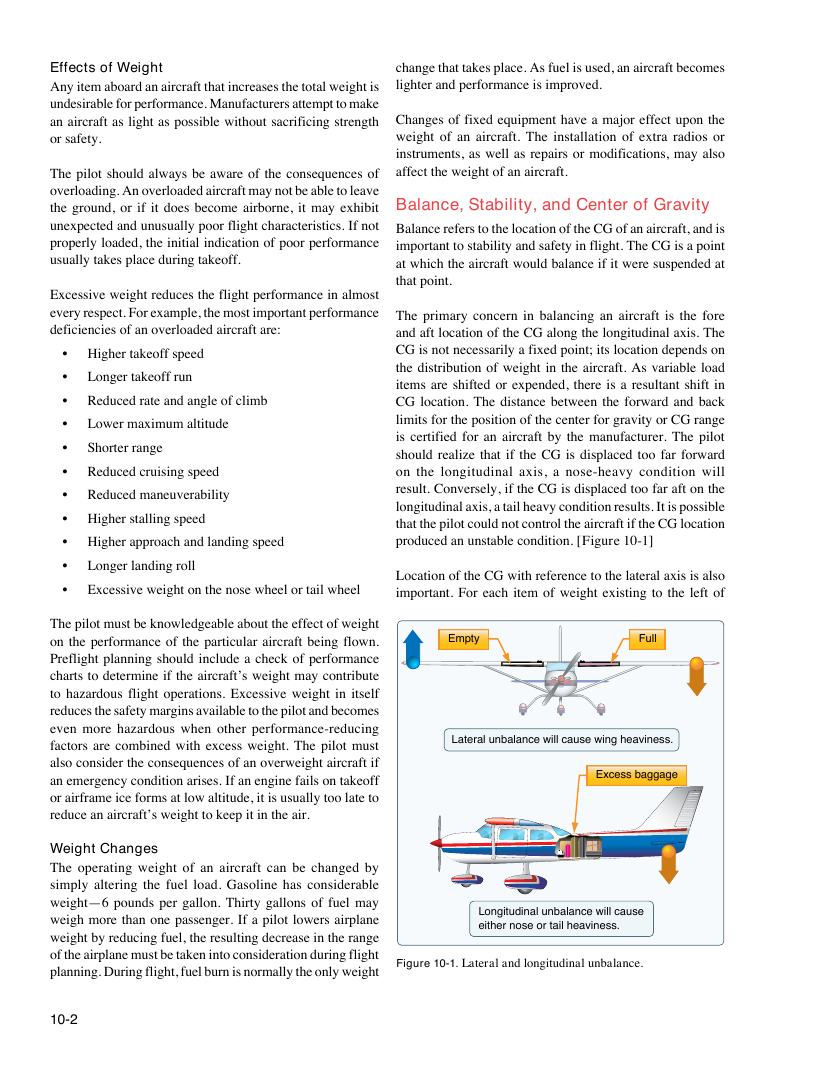
• Higher approach and landing speed produced an unstable condition. [Figure 10-1]
• Longer landing roll
Location of the CG with reference to the lateral axis is also
• Excessive weight on the nose wheel or tail wheel important. For each item of weight existing to the left of
The pilot must be knowledgeable about the effect of weight
on the performance of the particular aircraft being flown. Empty Full
Preflight planning should include a check of performance
charts to determine if the aircraft’s weight may contribute
to hazardous flight operations. Excessive weight in itself
reduces the safety margins available to the pilot and becomes
even more hazardous when other performance-reducing
Lateral unbalance will cause wing heaviness.
factors are combined with excess weight. The pilot must
also consider the consequences of an overweight aircraft if
an emergency condition arises. If an engine fails on takeoff Excess baggage
or airframe ice forms at low altitude, it is usually too late to
reduce an aircraft’s weight to keep it in the air.
Weight Changes
The operating weight of an aircraft can be changed by
simply altering the fuel load. Gasoline has considerable
weight—6 pounds per gallon. Thirty gallons of fuel may
Longitudinal unbalance will cause
weigh more than one passenger. If a pilot lowers airplane
either nose or tail heaviness.
weight by reducing fuel, the resulting decrease in the range
of the airplane must be taken into consideration during flight
Figure 10-1. Lateral and longitudinal unbalance.
planning. During flight, fuel burn is normally the only weight
10-2