FAA-H-8083-25C · Source PDF page 255
Weight and Balance
Weight Addition or Removal · PHAK page 10-11
Searchable transcription
Example Example
Weight shifted ∆CG (change of CG) Given:
=
Total weight Distance weight is shifted Aircraft total weight . . . . . . . . . . . . . . . . . . . . . . . . . . . . . . . . . 6,860 lb
CG station. . . . . . . . . . . . . . . . . . . . . . . . . . . . . . . . . . . . . . . . . . 80.0 in
100
=
∆CG
8,000 120 Determine the location of the CG if 140 pounds of baggage is added to
∆CG = 1.5 in station 150.
The change of CG is added to (or subtracted from when appropriate) Solution:
the original CG to determine the new CG:
Added weight ∆CG
77 + 1.5 = 78.5 inches aft of datum =
New total weight Distance between weight and old CG
The shifting weight proportion formula can also be used to determine 140 lb ∆CG
how much weight must be shifted to achieve a particular shift of the CG. =
6,860 lb + 140 lb 150 in − 80 in
The following problem illustrates a solution of this type.
140 lb ∆CG
=
7,000 lb 70 in
Example
CG = 1.4 in aft
Given:
Aircraft total weight . . . . . . . . . . . . . . . . . . . . . . . . . . . . . . . . . . 7,800 lb Add ∆CG to old CG
CG station. . . . . . . . . . . . . . . . . . . . . . . . . . . . . . . . . . . . . . . . . . 81.5 in New CG = 80 in + 1.4 in = 81.4 in
Aft CG limit . . . . . . . . . . . . . . . . . . . . . . . . . . . . . . . . . . . . . . . . . 80.5 in
Determine how much cargo must be shifted from the aft cargo compart-
Example
ment at station 150 to the forward cargo compartment at station 30 to
move the CG to exactly the aft limit.
Given:
Aircraft total weight . . . . . . . . . . . . . . . . . . . . . . . . . . . . . . . . . 6,100 lb
Solution:
CG station. . . . . . . . . . . . . . . . . . . . . . . . . . . . . . . . . . . . . . . . . 80.0 in
Weight to be shifted CG
=
Total weight Distance weight is shifted Determine the location of the CG if 100 pounds is removed from
station 150.
Weight to be shifted
=
1.0 in
7,800 lb 120 in Solution:
Weight to be shifted = 65 lb Weight removed = ∆CG
New total weight Distance between weight and old CG
100 lb ∆CG
A simpler solution may be obtained by using a computer =
6,100 lb − 100 lb 150 in − 80 in
or calculator and a proportional formula. This can be done
100 lb ∆CG
because the CG will shift a distance that is proportional to 6,000 lb = 70 in
the distance the weight is shifted.
CG = 1.2 in forward
Subtract ∆CG from old CG
Weight Addition or Removal
New CG = 80 in − 1.2 in = 78.8 in
In many instances, the weight and balance of the aircraft will
be changed by the addition or removal of weight. When this
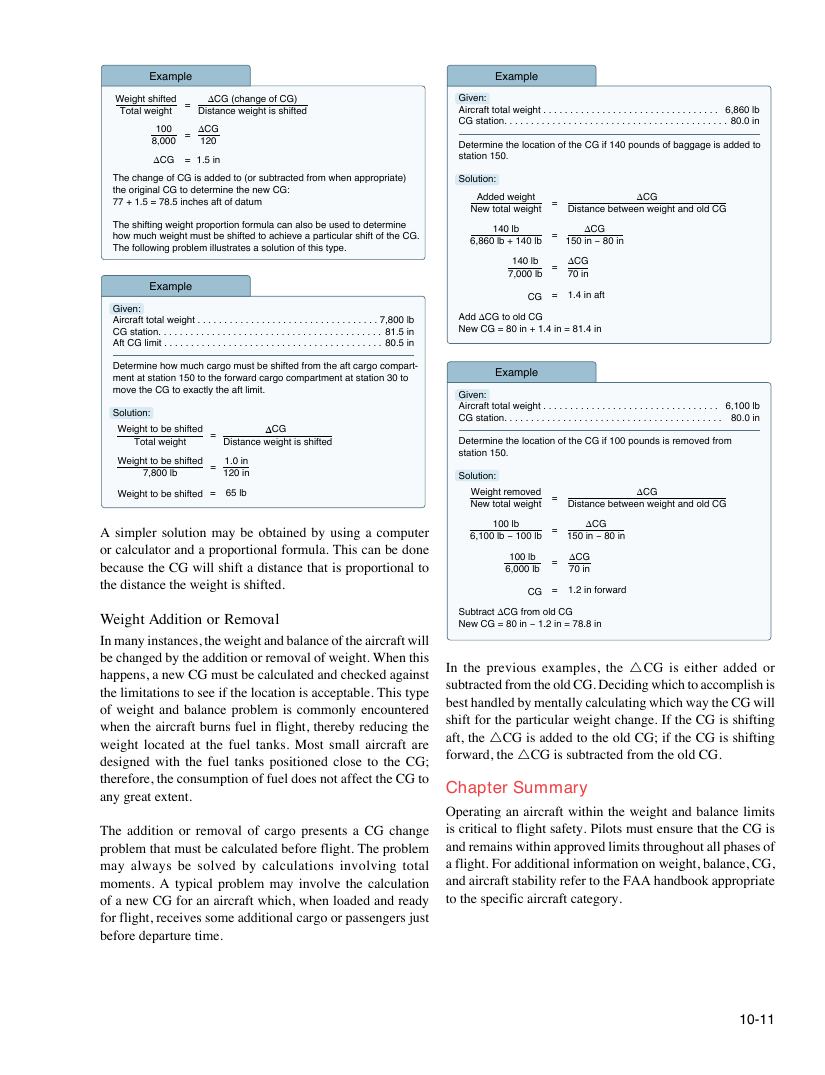
In the previous examples, the rCG is either added or
happens, a new CG must be calculated and checked against
subtracted from the old CG. Deciding which to accomplish is
the limitations to see if the location is acceptable. This type
best handled by mentally calculating which way the CG will
of weight and balance problem is commonly encountered
shift for the particular weight change. If the CG is shifting
when the aircraft burns fuel in flight, thereby reducing the
aft, the rCG is added to the old CG; if the CG is shifting
weight located at the fuel tanks. Most small aircraft are
forward, the rCG is subtracted from the old CG.
designed with the fuel tanks positioned close to the CG;
therefore, the consumption of fuel does not affect the CG to
Chapter Summary
any great extent.
Operating an aircraft within the weight and balance limits
The addition or removal of cargo presents a CG change is critical to flight safety. Pilots must ensure that the CG is
problem that must be calculated before flight. The problem and remains within approved limits throughout all phases of
may always be solved by calculations involving total a flight. For additional information on weight, balance, CG,
moments. A typical problem may involve the calculation and aircraft stability refer to the FAA handbook appropriate
of a new CG for an aircraft which, when loaded and ready to the specific aircraft category.
for flight, receives some additional cargo or passengers just
before departure time.
10-11