FAA-H-8083-25C · Source PDF page 262
Aircraft Performance
Performance · PHAK page 11-6
Searchable transcription
deriuqer
rewoP
Maximum available power
High cruise speed
Low cruise speed
Min. speed
Speed
deeps
thgilf
level
mumixaM
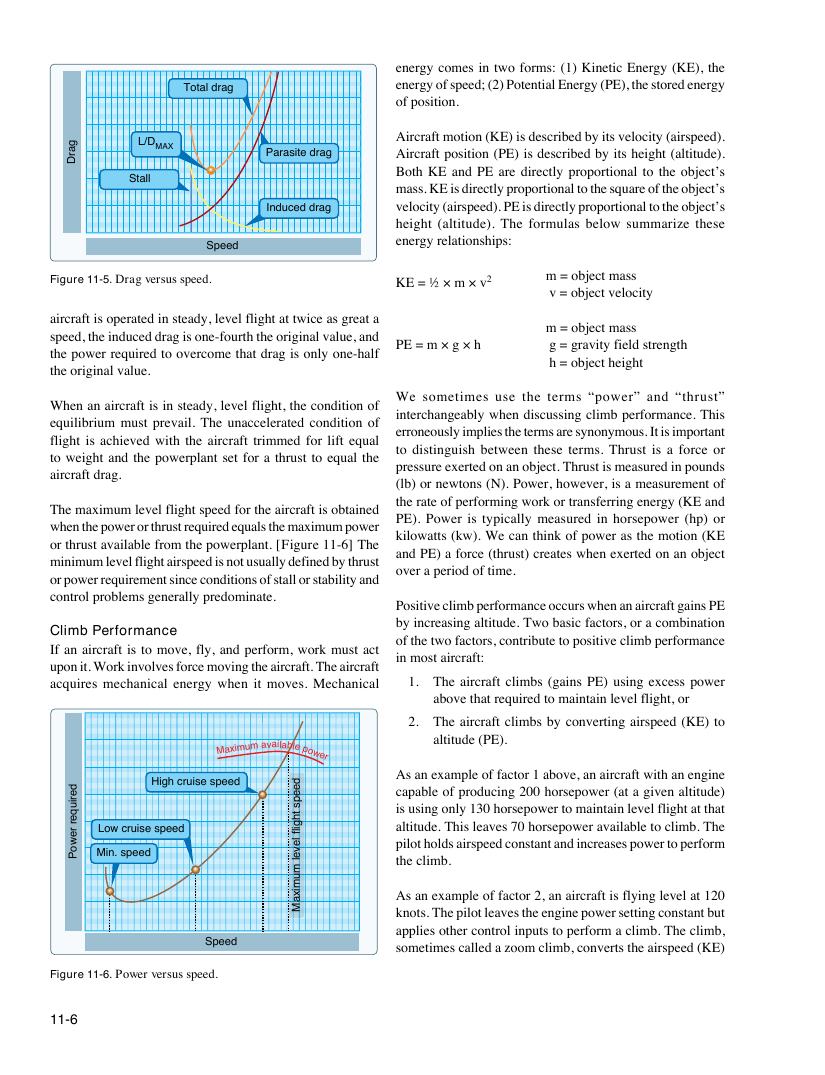
Figure 11-6. Power versus speed.
garD
energy comes in two forms: (1) Kinetic Energy (KE), the
energy of speed; (2) Potential Energy (PE), the stored energy
Total drag
of position.
Aircraft motion (KE) is described by its velocity (airspeed).
L/D MAX
Parasite drag Aircraft position (PE) is described by its height (altitude).
Both KE and PE are directly proportional to the object’s
Stall
mass. KE is directly proportional to the square of the object’s
Induced drag velocity (airspeed). PE is directly proportional to the object’s
height (altitude). The formulas below summarize these
energy relationships:
Speed
m = object mass
Figure 11-5. Drag versus speed. KE = ½ × m × v2
v = object velocity
aircraft is operated in steady, level flight at twice as great a
m = object mass
speed, the induced drag is one-fourth the original value, and
PE = m × g × h g = gravity field strength
the power required to overcome that drag is only one-half
h = object height
the original value.
We sometimes use the terms “power” and “thrust”
When an aircraft is in steady, level flight, the condition of
interchangeably when discussing climb performance. This
equilibrium must prevail. The unaccelerated condition of
erroneously implies the terms are synonymous. It is important
flight is achieved with the aircraft trimmed for lift equal
to distinguish between these terms. Thrust is a force or
to weight and the powerplant set for a thrust to equal the
pressure exerted on an object. Thrust is measured in pounds
aircraft drag.
(lb) or newtons (N). Power, however, is a measurement of
the rate of performing work or transferring energy (KE and
The maximum level flight speed for the aircraft is obtained
PE). Power is typically measured in horsepower (hp) or
when the power or thrust required equals the maximum power
kilowatts (kw). We can think of power as the motion (KE
or thrust available from the powerplant. [Figure 11-6] The
and PE) a force (thrust) creates when exerted on an object
minimum level flight airspeed is not usually defined by thrust
over a period of time.
or power requirement since conditions of stall or stability and
control problems generally predominate.
Positive climb performance occurs when an aircraft gains PE
by increasing altitude. Two basic factors, or a combination
Climb Performance
of the two factors, contribute to positive climb performance
If an aircraft is to move, fly, and perform, work must act
in most aircraft:
upon it. Work involves force moving the aircraft. The aircraft
acquires mechanical energy when it moves. Mechanical 1. The aircraft climbs (gains PE) using excess power
above that required to maintain level flight, or
2. The aircraft climbs by converting airspeed (KE) to
altitude (PE).
As an example of factor 1 above, an aircraft with an engine
capable of producing 200 horsepower (at a given altitude)
is using only 130 horsepower to maintain level flight at that
altitude. This leaves 70 horsepower available to climb. The
pilot holds airspeed constant and increases power to perform
the climb.
As an example of factor 2, an aircraft is flying level at 120
knots. The pilot leaves the engine power setting constant but
applies other control inputs to perform a climb. The climb,
sometimes called a zoom climb, converts the airspeed (KE)