FAA-H-8083-25C · Source PDF page 317
Aviation Weather Services
Weather Briefings · PHAK page 13-7
Searchable transcription
Descriptions of weather phenomena as they begin or
Sky Cover Contraction
end and hailstone size are also listed in the “Remarks”
Less than 1∕8 (Clear) SKC, CLR, FEW
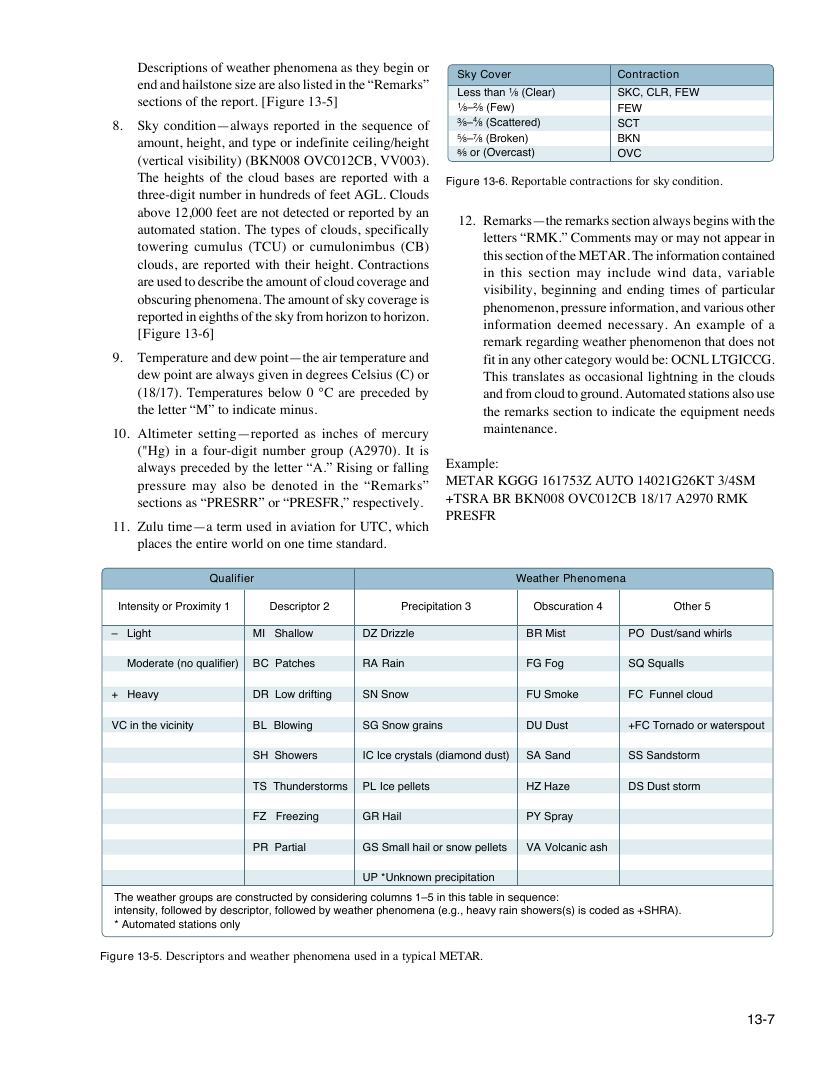
sections of the report. [Figure 13-5]
1∕8–2∕8 (Few) FEW
8. Sky condition—always reported in the sequence of ³∕8–4∕8 (Scattered) SCT
amount, height, and type or indefinite ceiling/height 5∕8–7∕8 (Broken) BKN
(vertical visibility) (BKN008 OVC012CB, VV003).
8∕8 or (Overcast) OVC
The heights of the cloud bases are reported with a Figure 13-6. Reportable contractions for sky condition.
three-digit number in hundreds of feet AGL. Clouds
above 12,000 feet are not detected or reported by an
12. Remarks—the remarks section always begins with the
automated station. The types of clouds, specifically
letters “RMK.” Comments may or may not appear in
towering cumulus (TCU) or cumulonimbus (CB)
this section of the METAR. The information contained
clouds, are reported with their height. Contractions
in this section may include wind data, variable
are used to describe the amount of cloud coverage and
visibility, beginning and ending times of particular
obscuring phenomena. The amount of sky coverage is
phenomenon, pressure information, and various other
reported in eighths of the sky from horizon to horizon.
information deemed necessary. An example of a
[Figure 13-6]
remark regarding weather phenomenon that does not
9. Temperature and dew point—the air temperature and fit in any other category would be: OCNL LTGICCG.
dew point are always given in degrees Celsius (C) or This translates as occasional lightning in the clouds
(18/17). Temperatures below 0 °C are preceded by and from cloud to ground. Automated stations also use
the letter “M” to indicate minus. the remarks section to indicate the equipment needs
maintenance.
10. Altimeter setting—reported as inches of mercury
("Hg) in a four-digit number group (A2970). It is
Example:
always preceded by the letter “A.” Rising or falling
METAR KGGG 161753Z AUTO 14021G26KT 3/4SM
pressure may also be denoted in the “Remarks”
+TSRA BR BKN008 OVC012CB 18/17 A2970 RMK
sections as “PRESRR” or “PRESFR,” respectively.
PRESFR
11. Zulu time—a term used in aviation for UTC, which
places the entire world on one time standard.
Qualifier Weather Phenomena
Intensity or Proximity 1 Descriptor 2 Precipitation 3 Obscuration 4 Other 5
– Light MI Shallow DZ Drizzle BR Mist PO Dust/sand whirls
Moderate (no qualifier) BC Patches RA Rain FG Fog SQ Squalls
+ Heavy DR Low drifting SN Snow FU Smoke FC Funnel cloud
VC in the vicinity BL Blowing SG Snow grains DU Dust +FC Tornado or waterspout
SH Showers IC Ice crystals (diamond dust) SA Sand SS Sandstorm
TS Thunderstorms PL Ice pellets HZ Haze DS Dust storm
FZ Freezing GR Hail PY Spray
PR Partial GS Small hail or snow pellets VA Volcanic ash
UP *Unknown precipitation
The weather groups are constructed by considering columns 1–5 in this table in sequence:
intensity, followed by descriptor, followed by weather phenomena (e.g., heavy rain showers(s) is coded as +SHRA).
* Automated stations only
Figure 13-5. Descriptors and weather phenomena used in a typical METAR.
13-7