FAA-H-8083-25C · Source PDF page 366
Airport Operations
Causal Factors of Runway Confusion · PHAK page 14-32
Searchable transcription
Pilot Deviations:
• Crossing a runway hold marking without clearance
from ATC
• Taking off without clearance
• Landing without clearance
Operational Incidents (OI):
• Clearing an aircraft onto a runway while another
aircraft is landing on the same runway
• Issuing a takeoff clearance while the runway is
occupied by another aircraft or vehicle
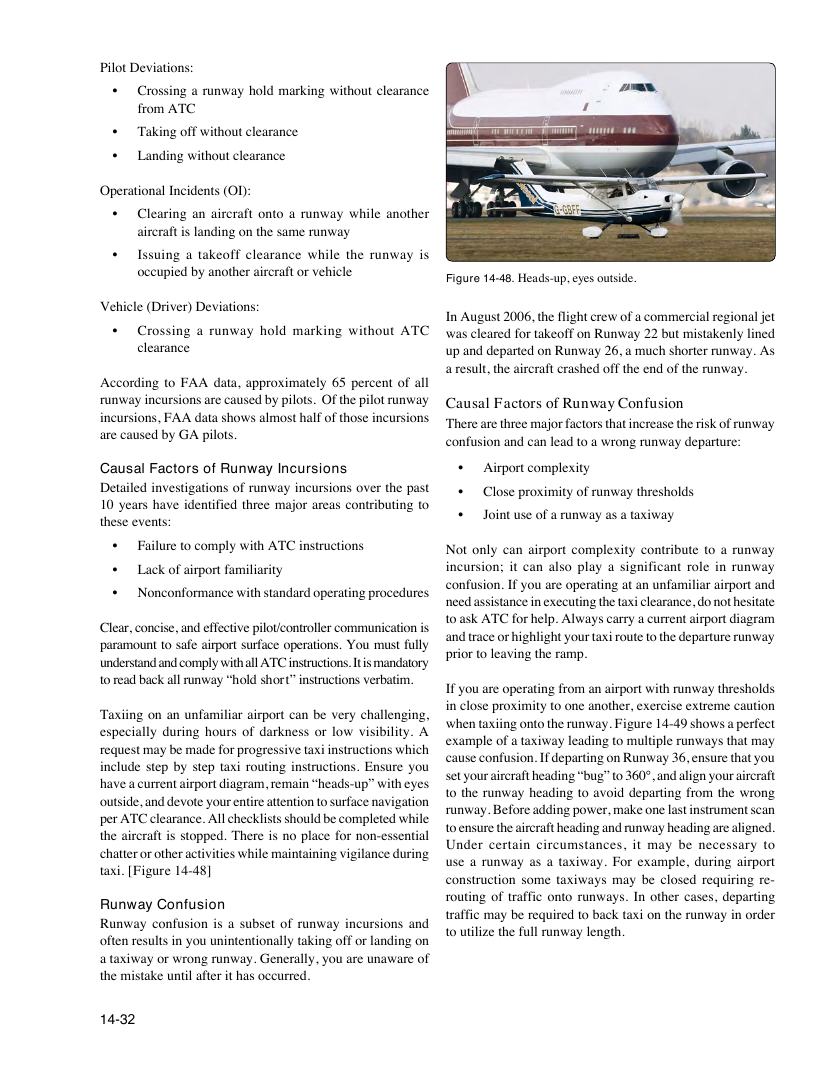
Figure 14-48. Heads-up, eyes outside.
Vehicle (Driver) Deviations:
In August 2006, the flight crew of a commercial regional jet
• Crossing a runway hold marking without ATC was cleared for takeoff on Runway 22 but mistakenly lined
clearance up and departed on Runway 26, a much shorter runway. As
a result, the aircraft crashed off the end of the runway.
According to FAA data, approximately 65 percent of all
runway incursions are caused by pilots. Of the pilot runway Causal Factors of Runway Confusion
incursions, FAA data shows almost half of those incursions
There are three major factors that increase the risk of runway
are caused by GA pilots.
confusion and can lead to a wrong runway departure:
Causal Factors of Runway Incursions • Airport complexity
Detailed investigations of runway incursions over the past • Close proximity of runway thresholds
10 years have identified three major areas contributing to
• Joint use of a runway as a taxiway
these events:
• Failure to comply with ATC instructions Not only can airport complexity contribute to a runway
• Lack of airport familiarity incursion; it can also play a significant role in runway
confusion. If you are operating at an unfamiliar airport and
• Nonconformance with standard operating procedures
need assistance in executing the taxi clearance, do not hesitate
to ask ATC for help. Always carry a current airport diagram
Clear, concise, and effective pilot/controller communication is
and trace or highlight your taxi route to the departure runway
paramount to safe airport surface operations. You must fully
prior to leaving the ramp.
understand and comply with all ATC instructions. It is mandatory
to read back all runway “hold short” instructions verbatim.
If you are operating from an airport with runway thresholds
in close proximity to one another, exercise extreme caution
Taxiing on an unfamiliar airport can be very challenging,
when taxiing onto the runway. Figure 14-49 shows a perfect
especially during hours of darkness or low visibility. A
example of a taxiway leading to multiple runways that may
request may be made for progressive taxi instructions which
cause confusion. If departing on Runway 36, ensure that you
include step by step taxi routing instructions. Ensure you
set your aircraft heading “bug” to 360°, and align your aircraft
have a current airport diagram, remain “heads-up” with eyes
to the runway heading to avoid departing from the wrong
outside, and devote your entire attention to surface navigation
runway. Before adding power, make one last instrument scan
per ATC clearance. All checklists should be completed while
to ensure the aircraft heading and runway heading are aligned.
the aircraft is stopped. There is no place for non-essential
Under certain circumstances, it may be necessary to
chatter or other activities while maintaining vigilance during
use a runway as a taxiway. For example, during airport
taxi. [Figure 14-48]
construction some taxiways may be closed requiring re-
routing of traffic onto runways. In other cases, departing
Runway Confusion
traffic may be required to back taxi on the runway in order
Runway confusion is a subset of runway incursions and
to utilize the full runway length.
often results in you unintentionally taking off or landing on
a taxiway or wrong runway. Generally, you are unaware of
the mistake until after it has occurred.
14-32