FAA-H-8083-25C · Source PDF page 346
Airport Operations
Holding Position Signs and Markings for an · PHAK page 14-12
Searchable transcription
signs always have an arrow showing the direction of the taxi
route to that destination. [Figure 14-22] When the arrow on
the destination sign indicates a turn, the sign is located prior
to the intersection. Destinations commonly shown on these
types of signs include runways, aprons, terminals, military
areas, civil aviation areas, cargo areas, international areas,
and fixed-base operators. When the inscription for two or
more destinations having a common taxi route are placed
on a sign, the destinations are separated by a “dot” (•) and
one arrow would be used as shown in Figure 14-22. When
the inscription on a sign contains two or more destinations
having different taxi routes, each destination is accompanied
by an arrow and separated from the other destination(s) on
the sign with a vertical black message divider as shown in
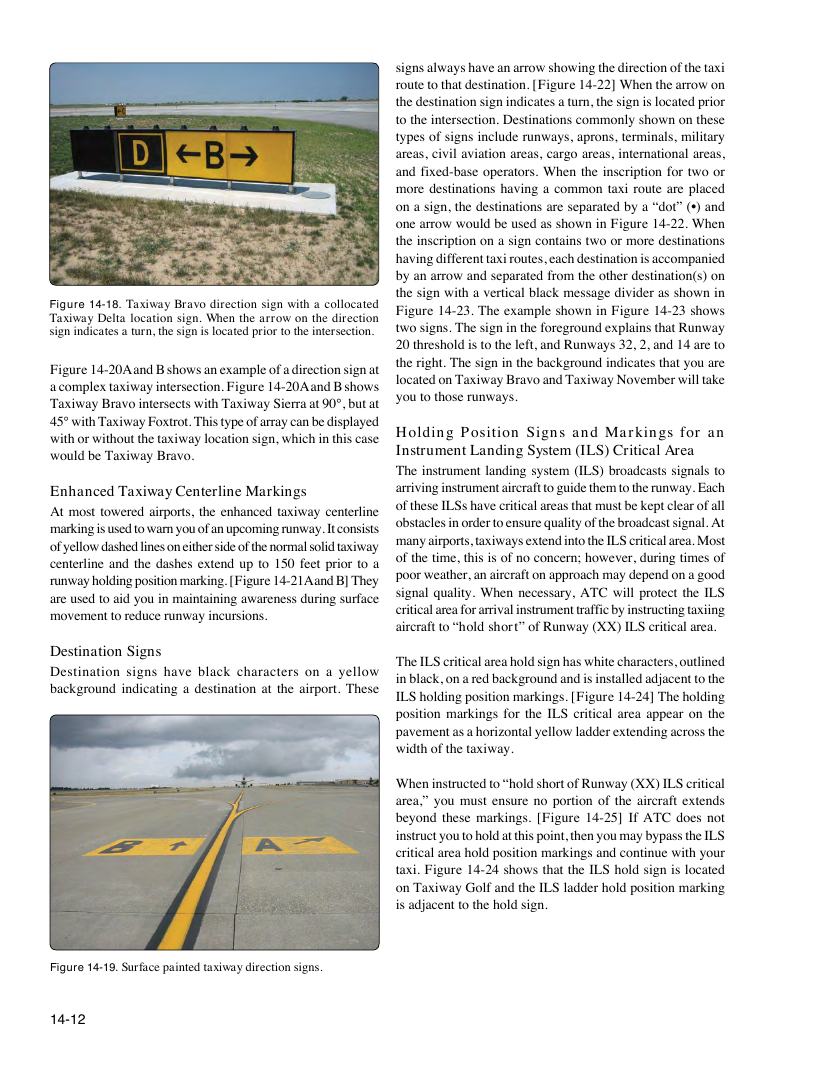
Figure 14-18. Taxiway Bravo direction sign with a collocated Figure 14-23. The example shown in Figure 14-23 shows
Taxiway Delta location sign. When the arrow on the direction
two signs. The sign in the foreground explains that Runway
sign indicates a turn, the sign is located prior to the intersection.
20 threshold is to the left, and Runways 32, 2, and 14 are to
the right. The sign in the background indicates that you are
Figure 14-20A and B shows an example of a direction sign at
located on Taxiway Bravo and Taxiway November will take
a complex taxiway intersection. Figure 14-20A and B shows
you to those runways.
Taxiway Bravo intersects with Taxiway Sierra at 90°, but at
45° with Taxiway Foxtrot. This type of array can be displayed
Holding Position Signs and Markings for an
with or without the taxiway location sign, which in this case
Instrument Landing System (ILS) Critical Area
would be Taxiway Bravo.
The instrument landing system (ILS) broadcasts signals to
Enhanced Taxiway Centerline Markings arriving instrument aircraft to guide them to the runway. Each
of these ILSs have critical areas that must be kept clear of all
At most towered airports, the enhanced taxiway centerline
obstacles in order to ensure quality of the broadcast signal. At
marking is used to warn you of an upcoming runway. It consists
many airports, taxiways extend into the ILS critical area. Most
of yellow dashed lines on either side of the normal solid taxiway
of the time, this is of no concern; however, during times of
centerline and the dashes extend up to 150 feet prior to a
poor weather, an aircraft on approach may depend on a good
runway holding position marking. [Figure 14-21A and B] They
signal quality. When necessary, ATC will protect the ILS
are used to aid you in maintaining awareness during surface
critical area for arrival instrument traffic by instructing taxiing
movement to reduce runway incursions.
aircraft to “hold short” of Runway (XX) ILS critical area.
Destination Signs
The ILS critical area hold sign has white characters, outlined
Destination signs have black characters on a yellow
in black, on a red background and is installed adjacent to the
background indicating a destination at the airport. These
ILS holding position markings. [Figure 14-24] The holding
position markings for the ILS critical area appear on the
pavement as a horizontal yellow ladder extending across the
width of the taxiway.
When instructed to “hold short of Runway (XX) ILS critical
area,” you must ensure no portion of the aircraft extends
beyond these markings. [Figure 14-25] If ATC does not
instruct you to hold at this point, then you may bypass the ILS
critical area hold position markings and continue with your
taxi. Figure 14-24 shows that the ILS hold sign is located
on Taxiway Golf and the ILS ladder hold position marking
is adjacent to the hold sign.
Figure 14-19. Surface painted taxiway direction signs.
14-12