FAA-H-8083-25C · Source PDF page 377
Airspace
Controlled Airspace · PHAK page 15-2
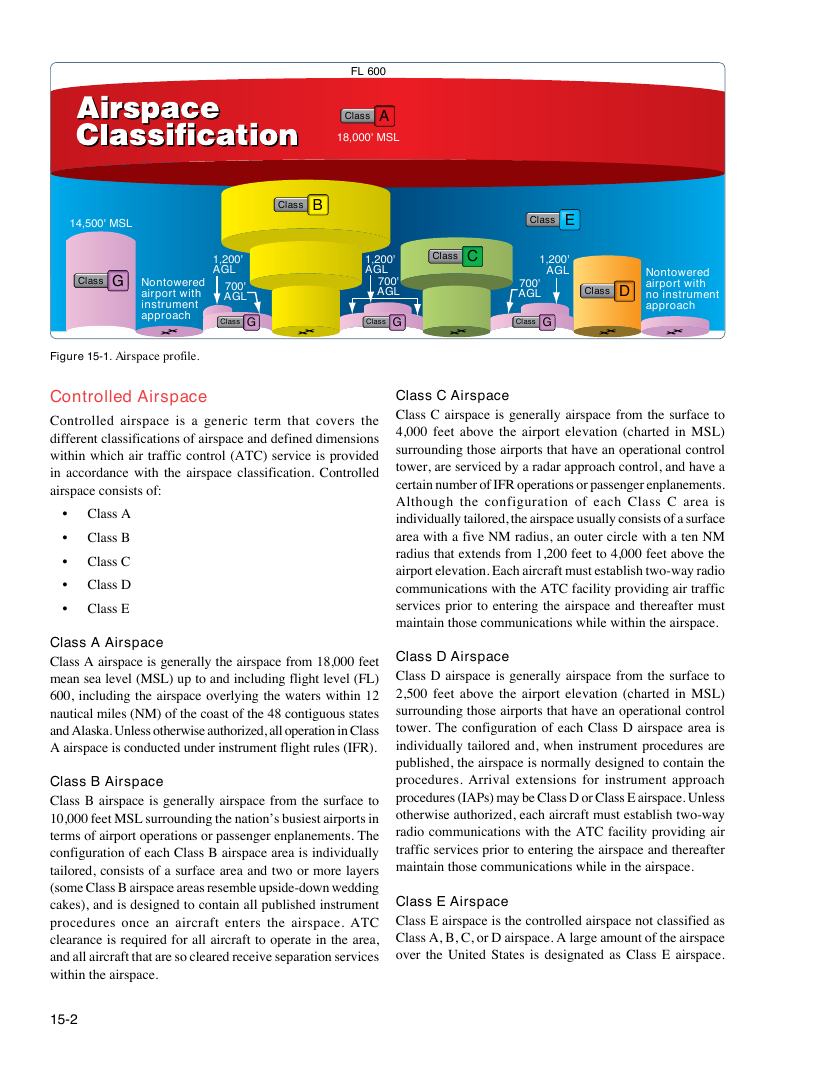
Searchable transcription
FL 600
Class A
18,000' MSL
Class B
14,500' MSL Class E
1,200' 1,200' Class C 1,200'
AGL AGL AGL Nontowered
Class G N ai o rp n o to rt w w er it e h d A 70 G 0 L ' A 70 G 0 L ' A 70 G 0 L ' Class D a n i o r p in o s rt t r w u i m th e nt
instrument approach
approach
Class G Class G Class G
Figure 15-1. Airspace profile.
Controlled Airspace Class C Airspace
Class C airspace is generally airspace from the surface to
Controlled airspace is a generic term that covers the
4,000 feet above the airport elevation (charted in MSL)
different classifications of airspace and defined dimensions
surrounding those airports that have an operational control
within which air traffic control (ATC) service is provided
tower, are serviced by a radar approach control, and have a
in accordance with the airspace classification. Controlled
certain number of IFR operations or passenger enplanements.
airspace consists of:
Although the configuration of each Class C area is
• Class A
individually tailored, the airspace usually consists of a surface
• Class B area with a five NM radius, an outer circle with a ten NM
radius that extends from 1,200 feet to 4,000 feet above the
• Class C
airport elevation. Each aircraft must establish two-way radio
• Class D communications with the ATC facility providing air traffic
• Class E services prior to entering the airspace and thereafter must
maintain those communications while within the airspace.
Class A Airspace
Class A airspace is generally the airspace from 18,000 feet Class D Airspace
mean sea level (MSL) up to and including flight level (FL) Class D airspace is generally airspace from the surface to
600, including the airspace overlying the waters within 12 2,500 feet above the airport elevation (charted in MSL)
nautical miles (NM) of the coast of the 48 contiguous states surrounding those airports that have an operational control
and Alaska. Unless otherwise authorized, all operation in Class tower. The configuration of each Class D airspace area is
A airspace is conducted under instrument flight rules (IFR). individually tailored and, when instrument procedures are
published, the airspace is normally designed to contain the
Class B Airspace procedures. Arrival extensions for instrument approach
Class B airspace is generally airspace from the surface to procedures (IAPs) may be Class D or Class E airspace. Unless
10,000 feet MSL surrounding the nation’s busiest airports in otherwise authorized, each aircraft must establish two-way
terms of airport operations or passenger enplanements. The radio communications with the ATC facility providing air
configuration of each Class B airspace area is individually traffic services prior to entering the airspace and thereafter
tailored, consists of a surface area and two or more layers maintain those communications while in the airspace.
(some Class B airspace areas resemble upside-down wedding
cakes), and is designed to contain all published instrument Class E Airspace
procedures once an aircraft enters the airspace. ATC Class E airspace is the controlled airspace not classified as
clearance is required for all aircraft to operate in the area, Class A, B, C, or D airspace. A large amount of the airspace
and all aircraft that are so cleared receive separation services over the United States is designated as Class E airspace.
within the airspace.
15-2