FAA-H-8083-25C · Source PDF page 417
Navigation
3 4 · PHAK page 16-30
Searchable transcription
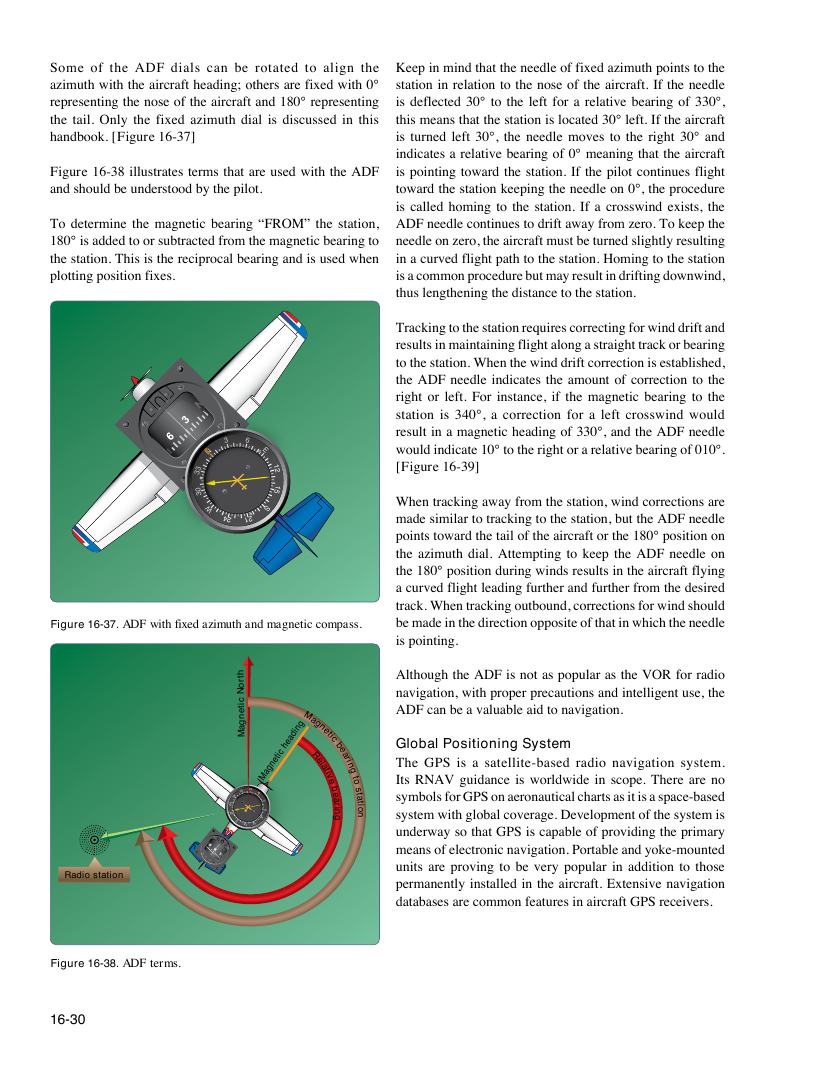
Some of the ADF dials can be rotated to align the Keep in mind that the needle of fixed azimuth points to the
azimuth with the aircraft heading; others are fixed with 0° station in relation to the nose of the aircraft. If the needle
representing the nose of the aircraft and 180° representing is deflected 30° to the left for a relative bearing of 330°,
the tail. Only the fixed azimuth dial is discussed in this this means that the station is located 30° left. If the aircraft
handbook. [Figure 16-37] is turned left 30°, the needle moves to the right 30° and
indicates a relative bearing of 0° meaning that the aircraft
Figure 16-38 illustrates terms that are used with the ADF is pointing toward the station. If the pilot continues flight
and should be understood by the pilot. toward the station keeping the needle on 0°, the procedure
is called homing to the station. If a crosswind exists, the
To determine the magnetic bearing “FROM” the station, ADF needle continues to drift away from zero. To keep the
180° is added to or subtracted from the magnetic bearing to needle on zero, the aircraft must be turned slightly resulting
the station. This is the reciprocal bearing and is used when in a curved flight path to the station. Homing to the station
plotting position fixes. is a common procedure but may result in drifting downwind,
thus lengthening the distance to the station.
Tracking to the station requires correcting for wind drift and
results in maintaining flight along a straight track or bearing
to the station. When the wind drift correction is established,
the ADF needle indicates the amount of correction to the
right or left. For instance, if the magnetic bearing to the
station is 340°, a correction for a left crosswind would
result in a magnetic heading of 330°, and the ADF needle
N-S
N E-W
3 6
E would indicate 10° to the right or a relative bearing of 010°.
33 12 [Figure 16-39]
03 51
When tracking away from the station, wind corrections are
W S
42 12 made similar to tracking to the station, but the ADF needle
points toward the tail of the aircraft or the 180° position on
the azimuth dial. Attempting to keep the ADF needle on
the 180° position during winds results in the aircraft flying
a curved flight leading further and further from the desired
track. When tracking outbound, corrections for wind should
Figure 16-37. ADF with fixed azimuth and magnetic compass. be made in the direction opposite of that in which the needle
is pointing.
h Although the ADF is not as popular as the VOR for radio
tro
N navigation, with proper precautions and intelligent use, the
c
ite
n g
a M
hea
di n
g M agnetic
b
A
G
D
lo
F
b
c
a
a
l
n
P
b
o
e
s
a
it
v
io
al
n
u
i
a
n
b
g
le
S
a
y
id
s
t
t
o
e m
navigation.
Ma g
netic R
e la tiv
e
e a
rin g
to
T
Its
h e
R
G
NA
PS
V
i
g
s
u
a
id a
sa
n
t
c
e
e
l l
i
i
s
t e
w
-b
o
a
r
s
ld
e
w
d
i
r
d
a
e
d
i
i
n
o
s
n
c
a
o
v
p
i
e
g
.
a
T
ti
h
o
e
n
r e
s y
a
s
r
t
e
e m
no
.
24 12 W S 30 51 33 21 N E 3 6 b e a r g in s ta ti n o s s u y y n m s d t e e b r m o w l s a w y f i o t s h r o G g t l P h o S a b t a o G l n c P a o e S v r e o is r n a a c g u a e t p . i a c D b a e l l e v c e h o l a f o r p t p s m r o a e s v n i i d t t i i o s n f g a t h s t p h e a e s c y p e s r - t i b e m a m s a e r i d y s
means of electronic navigation. Portable and yoke-mounted
N-S E-W units are proving to be very popular in addition to those
Radio station
permanently installed in the aircraft. Extensive navigation
databases are common features in aircraft GPS receivers.
Figure 16-38. ADF terms.
16-30