FAA-H-8083-25C · Source PDF page 17
Introduction to Flying
History of Flight · PHAK page 1-2
Searchable transcription
History of Flight billowing heap of cloth capable of no more than a one-way,
downwind journey.
From prehistoric times, humans have watched the flight of
birds, and longed to imitate them, but lacked the power to do
Balloons solved the problem of lift, but that was only one of
so. Logic dictated that if the small muscles of birds can lift
the problems of human flight. The ability to control speed and
them into the air and sustain them, then the larger muscles
direction eluded balloonists. The solution to that problem lay
of humans should be able to duplicate the feat. No one knew
in a child’s toy familiar to the East for 2,000 years, but not
about the intricate mesh of muscles, sinew, heart, breathing
introduced to the West until the 13th century—the kite. The
system, and devices not unlike wing flaps, variable-camber
kites used by the Chinese for aerial observation, to test winds
and spoilers of the modern airplane that enabled a bird to
for sailing, as a signaling device, and as a toy, held many of
fly. Still, thousands of years and countless lives were lost in
the answers to lifting a heavier-than-air device into the air.
attempts to fly like birds.
One of the men who believed the study of kites unlocked
The identity of the first “bird-men” who fitted themselves
the secrets of winged flight was Sir George Cayley. Born
with wings and leapt off of cliffs in an effort to fly are lost in
in England 10 years before the Mongolfier balloon flight,
time, but each failure gave those who wished to fly questions
Cayley spent his 84 years seeking to develop a heavier-than-
that needed to be answered. Where had the wing flappers
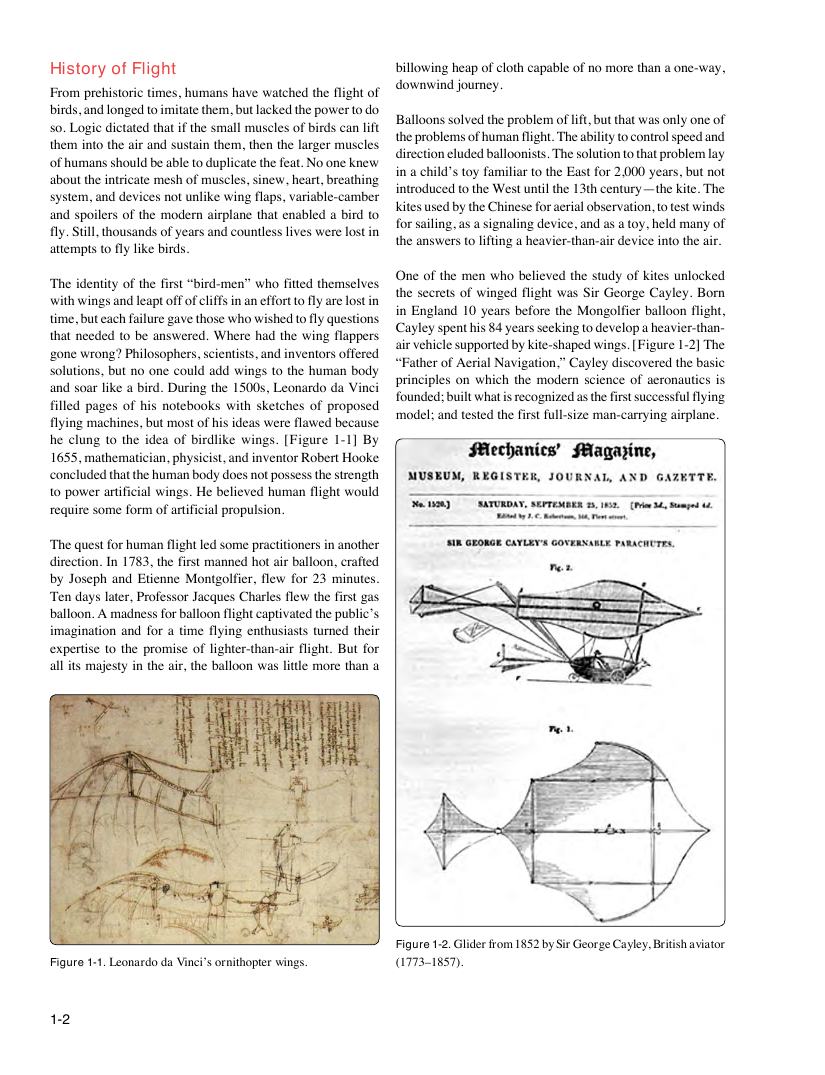
air vehicle supported by kite-shaped wings. [Figure 1-2] The
gone wrong? Philosophers, scientists, and inventors offered
“Father of Aerial Navigation,” Cayley discovered the basic
solutions, but no one could add wings to the human body
principles on which the modern science of aeronautics is
and soar like a bird. During the 1500s, Leonardo da Vinci
founded; built what is recognized as the first successful flying
filled pages of his notebooks with sketches of proposed
model; and tested the first full-size man-carrying airplane.
flying machines, but most of his ideas were flawed because
he clung to the idea of birdlike wings. [Figure 1-1] By
1655, mathematician, physicist, and inventor Robert Hooke
concluded that the human body does not possess the strength
to power artificial wings. He believed human flight would
require some form of artificial propulsion.
The quest for human flight led some practitioners in another
direction. In 1783, the first manned hot air balloon, crafted
by Joseph and Etienne Montgolfier, flew for 23 minutes.
Ten days later, Professor Jacques Charles flew the first gas
balloon. A madness for balloon flight captivated the public’s
imagination and for a time flying enthusiasts turned their
expertise to the promise of lighter-than-air flight. But for
all its majesty in the air, the balloon was little more than a
Figure 1-2. Glider from 1852 by Sir George Cayley, British aviator
Figure 1-1. Leonardo da Vinci’s ornithopter wings. (1773–1857).
1-2