FAA-H-8083-25C · Source PDF page 18
Introduction to Flying
History of the Federal Aviation · PHAK page 1-3
Searchable transcription
For the half-century after Cayley’s death, countless scientists, Petersburg across the waterway to Tampa. Benoist suggested
flying enthusiasts, and inventors worked toward building using his “Safety First” airboat and the two men signed an
a powered flying machine. Men, such as William Samuel agreement for what would become the first scheduled airline
Henson, who designed a huge monoplane that was propelled in the United States. The first aircraft was delivered to St.
by a steam engine housed inside the fuselage, and Otto Petersburg and made the first test flight on December 31,
Lilienthal, who proved human flight in aircraft heavier than 1913. [Figure 1-4]
air was practical, worked toward the dream of powered flight.
A dream turned into reality by Wilbur and Orville Wright at A public auction decided who would win the honor of
Kitty Hawk, North Carolina, on December 17, 1903. becoming the first paying airline customer. The former
mayor of St. Petersburg, A. C. Pheil, made the winning bid
The bicycle-building Wright brothers of Dayton, Ohio, had of $400.00, which secured his place in history as the first
experimented for 4 years with kites, their own homemade paying airline passenger.
wind tunnel, and different engines to power their biplane. One
of their great achievements in flight was proving the value of On January 1, 1914, the first scheduled airline flight was
the scientific, rather than a build-it-and-see approach. Their conducted. The flight length was 21 miles and lasted 23
biplane, The Flyer, combined inspired design and engineering minutes due to a headwind. The return trip took 20 minutes.
with superior craftsmanship. [Figure 1-3] By the afternoon The line, which was subsidized by Florida businessmen,
of December 17th, the Wright brothers had flown a total of continued for 4 months and offered regular passage for $5.00
98 seconds on four flights. The age of flight had arrived. per person or $5.00 per 100 pounds of cargo. Shortly after the
opening of the line, Benoist added a new airboat that afforded
History of the Federal Aviation more protection from spray during takeoff and landing.
Administration (FAA) The routes were also extended to Manatee, Bradenton, and
Sarasota giving further credence to the idea of a profitable
During the early years of manned flight, aviation was a
commercial airline.
free for all because no government body was in place to
establish policies or regulate and enforce safety standards.
The St. Petersburg-Tampa Airboat Line continued throughout
Individuals were free to conduct flights and operate aircraft
the winter months with flights finally being suspended when
with no government oversight. Most of the early flights were
the winter tourist industry began to dry up. The airline
conducted for sport. Aviation was expensive and became the
operated for only 4 months, but 1,205 passengers were
playground of the wealthy. Since these early airplanes were
carried without injury. This experiment proved commercial
small, many people doubted their commercial value. One
passenger airline travel was viable.
group of individuals believed otherwise and they became
the genesis for modern airline travel.
The advent of World War I offered the airplane a chance
to demonstrate its varied capabilities. It began the war as a
P. E. Fansler, a Florida businessman living in St. Petersburg,
reconnaissance platform, but by 1918, airplanes were being
approached Tom Benoist of the Benoist Aircraft Company
in St. Louis, Missouri, about starting a flight route from St.
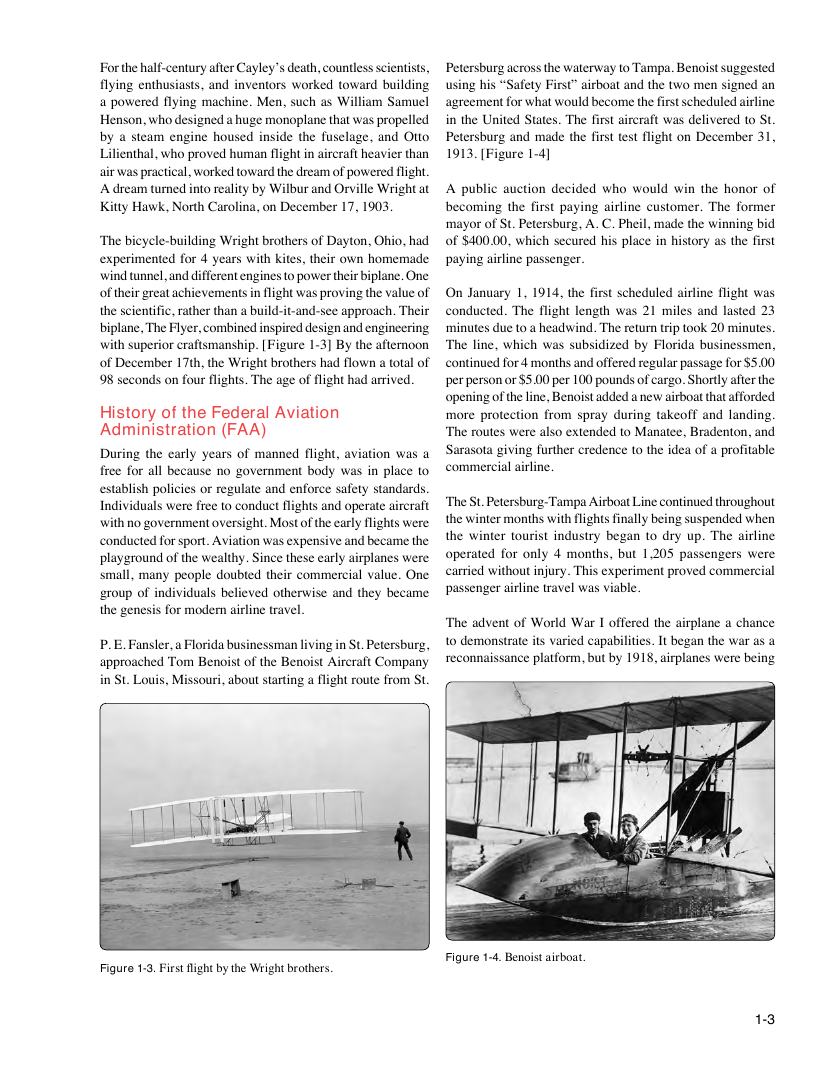
Figure 1-4. Benoist airboat.
Figure 1-3. First flight by the Wright brothers.
1-3