FAA-H-8083-25C · Source PDF page 41
Aeronautical Decision-Making
History of ADM · PHAK page 2-2
Searchable transcription
The importance of learning and understanding effective History of ADM
ADM skills cannot be overemphasized. While progress is
For over 25 years, the importance of good pilot judgment, or
continually being made in the advancement of pilot training
aeronautical decision-making (ADM), has been recognized
methods, aircraft equipment and systems, and services
as critical to the safe operation of aircraft, as well as accident
for pilots, accidents still occur. Despite all the changes in
avoidance. The airline industry, motivated by the need to
technology to improve flight safety, one factor remains the
reduce accidents caused by human factors, developed the first
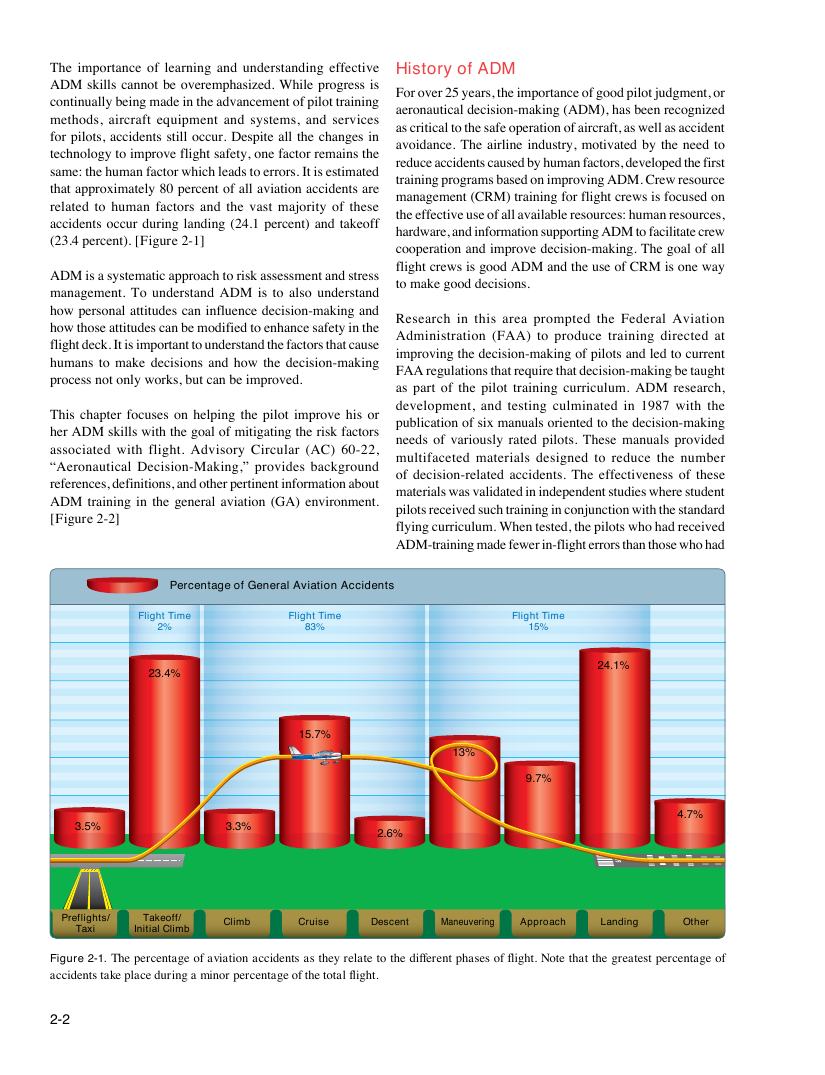
same: the human factor which leads to errors. It is estimated
training programs based on improving ADM. Crew resource
that approximately 80 percent of all aviation accidents are
management (CRM) training for flight crews is focused on
related to human factors and the vast majority of these
the effective use of all available resources: human resources,
accidents occur during landing (24.1 percent) and takeoff
hardware, and information supporting ADM to facilitate crew
(23.4 percent). [Figure 2-1]
cooperation and improve decision-making. The goal of all
flight crews is good ADM and the use of CRM is one way
ADM is a systematic approach to risk assessment and stress
to make good decisions.
management. To understand ADM is to also understand
how personal attitudes can influence decision-making and
Research in this area prompted the Federal Aviation
how those attitudes can be modified to enhance safety in the
Administration (FAA) to produce training directed at
flight deck. It is important to understand the factors that cause
improving the decision-making of pilots and led to current
humans to make decisions and how the decision-making
FAA regulations that require that decision-making be taught
process not only works, but can be improved.
as part of the pilot training curriculum. ADM research,
development, and testing culminated in 1987 with the
This chapter focuses on helping the pilot improve his or
publication of six manuals oriented to the decision-making
her ADM skills with the goal of mitigating the risk factors
needs of variously rated pilots. These manuals provided
associated with flight. Advisory Circular (AC) 60-22,
multifaceted materials designed to reduce the number
“Aeronautical Decision-Making,” provides background
of decision-related accidents. The effectiveness of these
references, definitions, and other pertinent information about
materials was validated in independent studies where student
ADM training in the general aviation (GA) environment.
pilots received such training in conjunction with the standard
[Figure 2-2]
flying curriculum. When tested, the pilots who had received
ADM-training made fewer in-flight errors than those who had
Percentage of General Aviation Accidents
Flight Time Flight Time Flight Time
2% 83% 15%
24.1%
23.4%
15.7%
13%
9.7%
4.7%
3.5% 3.3%
2.6%
Preflights/ Takeoff/
Climb Cruise Descent Maneuvering Approach Landing Other
Taxi Initial Climb
Figure 2-1. The percentage of aviation accidents as they relate to the different phases of flight. Note that the greatest percentage of
accidents take place during a minor percentage of the total flight.
2-2