FAA-H-8083-25C · Source PDF page 50
Aeronautical Decision-Making
Human Behavior · PHAK page 2-11
Searchable transcription
have been documented as a primary contributor to more than both its knowledge base and scope. Human factors involves
70 percent of aircraft accidents. gathering research specific to certain situations (i.e., flight,
maintenance, stress levels, knowledge) about human abilities,
Typically, human factor incidents/accidents are associated limitations, and other characteristics and applying it to tool
with flight operations but recently have also become a major design, machines, systems, tasks, jobs, and environments
concern in aviation maintenance and air traffic management to produce safe, comfortable, and effective human use. The
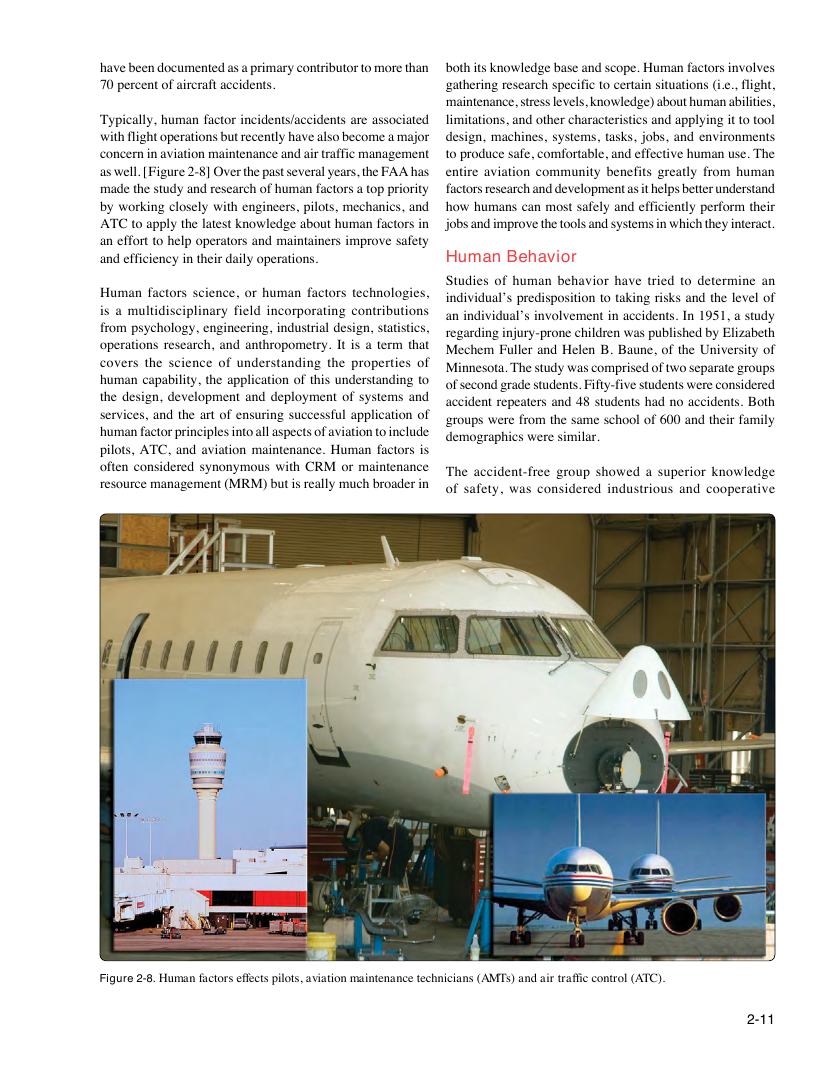
as well. [Figure 2-8] Over the past several years, the FAA has entire aviation community benefits greatly from human
made the study and research of human factors a top priority factors research and development as it helps better understand
by working closely with engineers, pilots, mechanics, and how humans can most safely and efficiently perform their
ATC to apply the latest knowledge about human factors in jobs and improve the tools and systems in which they interact.
an effort to help operators and maintainers improve safety
and efficiency in their daily operations. Human Behavior
Studies of human behavior have tried to determine an
Human factors science, or human factors technologies,
individual’s predisposition to taking risks and the level of
is a multidisciplinary field incorporating contributions
an individual’s involvement in accidents. In 1951, a study
from psychology, engineering, industrial design, statistics,
regarding injury-prone children was published by Elizabeth
operations research, and anthropometry. It is a term that
Mechem Fuller and Helen B. Baune, of the University of
covers the science of understanding the properties of
Minnesota. The study was comprised of two separate groups
human capability, the application of this understanding to
of second grade students. Fifty-five students were considered
the design, development and deployment of systems and
accident repeaters and 48 students had no accidents. Both
services, and the art of ensuring successful application of
groups were from the same school of 600 and their family
human factor principles into all aspects of aviation to include
demographics were similar.
pilots, ATC, and aviation maintenance. Human factors is
often considered synonymous with CRM or maintenance
The accident-free group showed a superior knowledge
resource management (MRM) but is really much broader in
of safety, was considered industrious and cooperative
Figure 2-8. Human factors effects pilots, aviation maintenance technicians (AMTs) and air traffic control (ATC).
2-11