FAA-H-8083-25C · Source PDF page 65
Aeronautical Decision-Making
Managing Risks · PHAK page 2-26
Searchable transcription
Automation is the single most important advance in aviation important to remember to check and confirm calculations.
technologies. Electronic flight displays (EFDs) have made Always remember that it is up to the pilot to maintain basic
vast improvements in how information is displayed and airmanship skills and use those skills often to maintain
what information is available to the pilot. Pilots can access proficiency in all tasks.
electronic databases that contain all of the information
traditionally contained in multiple handbooks, reducing Although automation has made flying safer, automated
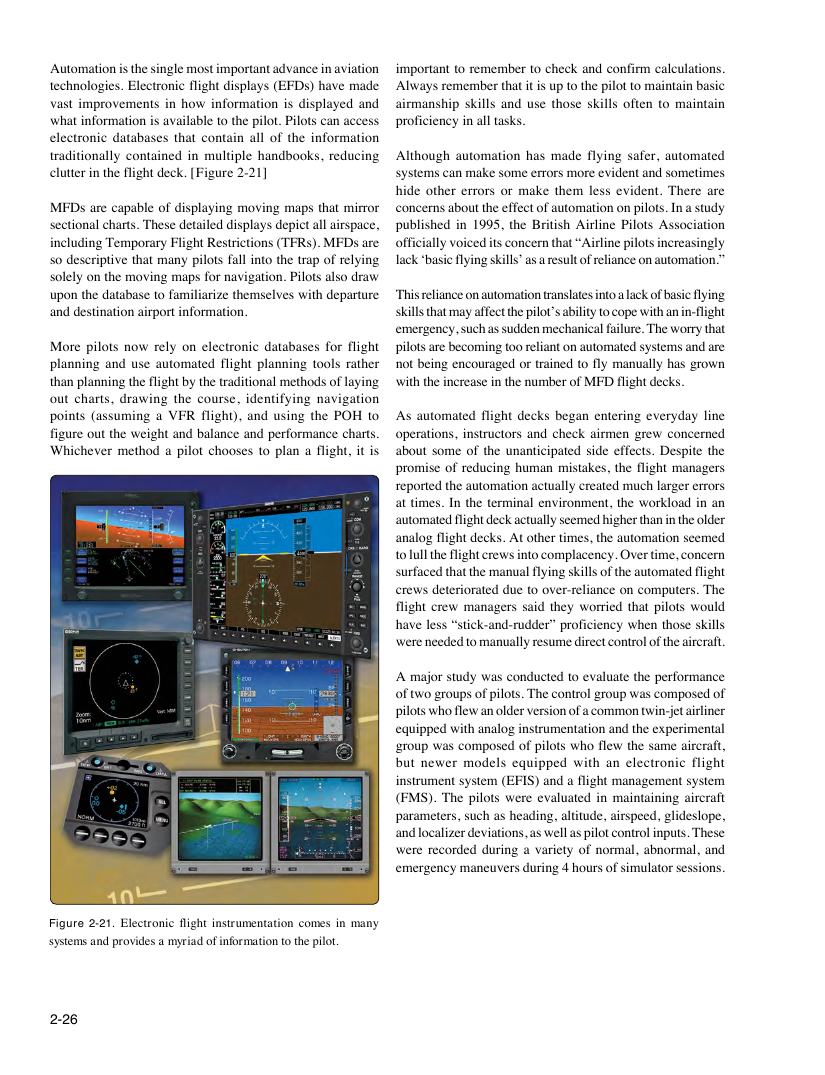
clutter in the flight deck. [Figure 2-21] systems can make some errors more evident and sometimes
hide other errors or make them less evident. There are
MFDs are capable of displaying moving maps that mirror concerns about the effect of automation on pilots. In a study
sectional charts. These detailed displays depict all airspace, published in 1995, the British Airline Pilots Association
including Temporary Flight Restrictions (TFRs). MFDs are officially voiced its concern that “Airline pilots increasingly
so descriptive that many pilots fall into the trap of relying lack ‘basic flying skills’ as a result of reliance on automation.”
solely on the moving maps for navigation. Pilots also draw
upon the database to familiarize themselves with departure This reliance on automation translates into a lack of basic flying
and destination airport information. skills that may affect the pilot’s ability to cope with an in-flight
emergency, such as sudden mechanical failure. The worry that
More pilots now rely on electronic databases for flight pilots are becoming too reliant on automated systems and are
planning and use automated flight planning tools rather not being encouraged or trained to fly manually has grown
than planning the flight by the traditional methods of laying with the increase in the number of MFD flight decks.
out charts, drawing the course, identifying navigation
points (assuming a VFR flight), and using the POH to As automated flight decks began entering everyday line
figure out the weight and balance and performance charts. operations, instructors and check airmen grew concerned
Whichever method a pilot chooses to plan a flight, it is about some of the unanticipated side effects. Despite the
promise of reducing human mistakes, the flight managers
reported the automation actually created much larger errors
at times. In the terminal environment, the workload in an
automated flight deck actually seemed higher than in the older
analog flight decks. At other times, the automation seemed
to lull the flight crews into complacency. Over time, concern
surfaced that the manual flying skills of the automated flight
crews deteriorated due to over-reliance on computers. The
flight crew managers said they worried that pilots would
have less “stick-and-rudder” proficiency when those skills
were needed to manually resume direct control of the aircraft.
A major study was conducted to evaluate the performance
of two groups of pilots. The control group was composed of
pilots who flew an older version of a common twin-jet airliner
equipped with analog instrumentation and the experimental
group was composed of pilots who flew the same aircraft,
but newer models equipped with an electronic flight
instrument system (EFIS) and a flight management system
(FMS). The pilots were evaluated in maintaining aircraft
parameters, such as heading, altitude, airspeed, glideslope,
and localizer deviations, as well as pilot control inputs. These
were recorded during a variety of normal, abnormal, and
emergency maneuvers during 4 hours of simulator sessions.
Figure 2-21. Electronic flight instrumentation comes in many
systems and provides a myriad of information to the pilot.
2-26