FAA-H-8083-25C · Source PDF page 63
Aeronautical Decision-Making
Workload Management · PHAK page 2-24
Searchable transcription
given a vector, or decrease speed, ATC assists and becomes but result in accidents as the pilot diverts attention to the
integrated as part of the crew. The services provided by ATC perceived problem and neglects proper control of the aircraft.
can not only decrease pilot workload, but also help pilots
make informed in-flight decisions. Workload Management
Effective workload management ensures essential operations
The Flight Service Stations (FSSs) are air traffic facilities are accomplished by planning, prioritizing, and sequencing
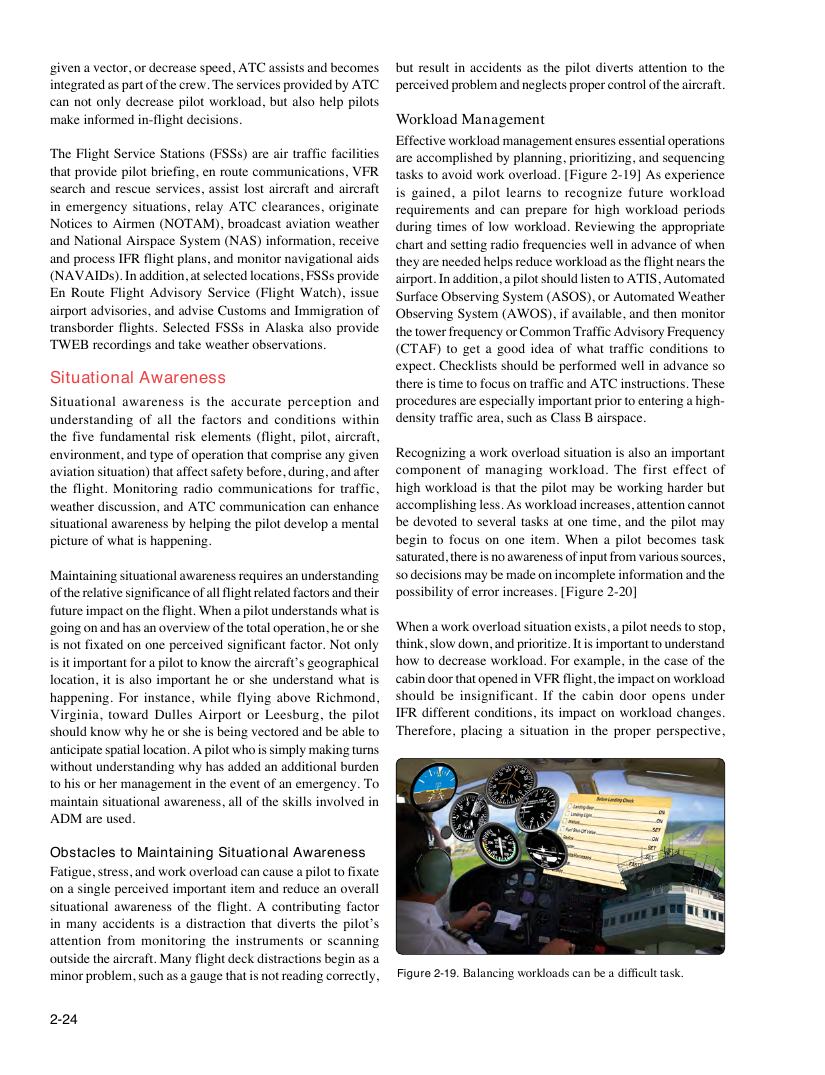
that provide pilot briefing, en route communications, VFR tasks to avoid work overload. [Figure 2-19] As experience
search and rescue services, assist lost aircraft and aircraft is gained, a pilot learns to recognize future workload
in emergency situations, relay ATC clearances, originate requirements and can prepare for high workload periods
Notices to Airmen (NOTAM), broadcast aviation weather during times of low workload. Reviewing the appropriate
and National Airspace System (NAS) information, receive chart and setting radio frequencies well in advance of when
and process IFR flight plans, and monitor navigational aids they are needed helps reduce workload as the flight nears the
(NAVAIDs). In addition, at selected locations, FSSs provide airport. In addition, a pilot should listen to ATIS, Automated
En Route Flight Advisory Service (Flight Watch), issue Surface Observing System (ASOS), or Automated Weather
airport advisories, and advise Customs and Immigration of Observing System (AWOS), if available, and then monitor
transborder flights. Selected FSSs in Alaska also provide the tower frequency or Common Traffic Advisory Frequency
TWEB recordings and take weather observations. (CTAF) to get a good idea of what traffic conditions to
expect. Checklists should be performed well in advance so
Situational Awareness
there is time to focus on traffic and ATC instructions. These
Situational awareness is the accurate perception and procedures are especially important prior to entering a high-
understanding of all the factors and conditions within density traffic area, such as Class B airspace.
the five fundamental risk elements (flight, pilot, aircraft,
environment, and type of operation that comprise any given Recognizing a work overload situation is also an important
aviation situation) that affect safety before, during, and after component of managing workload. The first effect of
the flight. Monitoring radio communications for traffic, high workload is that the pilot may be working harder but
weather discussion, and ATC communication can enhance accomplishing less. As workload increases, attention cannot
situational awareness by helping the pilot develop a mental be devoted to several tasks at one time, and the pilot may
picture of what is happening. begin to focus on one item. When a pilot becomes task
saturated, there is no awareness of input from various sources,
Maintaining situational awareness requires an understanding so decisions may be made on incomplete information and the
of the relative significance of all flight related factors and their possibility of error increases. [Figure 2-20]
future impact on the flight. When a pilot understands what is
going on and has an overview of the total operation, he or she When a work overload situation exists, a pilot needs to stop,
is not fixated on one perceived significant factor. Not only think, slow down, and prioritize. It is important to understand
is it important for a pilot to know the aircraft’s geographical how to decrease workload. For example, in the case of the
location, it is also important he or she understand what is cabin door that opened in VFR flight, the impact on workload
happening. For instance, while flying above Richmond, should be insignificant. If the cabin door opens under
Virginia, toward Dulles Airport or Leesburg, the pilot IFR different conditions, its impact on workload changes.
should know why he or she is being vectored and be able to Therefore, placing a situation in the proper perspective,
anticipate spatial location. A pilot who is simply making turns
without understanding why has added an additional burden
to his or her management in the event of an emergency. To
maintain situational awareness, all of the skills involved in
ADM are used.
Obstacles to Maintaining Situational Awareness
Fatigue, stress, and work overload can cause a pilot to fixate
on a single perceived important item and reduce an overall
situational awareness of the flight. A contributing factor
in many accidents is a distraction that diverts the pilot’s
attention from monitoring the instruments or scanning
outside the aircraft. Many flight deck distractions begin as a
minor problem, such as a gauge that is not reading correctly, Figure 2-19. Balancing workloads can be a difficult task.
2-24