FAA-H-8083-25C · Source PDF page 82
Aircraft Construction
Fluid Spills on Composites · PHAK page 3-11
Searchable transcription
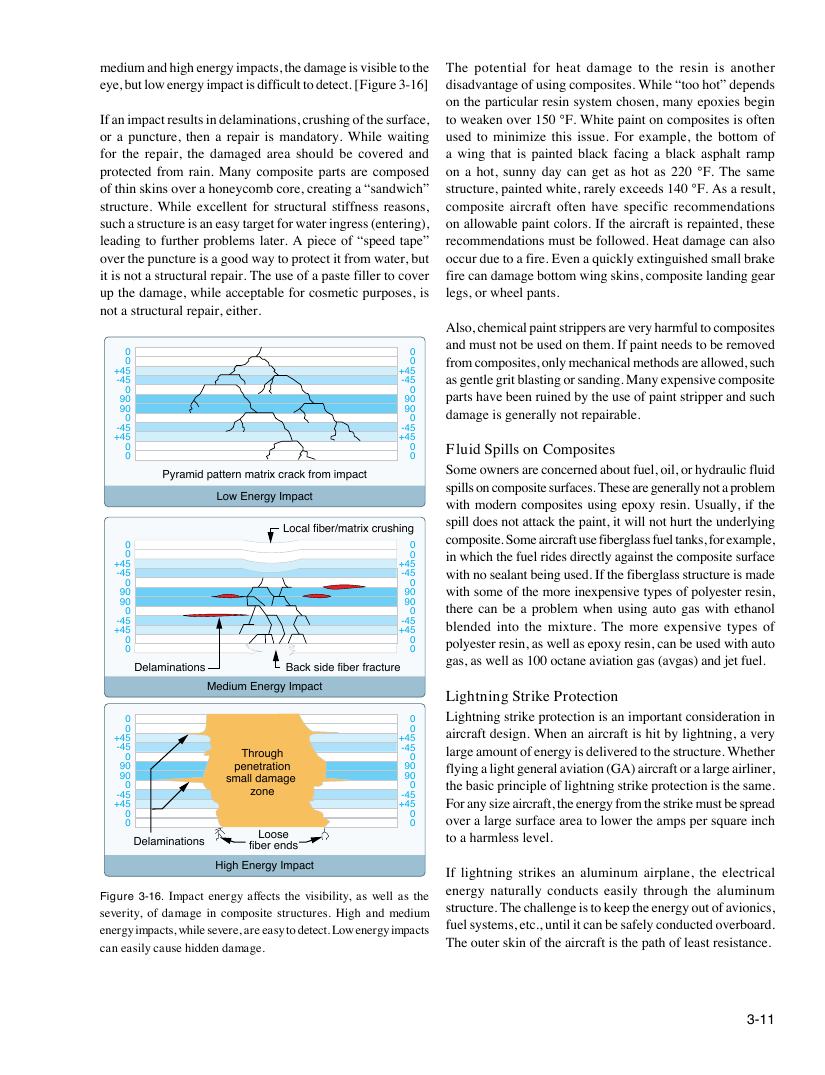
medium and high energy impacts, the damage is visible to the The potential for heat damage to the resin is another
eye, but low energy impact is difficult to detect. [Figure 3-16] disadvantage of using composites. While “too hot” depends
on the particular resin system chosen, many epoxies begin
If an impact results in delaminations, crushing of the surface, to weaken over 150 °F. White paint on composites is often
or a puncture, then a repair is mandatory. While waiting used to minimize this issue. For example, the bottom of
for the repair, the damaged area should be covered and a wing that is painted black facing a black asphalt ramp
protected from rain. Many composite parts are composed on a hot, sunny day can get as hot as 220 °F. The same
of thin skins over a honeycomb core, creating a “sandwich” structure, painted white, rarely exceeds 140 °F. As a result,
structure. While excellent for structural stiffness reasons, composite aircraft often have specific recommendations
such a structure is an easy target for water ingress (entering), on allowable paint colors. If the aircraft is repainted, these
leading to further problems later. A piece of “speed tape” recommendations must be followed. Heat damage can also
over the puncture is a good way to protect it from water, but occur due to a fire. Even a quickly extinguished small brake
it is not a structural repair. The use of a paste filler to cover fire can damage bottom wing skins, composite landing gear
up the damage, while acceptable for cosmetic purposes, is legs, or wheel pants.
not a structural repair, either.
Also, chemical paint strippers are very harmful to composites
and must not be used on them. If paint needs to be removed
0 0
0 0 from composites, only mechanical methods are allowed, such
+45 +45
-45 -45 as gentle grit blasting or sanding. Many expensive composite
0 0
parts have been ruined by the use of paint stripper and such
90 90
90 90 damage is generally not repairable.
0 0
-45 -45
+45 +45
0 0 Fluid Spills on Composites
0 0
Some owners are concerned about fuel, oil, or hydraulic fluid
Pyramid pattern matrix crack from impact
spills on composite surfaces. These are generally not a problem
Low Energy Impact
with modern composites using epoxy resin. Usually, if the
spill does not attack the paint, it will not hurt the underlying
Local fiber/matrix crushing
composite. Some aircraft use fiberglass fuel tanks, for example,
0 0
0 0 in which the fuel rides directly against the composite surface
+45 +45
-45 -45 with no sealant being used. If the fiberglass structure is made
0 0
90 90 with some of the more inexpensive types of polyester resin,
90 90
there can be a problem when using auto gas with ethanol
0 0
-45 -45 blended into the mixture. The more expensive types of
+45 +45
0 0 polyester resin, as well as epoxy resin, can be used with auto
0 0
gas, as well as 100 octane aviation gas (avgas) and jet fuel.
Delaminations Back side fiber fracture
Medium Energy Impact
Lightning Strike Protection
Lightning strike protection is an important consideration in
0 0
0 0 aircraft design. When an aircraft is hit by lightning, a very
+45 +45
-45 0 Through -45 0 large amount of energy is delivered to the structure. Whether
90 penetration 90 flying a light general aviation (GA) aircraft or a large airliner,
90 small damage 90
0 0 the basic principle of lightning strike protection is the same.
-45 zone -45
+45 +45 For any size aircraft, the energy from the strike must be spread
0 0
over a large surface area to lower the amps per square inch
0 0
Loose to a harmless level.
Delaminations
fiber ends
High Energy Impact
If lightning strikes an aluminum airplane, the electrical
energy naturally conducts easily through the aluminum
Figure 3-16. Impact energy affects the visibility, as well as the
structure. The challenge is to keep the energy out of avionics,
severity, of damage in composite structures. High and medium
fuel systems, etc., until it can be safely conducted overboard.
energy impacts, while severe, are easy to detect. Low energy impacts
The outer skin of the aircraft is the path of least resistance.
can easily cause hidden damage.
3-11