FAA-H-8083-25C · Source PDF page 81
Aircraft Construction
Disadvantages of Composites · PHAK page 3-10
Searchable transcription
and Columbia line of production aircraft, leading to their high
performance despite their fixed landing gear. Composites also
help mask the radar signature of “stealth” aircraft designs,
such as the B-2 and the F-22. Today, composites can be
found in aircraft as varied as gliders to most new helicopters.
Lack of corrosion is a third advantage of composites. Boeing
is designing the 787, with its all-composite fuselage, to have
both a higher pressure differential and higher humidity in
the cabin than previous airliners. Engineers are no longer as
concerned about corrosion from moisture condensation on the
hidden areas of the fuselage skins, such as behind insulation
blankets. This should lead to lower long-term maintenance
costs for the airlines.
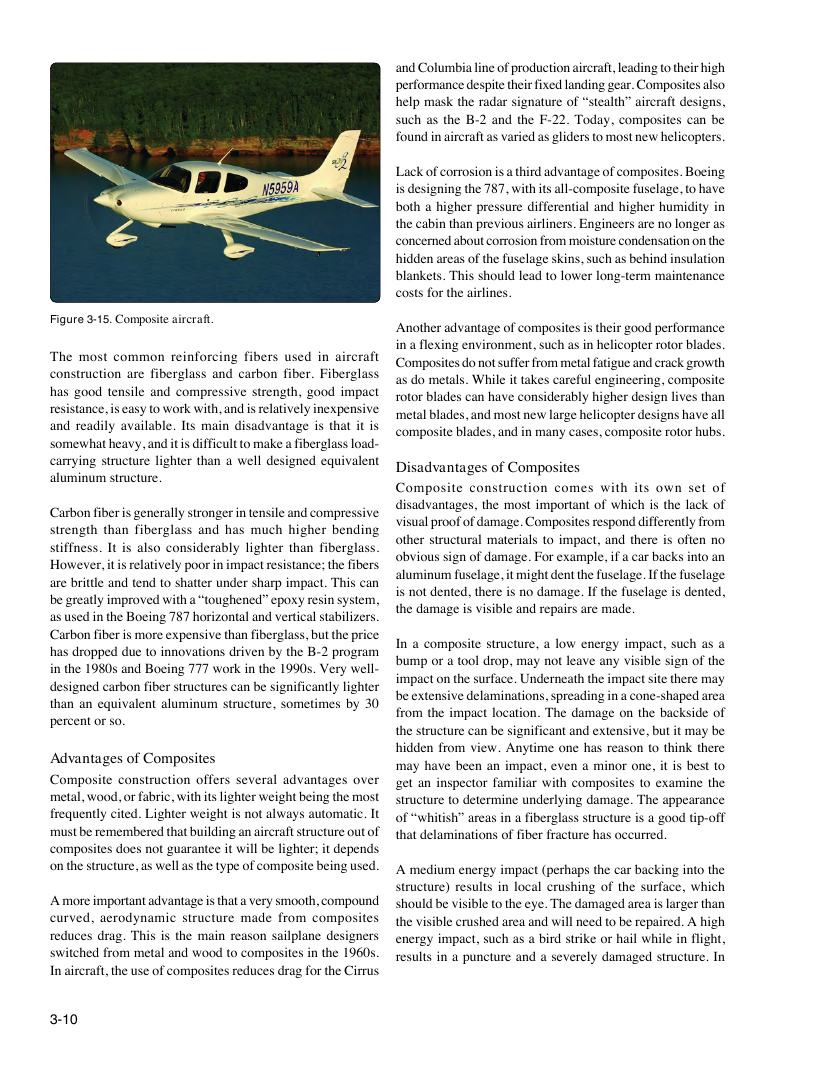
Figure 3-15. Composite aircraft.
Another advantage of composites is their good performance
in a flexing environment, such as in helicopter rotor blades.
The most common reinforcing fibers used in aircraft
Composites do not suffer from metal fatigue and crack growth
construction are fiberglass and carbon fiber. Fiberglass
as do metals. While it takes careful engineering, composite
has good tensile and compressive strength, good impact
rotor blades can have considerably higher design lives than
resistance, is easy to work with, and is relatively inexpensive
metal blades, and most new large helicopter designs have all
and readily available. Its main disadvantage is that it is
composite blades, and in many cases, composite rotor hubs.
somewhat heavy, and it is difficult to make a fiberglass load-
carrying structure lighter than a well designed equivalent
Disadvantages of Composites
aluminum structure.
Composite construction comes with its own set of
disadvantages, the most important of which is the lack of
Carbon fiber is generally stronger in tensile and compressive
visual proof of damage. Composites respond differently from
strength than fiberglass and has much higher bending
other structural materials to impact, and there is often no
stiffness. It is also considerably lighter than fiberglass.
obvious sign of damage. For example, if a car backs into an
However, it is relatively poor in impact resistance; the fibers
aluminum fuselage, it might dent the fuselage. If the fuselage
are brittle and tend to shatter under sharp impact. This can
is not dented, there is no damage. If the fuselage is dented,
be greatly improved with a “toughened” epoxy resin system,
the damage is visible and repairs are made.
as used in the Boeing 787 horizontal and vertical stabilizers.
Carbon fiber is more expensive than fiberglass, but the price
In a composite structure, a low energy impact, such as a
has dropped due to innovations driven by the B-2 program
bump or a tool drop, may not leave any visible sign of the
in the 1980s and Boeing 777 work in the 1990s. Very well-
impact on the surface. Underneath the impact site there may
designed carbon fiber structures can be significantly lighter
be extensive delaminations, spreading in a cone-shaped area
than an equivalent aluminum structure, sometimes by 30
from the impact location. The damage on the backside of
percent or so.
the structure can be significant and extensive, but it may be
hidden from view. Anytime one has reason to think there
Advantages of Composites
may have been an impact, even a minor one, it is best to
Composite construction offers several advantages over get an inspector familiar with composites to examine the
metal, wood, or fabric, with its lighter weight being the most structure to determine underlying damage. The appearance
frequently cited. Lighter weight is not always automatic. It of “whitish” areas in a fiberglass structure is a good tip-off
must be remembered that building an aircraft structure out of that delaminations of fiber fracture has occurred.
composites does not guarantee it will be lighter; it depends
on the structure, as well as the type of composite being used. A medium energy impact (perhaps the car backing into the
structure) results in local crushing of the surface, which
A more important advantage is that a very smooth, compound should be visible to the eye. The damaged area is larger than
curved, aerodynamic structure made from composites the visible crushed area and will need to be repaired. A high
reduces drag. This is the main reason sailplane designers energy impact, such as a bird strike or hail while in flight,
switched from metal and wood to composites in the 1960s. results in a puncture and a severely damaged structure. In
In aircraft, the use of composites reduces drag for the Cirrus
3-10