FAA-H-8083-25C · Source PDF page 96
Principles of Flight
Chapter Summary · PHAK page 4-9
Searchable transcription
vorte
x
4-9
are identical. In both examples, the only difference is the
relationship of the airfoil with the oncoming airstream
(angle). A paper airplane, which is simply a flat plate, has a
bottom and top exactly the same shape and length. Yet, these
airfoils do produce lift, and “flow turning” is partly (or fully)
responsible for creating lift.
As an airfoil moves through air, the airfoil is inclined
against the airflow, producing a different flow caused by the
airfoil’s relationship to the oncoming air. Think of a hand
Tip
being placed outside the car window at a high speed. If the
hand is inclined in one direction or another, the hand will
move upward or downward. This is caused by deflection,
which in turn causes the air to turn about the object within
the air stream. As a result of this change, the velocity about
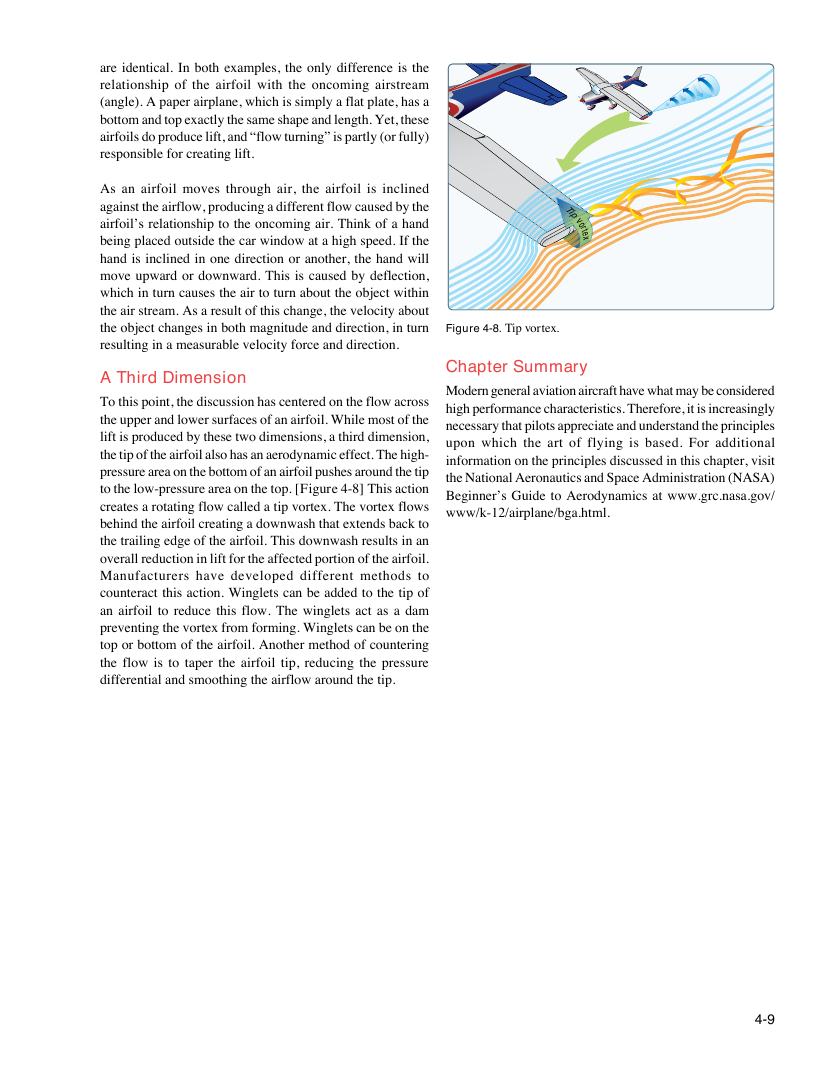
the object changes in both magnitude and direction, in turn Figure 4-8. Tip vortex.
resulting in a measurable velocity force and direction.
Chapter Summary
A Third Dimension
Modern general aviation aircraft have what may be considered
To this point, the discussion has centered on the flow across
high performance characteristics. Therefore, it is increasingly
the upper and lower surfaces of an airfoil. While most of the
necessary that pilots appreciate and understand the principles
lift is produced by these two dimensions, a third dimension,
upon which the art of flying is based. For additional
the tip of the airfoil also has an aerodynamic effect. The high-
information on the principles discussed in this chapter, visit
pressure area on the bottom of an airfoil pushes around the tip
the National Aeronautics and Space Administration (NASA)
to the low-pressure area on the top. [Figure 4-8] This action
Beginner’s Guide to Aerodynamics at www.grc.nasa.gov/
creates a rotating flow called a tip vortex. The vortex flows
www/k-12/airplane/bga.html.
behind the airfoil creating a downwash that extends back to
the trailing edge of the airfoil. This downwash results in an
overall reduction in lift for the affected portion of the airfoil.
Manufacturers have developed different methods to
counteract this action. Winglets can be added to the tip of
an airfoil to reduce this flow. The winglets act as a dam
preventing the vortex from forming. Winglets can be on the
top or bottom of the airfoil. Another method of countering
the flow is to taper the airfoil tip, reducing the pressure
differential and smoothing the airflow around the tip.