FAA-H-8083-25C · Source PDF page 95
Principles of Flight
Airfoil Design · PHAK page 4-8
Searchable transcription
drop in pressure. This lowered pressure is a component of
Low angle of attack
total lift. The pressure difference between the upper and
lower surface of a wing alone does not account for the total
lift force produced.
The downward backward flow from the top surface of an
CP
airfoil creates a downwash. This downwash meets the flow
from the bottom of the airfoil at the trailing edge. Applying
Newton’s third law, the reaction of this downward backward
flow results in an upward forward force on the airfoil. gl n e A of a t c ta k 8 ° -
High Pressure Below
A certain amount of lift is generated by pressure conditions
underneath the airfoil. Because of the manner in which air
flows underneath the airfoil, a positive pressure results,
Normal angle of attack
particularly at higher angles of attack. However, there is
another aspect to this airflow that must be considered. At a
point close to the leading edge, the airflow is virtually stopped
(stagnation point) and then gradually increases speed. At
some point near the trailing edge, it again reaches a velocity
CP
equal to that on the upper surface. In conformance with
Bernoulli’s principle, where the airflow was slowed beneath
t t
th
h h
e
e e
p
f a l
r
i u
e
r i f
s
d o
s
i
u
s l p
r
,
e
e a e
d
p d
if
o
f
d s
e
e i
r
t c
e
i r v
n
e e
t
a
i a
s u
l
e p s
b
w ,
e
t
t
a h
w
r e d
e
p
e
p r
n
e r e
t
s
h
s s
e
s u u r
u
e r
p
e m
p
w
e
u
r
a s
a
s t
n
i c n
d
r c e
l
r
o
a e
w
t a e s
e
d e
r
) (
s
. i
u
. S e
r
i
f
., n
a
c
c
a
e
e s A n gl e of a tt a c k + 4 °
of the airfoil increases, total lift increases. Both Bernoulli’s
Principle and Newton’s Laws are in operation whenever lift
is being generated by an airfoil.
High angle of attack
Pressure Distribution
From experiments conducted on wind tunnel models and on
full size airplanes, it has been determined that as air flows
along the surface of a wing at different angles of attack CP
(AOA), there are regions along the surface where the pressure
is negative, or less than atmospheric, and regions where the
p
p
o
r
r
n
e
e
t
s
s
h
s
s
u
e
u
r
r
w
e
e
i
i
o
n
s
n
g
p
t
o
t
h
h
s
e
i
a
t
n
i
u
v
p
i
e
s
p
,
e
o
c
r
a
r
s
u
g
u
s
r
r
e
e
f
a
d
a
t
c
e
b
e
r
y
t
c
h
t
r
h
a
e
e
n
a
p
t
a
e
o
t
s
m
s
a
i
o
t
r
i
s
v
e
p
l
e
h
a
p
e
ti
r
r
v
i
e
c
e
s
.
l
s
y
T
u
h
l
r
a
e
is
r g
r
n
e
e
e
s
r
g
u
f
a
l
o
t
t
i
r
i
n
v
c
g
e
e
A n
gl e
of
att
a c
k
+ 1
0 °
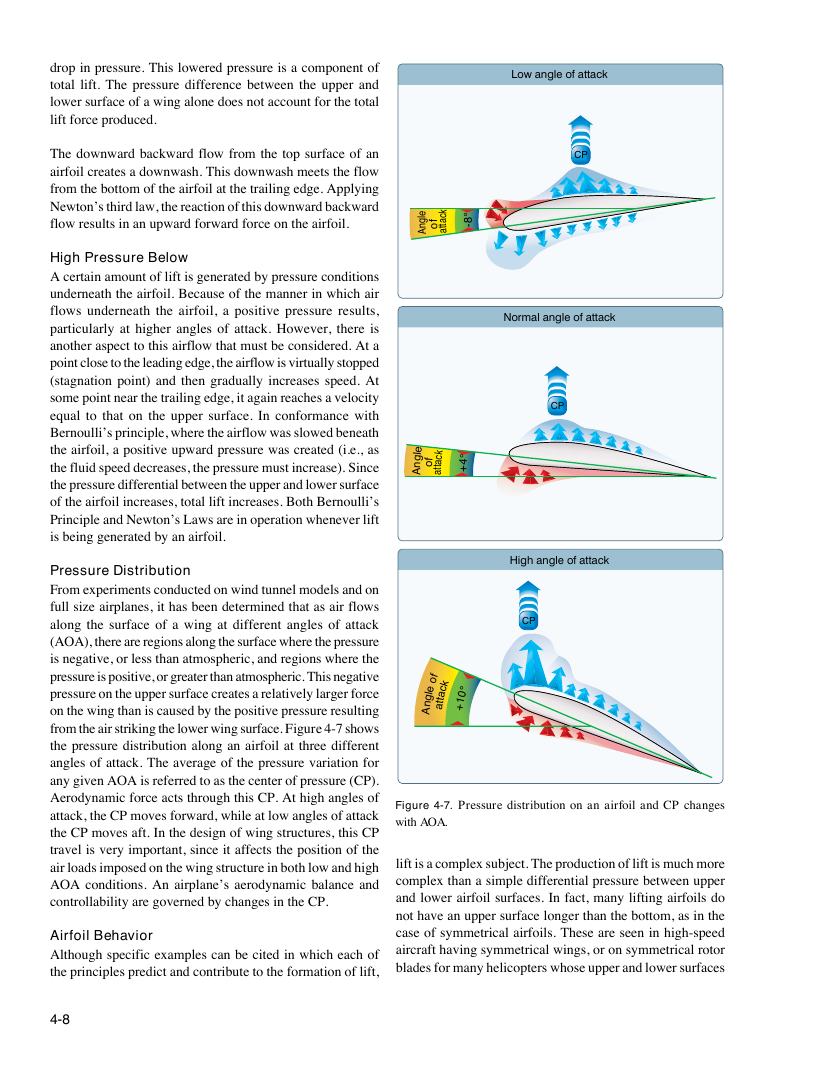
from the air striking the lower wing surface. Figure 4-7 shows
the pressure distribution along an airfoil at three different
angles of attack. The average of the pressure variation for
any given AOA is referred to as the center of pressure (CP).
Aerodynamic force acts through this CP. At high angles of Figure 2-8. Pressure distribution on an airfoil & CP changes
Figure 4-7. Pressure distribution on an airfoil and CP changes
attack, the CP moves forward, while at low angles of attack with an angle of attack.
with AOA.
the CP moves aft. In the design of wing structures, this CP
travel is very important, since it affects the position of the
air loads imposed on the wing structure in both low and high lift is a complex subject. The production of lift is much more
AOA conditions. An airplane’s aerodynamic balance and complex than a simple differential pressure between upper
controllability are governed by changes in the CP. and lower airfoil surfaces. In fact, many lifting airfoils do
not have an upper surface longer than the bottom, as in the
case of symmetrical airfoils. These are seen in high-speed
Airfoil Behavior
aircraft having symmetrical wings, or on symmetrical rotor
Although specific examples can be cited in which each of
blades for many helicopters whose upper and lower surfaces
the principles predict and contribute to the formation of lift,
4-8