FAA-H-8083-25C · Source PDF page 89
Principles of Flight
Friction · PHAK page 4-2
Searchable transcription
Air is a Fluid the viscosity of air. However, since air is a fluid and has
When most people hear the word “fluid,” they usually think viscosity properties, it resists flow around any object to
of liquid. However, gasses, like air, are also fluids. Fluids some extent.
take on the shape of their containers. Fluids generally do not
resist deformation when even the smallest stress is applied, Friction
or they resist it only slightly. We call this slight resistance Another factor at work when a fluid flows over or around
viscosity. Fluids also have the ability to flow. Just as a liquid an object is called friction. Friction is the resistance that one
flows and fills a container, air will expand to fill the available surface or object encounters when moving over another.
volume of its container. Both liquids and gasses display these Friction exists between any two materials that contact each
unique fluid properties, even though they differ greatly in other.
density. Understanding the fluid properties of air is essential
to understanding the principles of flight. The effects of friction can be demonstrated using a similar
example as before. If identical fluids are poured down two
Viscosity identical ramps, they flow in the same manner and at the
Viscosity is the property of a fluid that causes it to resist same speed. If the surface of one ramp is rough, and the other
flowing. The way individual molecules of the fluid tend to smooth, the flow down the two ramps differs significantly.
adhere, or stick, to each other determines how much a fluid The rough surface ramp impedes the flow of the fluid due
resists flow. High-viscosity fluids are “thick” and resist flow; to resistance from the surface (friction). It is important to
low-viscosity fluids are “thin” and flow easily. Air has a low remember that all surfaces, no matter how smooth they
viscosity and flows easily. appear, are not smooth on a microscopic level and impede
the flow of a fluid.
Using two liquids as an example, similar amounts of oil and
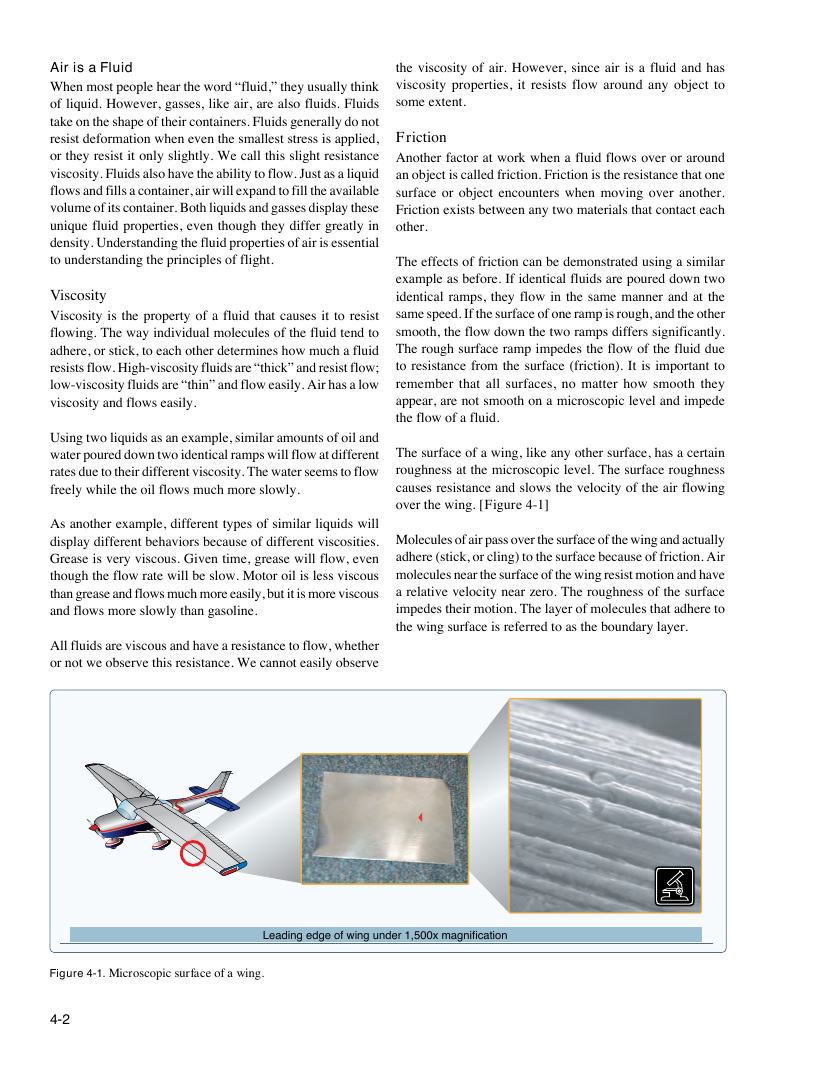
water poured down two identical ramps will flow at different The surface of a wing, like any other surface, has a certain
rates due to their different viscosity. The water seems to flow roughness at the microscopic level. The surface roughness
freely while the oil flows much more slowly. causes resistance and slows the velocity of the air flowing
over the wing. [Figure 4-1]
As another example, different types of similar liquids will
display different behaviors because of different viscosities. Molecules of air pass over the surface of the wing and actually
Grease is very viscous. Given time, grease will flow, even adhere (stick, or cling) to the surface because of friction. Air
though the flow rate will be slow. Motor oil is less viscous molecules near the surface of the wing resist motion and have
than grease and flows much more easily, but it is more viscous a relative velocity near zero. The roughness of the surface
and flows more slowly than gasoline. impedes their motion. The layer of molecules that adhere to
the wing surface is referred to as the boundary layer.
All fluids are viscous and have a resistance to flow, whether
or not we observe this resistance. We cannot easily observe
Leading edge of wing under 1,500x magnification
Figure 4-1. Microscopic surface of a wing.
4-2