FAA-H-8083-25C · Source PDF page 90
Principles of Flight
Pressure · PHAK page 4-3
Searchable transcription
Once the boundary layer of the air adheres to the wing by
friction, further resistance to the airflow is caused by the
viscosity, the tendency of the air to stick to itself. When
Inches of
these two forces act together to resist airflow over a wing, Standard Mercury Millibars Standard
Sea Level Sea Level
it is called drag. Pressure 30 1016 Pressure
29.92 1013
Hg 25 847 mb
Pressure
20 677
Pressure is the force applied in a perpendicular direction to the
15 508
surface of an object. Often, pressure is measured in pounds of
force exerted per square inch of an object, or PSI. An object 10 339
completely immersed in a fluid will feel pressure uniformly 5 170
around the entire surface of the object. If the pressure on one Atmospheric Pressure
0 0
surface of the object becomes less than the pressure exerted
on the other surfaces, the object will move in the direction
of the lower pressure.
Atmospheric Pressure
Although there are various kinds of pressure, pilots are
mainly concerned with atmospheric pressure. It is one of
the basic factors in weather changes, helps to lift an aircraft,
and actuates some of the important flight instruments. These
instruments are the altimeter, airspeed indicator, vertical Figure 4-2. Standard sea level pressure.
speed indicator, and manifold pressure gauge.
Standard Atmosphere
Temperature
Air is very light, but it has mass and is affected by the
Altitude (ft) Pressure (Hg)
attraction of gravity. Therefore, like any other substance, (°C) (°F)
it has weight, and because of its weight, it has force. Since 0 29.92 15.0 59.0
1,000 28.86 13.0 55.4
air is a fluid substance, this force is exerted equally in all
2,000 27.82 11.0 51.9
directions. Its effect on bodies within the air is called pressure.
3,000 26.82 9.1 48.3
Under standard conditions at sea level, the average pressure
4,000 25.84 7.1 44.7
exerted by the weight of the atmosphere is approximately
5,000 24.89 5.1 41.2
14.70 pounds per square inch (psi) of surface, or 1,013.2 6,000 23.98 3.1 37.6
millibars (mb). The thickness of the atmosphere is limited; 7,000 23.09 1.1 34.0
therefore, the higher the altitude, the less air there is above. 8,000 22.22 -0.9 30.5
For this reason, the weight of the atmosphere at 18,000 feet 9,000 21.38 -2.8 26.9
is one-half what it is at sea level. 10,000 20.57 -4.8 23.3
11,000 19.79 -6.8 19.8
12,000 19.02 -8.8 16.2
The pressure of the atmosphere varies with time and location.
13,000 18.29 -10.8 12.6
Due to the changing atmospheric pressure, a standard
14,000 17.57 -12.7 9.1
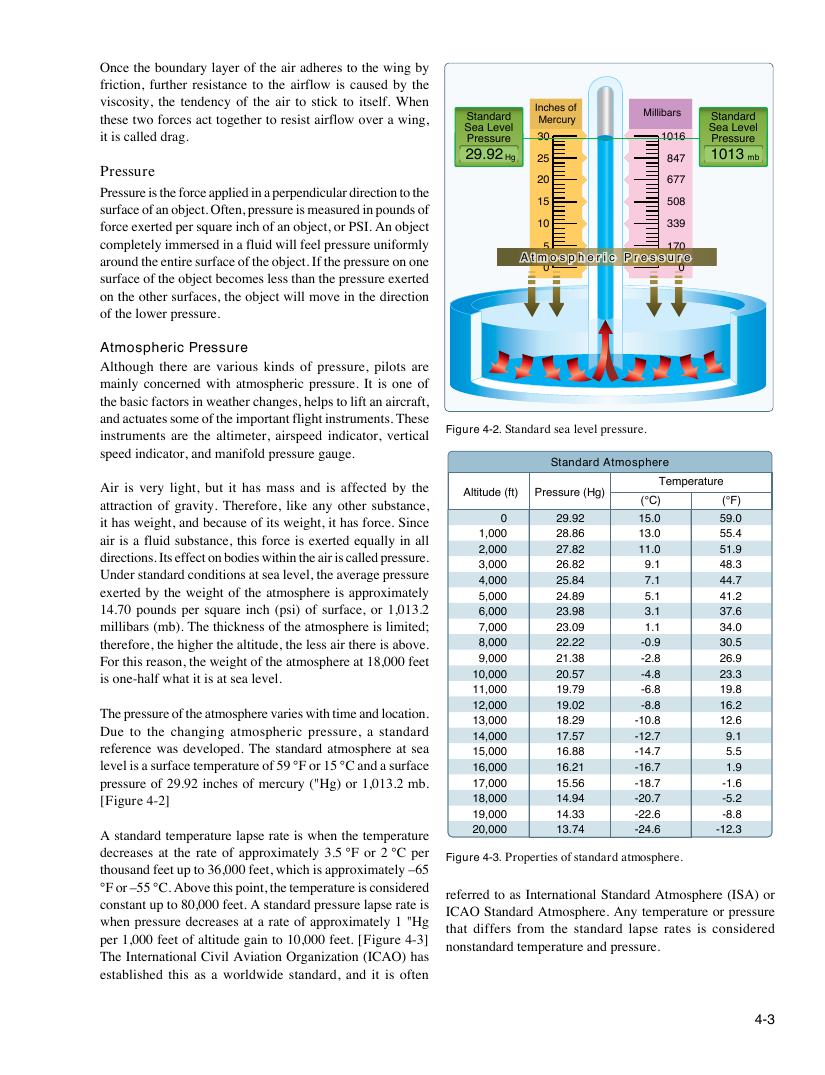
reference was developed. The standard atmosphere at sea
15,000 16.88 -14.7 5.5
level is a surface temperature of 59 °F or 15 °C and a surface 16,000 16.21 -16.7 1.9
pressure of 29.92 inches of mercury ("Hg) or 1,013.2 mb. 17,000 15.56 -18.7 -1.6
[Figure 4-2] 18,000 14.94 -20.7 -5.2
19,000 14.33 -22.6 -8.8
A standard temperature lapse rate is when the temperature 20,000 13.74 -24.6 -12.3
decreases at the rate of approximately 3.5 °F or 2 °C per
Figure 4-3. Properties of standard atmosphere.
thousand feet up to 36,000 feet, which is approximately –65
°F or –55 °C. Above this point, the temperature is considered
referred to as International Standard Atmosphere (ISA) or
constant up to 80,000 feet. A standard pressure lapse rate is
ICAO Standard Atmosphere. Any temperature or pressure
when pressure decreases at a rate of approximately 1 "Hg
that differs from the standard lapse rates is considered
per 1,000 feet of altitude gain to 10,000 feet. [Figure 4-3]
nonstandard temperature and pressure.
The International Civil Aviation Organization (ICAO) has
established this as a worldwide standard, and it is often
4-3