FAA-H-8083-25C · Source PDF page 99
Aerodynamics of Flight
Aerodynamics · PHAK page 5-2
Searchable transcription
• Weight—the combined load of the aircraft itself, the thrust has an upward component. But because the aircraft is in
crew, the fuel, and the cargo or baggage. Weight is level flight, weight does not contribute to drag. [Figure 5-2]
a force that pulls the aircraft downward because of
the force of gravity. It opposes lift and acts vertically In glides, a portion of the weight vector is directed along
downward through the aircraft’s center of gravity (CG). the forward flight path and, therefore, acts as thrust. In other
words, any time the flight path of the aircraft is not horizontal,
In steady flight, the sum of these opposing forces is always lift, weight, thrust, and drag vectors must each be broken down
zero. There can be no unbalanced forces in steady, straight into two components.
flight based upon Newton’s Third Law, which states that for
every action or force there is an equal, but opposite, reaction Another important concept to understand is angle of attack
or force. This is true whether flying level or when climbing (AOA). Since the early days of flight, AOA is fundamental to
or descending. understanding many aspects of airplane performance, stability,
and control. The AOA is defined as the acute angle between the
It does not mean the four forces are equal. It means the chord line of the airfoil and the direction of the relative wind.
opposing forces are equal to, and thereby cancel, the effects of
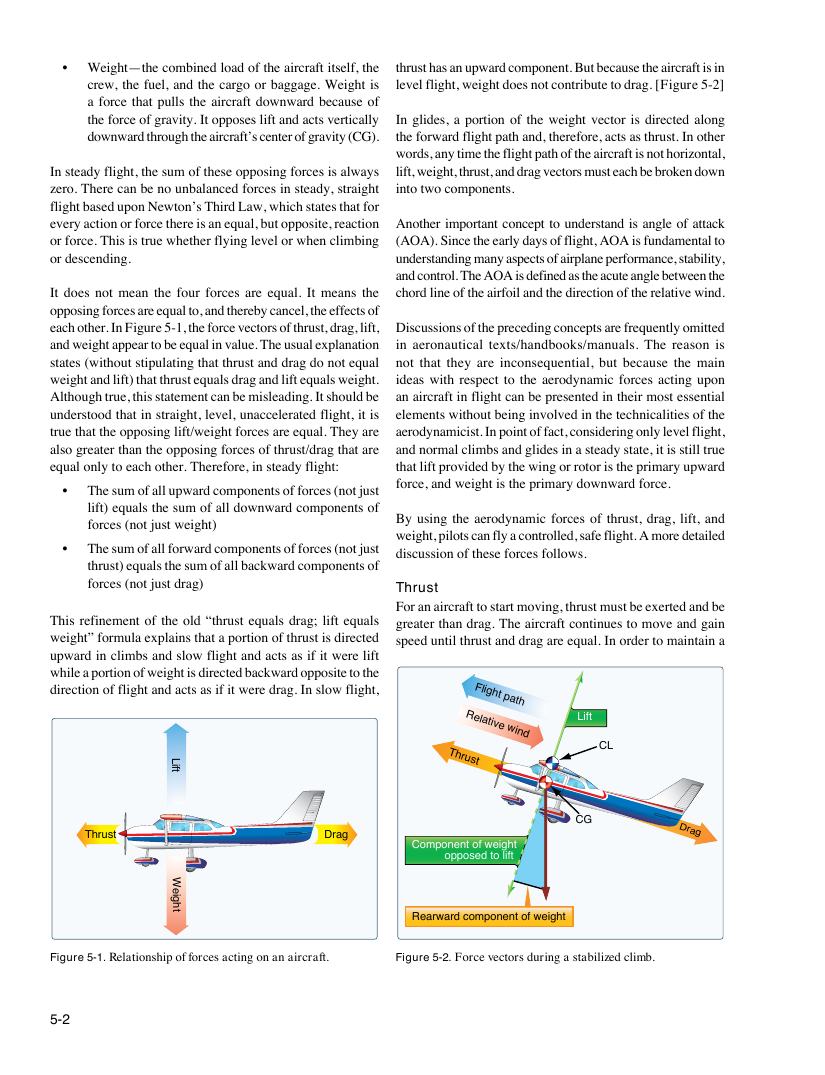
each other. In Figure 5-1, the force vectors of thrust, drag, lift, Discussions of the preceding concepts are frequently omitted
and weight appear to be equal in value. The usual explanation in aeronautical texts/handbooks/manuals. The reason is
states (without stipulating that thrust and drag do not equal not that they are inconsequential, but because the main
weight and lift) that thrust equals drag and lift equals weight. ideas with respect to the aerodynamic forces acting upon
Although true, this statement can be misleading. It should be an aircraft in flight can be presented in their most essential
understood that in straight, level, unaccelerated flight, it is elements without being involved in the technicalities of the
true that the opposing lift/weight forces are equal. They are aerodynamicist. In point of fact, considering only level flight,
also greater than the opposing forces of thrust/drag that are and normal climbs and glides in a steady state, it is still true
equal only to each other. Therefore, in steady flight: that lift provided by the wing or rotor is the primary upward
force, and weight is the primary downward force.
• The sum of all upward components of forces (not just
lift) equals the sum of all downward components of
By using the aerodynamic forces of thrust, drag, lift, and
forces (not just weight)
weight, pilots can fly a controlled, safe flight. A more detailed
• The sum of all forward components of forces (not just
discussion of these forces follows.
thrust) equals the sum of all backward components of
forces (not just drag)
Thrust
For an aircraft to start moving, thrust must be exerted and be
This refinement of the old “thrust equals drag; lift equals greater than drag. The aircraft continues to move and gain
weight” formula explains that a portion of thrust is directed speed until thrust and drag are equal. In order to maintain a
upward in climbs and slow flight and acts as if it were lift
while a portion of weight is directed backward opposite to the
direction of flight and acts as if it were drag. In slow flight, Flight
path
Relative
wind
Lift
CL
L
Thrust
ift
CG
Thrust Drag
Drag
Component of weight
opposed to lift
W
e
ig
h
t Rearward component of weight
Figure 5-1. Relationship of forces acting on an aircraft. Figure 5-2. Force vectors during a stabilized climb.
5-2