FAA-H-8083-25C · Source PDF page 100
Aerodynamics of Flight
Aerodynamics · PHAK page 5-3
Searchable transcription
constant airspeed, thrust and drag must remain equal, just as In level flight, when thrust is increased, the aircraft speeds
lift and weight must be equal to maintain a constant altitude. up and the lift increases. The aircraft will start to climb
If in level flight, the engine power is reduced, the thrust is unless the AOA is decreased just enough to maintain the
lessened, and the aircraft slows down. As long as the thrust relationship between lift and weight. The timing of this
is less than the drag, the aircraft continues to decelerate. To decrease in AOA needs to be coordinated with the increase
a point, as the aircraft slows down, the drag force will also in thrust and airspeed. Otherwise, if the AOA is decreased too
decrease. The aircraft will continue to slow down until thrust fast, the aircraft will descend, and if the AOA is decreased
again equals drag at which point the airspeed will stabilize. too slowly, the aircraft will climb.
Likewise, if the engine power is increased, thrust becomes As the airspeed varies due to thrust, the AOA must also vary
greater than drag and the airspeed increases. As long as to maintain level flight. At very high speeds and level flight,
the thrust continues to be greater than the drag, the aircraft it is even possible to have a slightly negative AOA. As thrust
continues to accelerate. When drag equals thrust, the aircraft is reduced and airspeed decreases, the AOA must increase
flies at a constant airspeed. in order to maintain altitude. If speed decreases enough, the
required AOA will increase to the critical AOA. Any further
Straight-and-level flight may be sustained at a wide range increase in the AOA will result in the wing stalling. Therefore,
of speeds. The pilot coordinates AOA and thrust in all extra vigilance is required at reduced thrust settings and low
speed regimes if the aircraft is to be held in level flight. An speeds so as not to exceed the critical angle of attack. If the
important fact related to the principal of lift (for a given airplane is equipped with an AOA indicator, it should be
airfoil shape) is that lift varies with the AOA and airspeed. referenced to help monitor the proximity to the critical AOA.
Therefore, a large AOA at low airspeeds produces an equal
amount of lift at high airspeeds with a low AOA. The speed Some aircraft have the ability to change the direction of the
regimes of flight can be grouped in three categories: low- thrust rather than changing the AOA. This is accomplished
speed flight, cruising flight, and high-speed flight. either by pivoting the engines or by vectoring the exhaust
gases. [Figure 5-4]
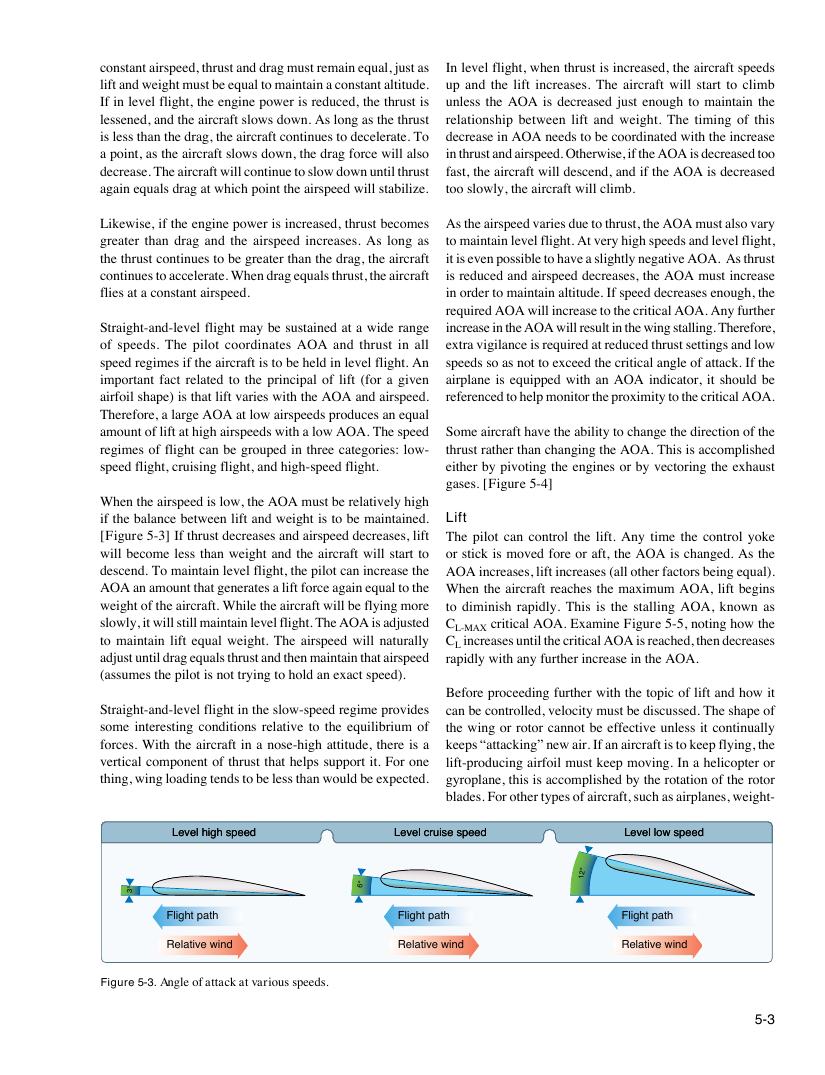
When the airspeed is low, the AOA must be relatively high
if the balance between lift and weight is to be maintained. Lift
[Figure 5-3] If thrust decreases and airspeed decreases, lift The pilot can control the lift. Any time the control yoke
will become less than weight and the aircraft will start to or stick is moved fore or aft, the AOA is changed. As the
descend. To maintain level flight, the pilot can increase the AOA increases, lift increases (all other factors being equal).
AOA an amount that generates a lift force again equal to the When the aircraft reaches the maximum AOA, lift begins
weight of the aircraft. While the aircraft will be flying more to diminish rapidly. This is the stalling AOA, known as
slowly, it will still maintain level flight. The AOA is adjusted C critical AOA. Examine Figure 5-5, noting how the
L-MAX
to maintain lift equal weight. The airspeed will naturally C increases until the critical AOA is reached, then decreases
L
adjust until drag equals thrust and then maintain that airspeed rapidly with any further increase in the AOA.
(assumes the pilot is not trying to hold an exact speed).
Before proceeding further with the topic of lift and how it
Straight-and-level flight in the slow-speed regime provides can be controlled, velocity must be discussed. The shape of
some interesting conditions relative to the equilibrium of the wing or rotor cannot be effective unless it continually
forces. With the aircraft in a nose-high attitude, there is a keeps “attacking” new air. If an aircraft is to keep flying, the
vertical component of thrust that helps support it. For one lift-producing airfoil must keep moving. In a helicopter or
thing, wing loading tends to be less than would be expected. gyroplane, this is accomplished by the rotation of the rotor
blades. For other types of aircraft, such as airplanes, weight-
LLeevveell hhiigghh ssppeeeedd LLeevveell ccrruuiissee ssppeeeedd LLeevveell llooww ssppeeeedd
3°
6°
1
2°
Flight path Flight path Flight path
Relative wind Relative wind Relative wind
Figure 5-3. Angle of attack at various speeds.
5-3