FAA-H-8083-25C · Source PDF page 101
Aerodynamics of Flight
Aerodynamics · PHAK page 5-4
Searchable transcription
Figure 5-4. Some aircraft have the ability to change the direction of thrust.
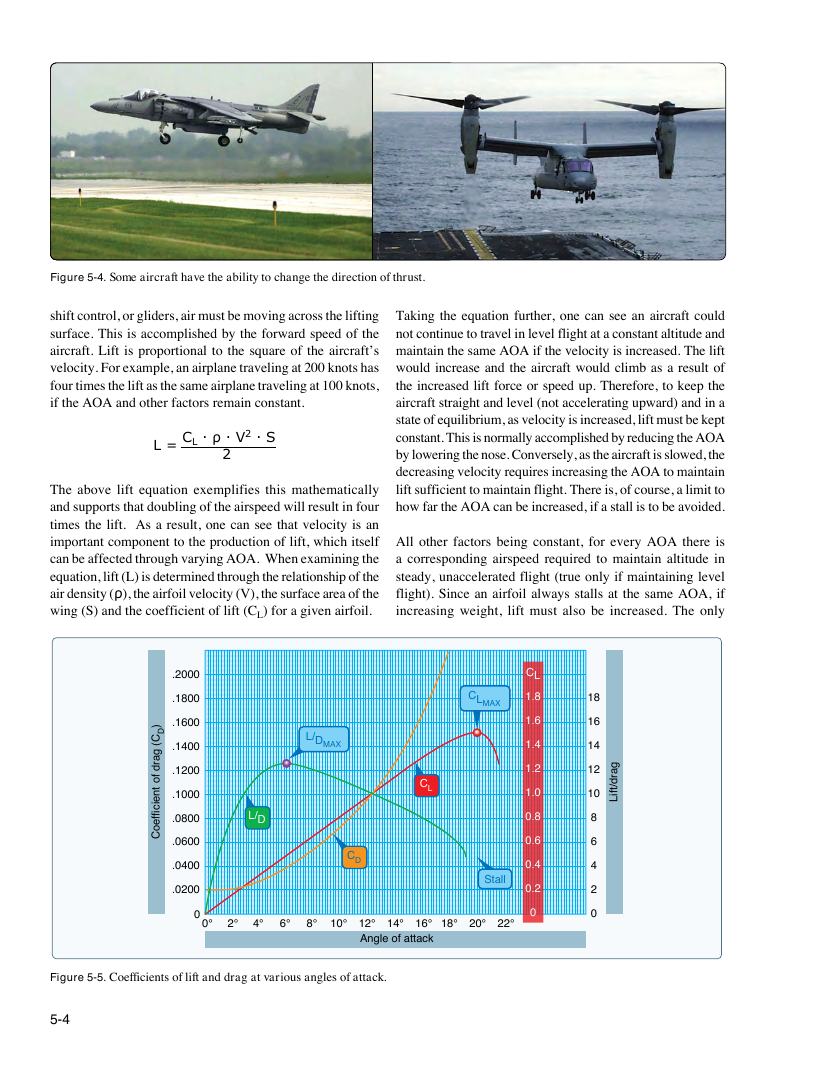
.2000
.1800 CL 18
MAX
.1600 16
L/D
.1400 MAX 14
.1200 12
C
.1000 L 10
.0800 L/D 8
.0600 6
C
.0400 D 4
Stall
.0200 2
0 0
5-4
) C(
gard
fo
tneiciffeoC
D
gard/tfiL
shift control, or gliders, air must be moving across the lifting Taking the equation further, one can see an aircraft could
surface. This is accomplished by the forward speed of the not continue to travel in level flight at a constant altitude and
aircraft. Lift is proportional to the square of the aircraft’s maintain the same AOA if the velocity is increased. The lift
velocity. For example, an airplane traveling at 200 knots has would increase and the aircraft would climb as a result of
four times the lift as the same airplane traveling at 100 knots, the increased lift force or speed up. Therefore, to keep the
if the AOA and other factors remain constant. aircraft straight and level (not accelerating upward) and in a
state of equilibrium, as velocity is increased, lift must be kept
C . ρ . V2 . S constant. This is normally accomplished by reducing the AOA
L = L
2 by lowering the nose. Conversely, as the aircraft is slowed, the
decreasing velocity requires increasing the AOA to maintain
The above lift equation exemplifies this mathematically lift sufficient to maintain flight. There is, of course, a limit to
and supports that doubling of the airspeed will result in four how far the AOA can be increased, if a stall is to be avoided.
times the lift. As a result, one can see that velocity is an
important component to the production of lift, which itself All other factors being constant, for every AOA there is
can be affected through varying AOA. When examining the a corresponding airspeed required to maintain altitude in
equation, lift (L) is determined through the relationship of the steady, unaccelerated flight (true only if maintaining level
air density (ρ), the airfoil velocity (V), the surface area of the flight). Since an airfoil always stalls at the same AOA, if
wing (S) and the coefficient of lift (C ) for a given airfoil. increasing weight, lift must also be increased. The only
L
CL
1.8
1.6
1.4
1.2
1.0
0.8
0.6
0.4
0.2
0
0° 2° 4° 6° 8° 10° 12° 14° 16° 18° 20° 22°
Angle of attack
Figure 5-5. Coefficients of lift and drag at various angles of attack.