FAA-H-8083-25C · Source PDF page 144
Aerodynamics of Flight
Laminar Boundary Layer Flow · PHAK page 5-47
Searchable transcription
Turbulent boundary layer
Transition region
Laminar boundary layer
Laminar sublayer
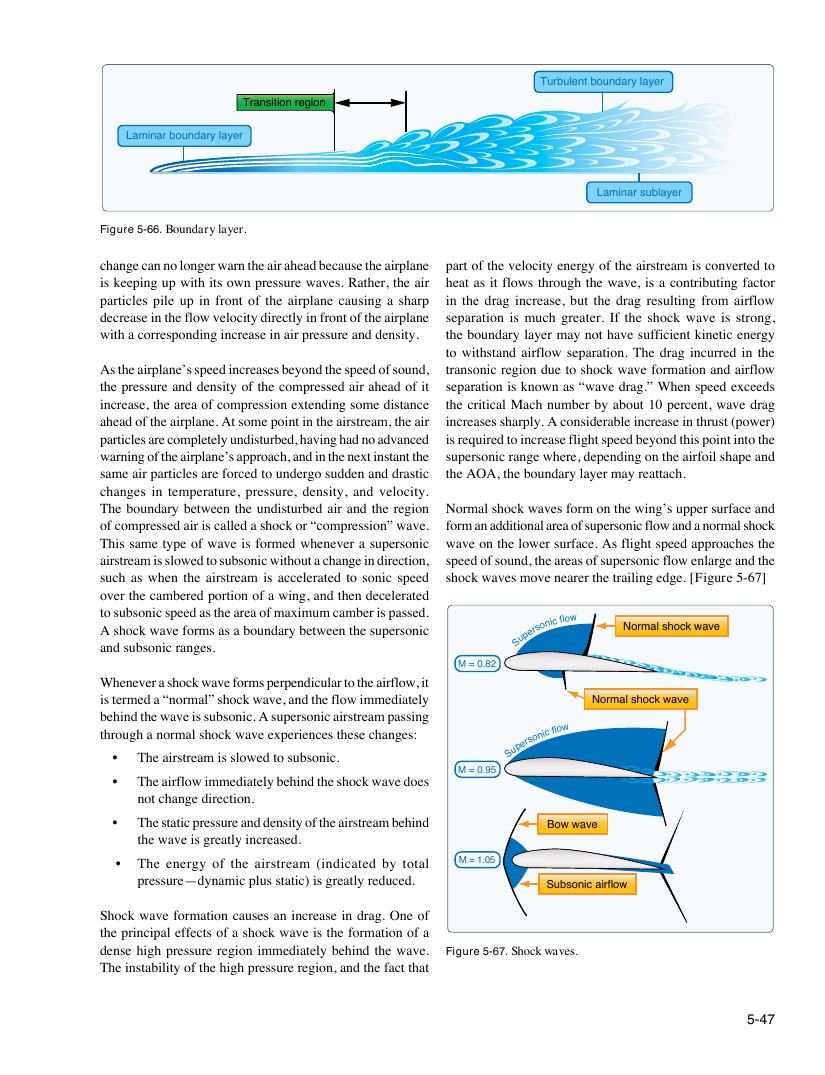
Figure 5-66. Boundary layer.
change can no longer warn the air ahead because the airplane part of the velocity energy of the airstream is converted to
is keeping up with its own pressure waves. Rather, the air heat as it flows through the wave, is a contributing factor
particles pile up in front of the airplane causing a sharp in the drag increase, but the drag resulting from airflow
decrease in the flow velocity directly in front of the airplane separation is much greater. If the shock wave is strong,
with a corresponding increase in air pressure and density. the boundary layer may not have sufficient kinetic energy
to withstand airflow separation. The drag incurred in the
As the airplane’s speed increases beyond the speed of sound, transonic region due to shock wave formation and airflow
the pressure and density of the compressed air ahead of it separation is known as “wave drag.” When speed exceeds
increase, the area of compression extending some distance the critical Mach number by about 10 percent, wave drag
ahead of the airplane. At some point in the airstream, the air increases sharply. A considerable increase in thrust (power)
particles are completely undisturbed, having had no advanced is required to increase flight speed beyond this point into the
warning of the airplane’s approach, and in the next instant the supersonic range where, depending on the airfoil shape and
same air particles are forced to undergo sudden and drastic the AOA, the boundary layer may reattach.
changes in temperature, pressure, density, and velocity.
The boundary between the undisturbed air and the region Normal shock waves form on the wing’s upper surface and
of compressed air is called a shock or “compression” wave. form an additional area of supersonic flow and a normal shock
This same type of wave is formed whenever a supersonic wave on the lower surface. As flight speed approaches the
airstream is slowed to subsonic without a change in direction, speed of sound, the areas of supersonic flow enlarge and the
such as when the airstream is accelerated to sonic speed shock waves move nearer the trailing edge. [Figure 5-67]
over the cambered portion of a wing, and then decelerated
to subsonic speed as the area of maximum camber is passed.
A
an d
sh
s
o
u
c
b
k
s o
w
n
a
i
v
c
e
r a
f
n
o
g
rm
es
s
.
as a boundary between the supersonic
Supersonic flow
Normal shock wave
M = 0.82
Whenever a shock wave forms perpendicular to the airflow, it
is termed a “normal” shock wave, and the flow immediately Normal shock wave
behind the wave is subsonic. A supersonic airstream passing
thr
•
o ugh
T h
a
e
n
a
o
i
r
r
m
st
a
re
l
a
s
m
ho
i
c
s
k
s
w
lo
a
w
v
e
e
d
e
t
x
o
p
s
e
u
ri
b
e
s
n
o
c
n
e
i
s
c .
these changes: Supersonic
flow
M = 0.95
• The airflow immediately behind the shock wave does
not change direction.
• The static pressure and density of the airstream behind Bow wave
the wave is greatly increased.
• The energy of the airstream (indicated by total M = 1.05
pressure—dynamic plus static) is greatly reduced.
Subsonic airflow
Shock wave formation causes an increase in drag. One of
the principal effects of a shock wave is the formation of a
dense high pressure region immediately behind the wave. Figure 5-67. Shock waves.
The instability of the high pressure region, and the fact that
5-47