FAA-H-8083-25C · Source PDF page 145
Aerodynamics of Flight
Laminar Boundary Layer Flow · PHAK page 5-48
Searchable transcription
Associated with “drag rise” are buffet (known as Mach
buffet), trim, and stability changes and a decrease in control
force effectiveness. The loss of lift due to airflow separation
results in a loss of downwash and a change in the position of
the center pressure on the wing. Airflow separation produces
a turbulent wake behind the wing, which causes the tail
surfaces to buffet (vibrate). The nose-up and nose-down pitch
control provided by the horizontal tail is dependent on the
downwash behind the wing. Thus, an increase in downwash
decreases the horizontal tail’s pitch control effectiveness
since it effectively increases the AOA that the tail surface is
seeing. Movement of the wing CP affects the wing pitching
moment. If the CP moves aft, a diving moment referred to
Spanwise flow
as “Mach tuck” or “tuck under” is produced, and if it moves
forward, a nose-up moment is produced. This is the primary
reason for the development of the T-tail configuration on
many turbine-powered aircraft, which places the horizontal
stabilizer as far as practical from the turbulence of the wings.
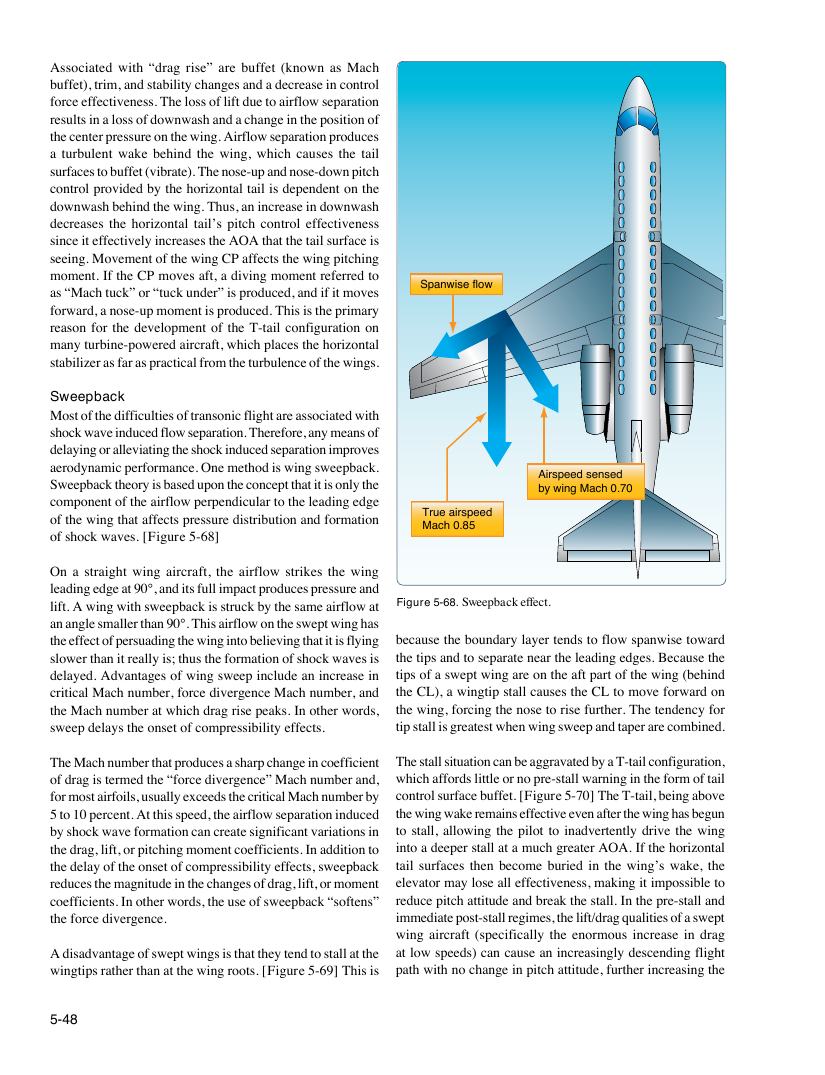
Sweepback
Most of the difficulties of transonic flight are associated with
shock wave induced flow separation. Therefore, any means of
delaying or alleviating the shock induced separation improves
aerodynamic performance. One method is wing sweepback.
Airspeed sensed
Sweepback theory is based upon the concept that it is only the
by wing Mach 0.70
component of the airflow perpendicular to the leading edge
True airspeed
of the wing that affects pressure distribution and formation
Mach 0.85
of shock waves. [Figure 5-68]
On a straight wing aircraft, the airflow strikes the wing
leading edge at 90°, and its full impact produces pressure and
lift. A wing with sweepback is struck by the same airflow at Figure 5-68. Sweepback effect.
an angle smaller than 90°. This airflow on the swept wing has
the effect of persuading the wing into believing that it is flying because the boundary layer tends to flow spanwise toward
slower than it really is; thus the formation of shock waves is the tips and to separate near the leading edges. Because the
delayed. Advantages of wing sweep include an increase in tips of a swept wing are on the aft part of the wing (behind
critical Mach number, force divergence Mach number, and the CL), a wingtip stall causes the CL to move forward on
the Mach number at which drag rise peaks. In other words, the wing, forcing the nose to rise further. The tendency for
sweep delays the onset of compressibility effects. tip stall is greatest when wing sweep and taper are combined.
The Mach number that produces a sharp change in coefficient The stall situation can be aggravated by a T-tail configuration,
of drag is termed the “force divergence” Mach number and, which affords little or no pre-stall warning in the form of tail
for most airfoils, usually exceeds the critical Mach number by control surface buffet. [Figure 5-70] The T-tail, being above
5 to 10 percent. At this speed, the airflow separation induced the wing wake remains effective even after the wing has begun
by shock wave formation can create significant variations in to stall, allowing the pilot to inadvertently drive the wing
the drag, lift, or pitching moment coefficients. In addition to into a deeper stall at a much greater AOA. If the horizontal
the delay of the onset of compressibility effects, sweepback tail surfaces then become buried in the wing’s wake, the
reduces the magnitude in the changes of drag, lift, or moment elevator may lose all effectiveness, making it impossible to
coefficients. In other words, the use of sweepback “softens” reduce pitch attitude and break the stall. In the pre-stall and
the force divergence. immediate post-stall regimes, the lift/drag qualities of a swept
wing aircraft (specifically the enormous increase in drag
A disadvantage of swept wings is that they tend to stall at the at low speeds) can cause an increasingly descending flight
wingtips rather than at the wing roots. [Figure 5-69] This is path with no change in pitch attitude, further increasing the
5-48