FAA-H-8083-25C · Source PDF page 115
Aerodynamics of Flight
Lateral Stability (Rolling) · PHAK page 5-18
Searchable transcription
Dihedral
Some aircraft are designed so that the outer tips of the wings
are higher than the wing roots. The upward angle thus formed
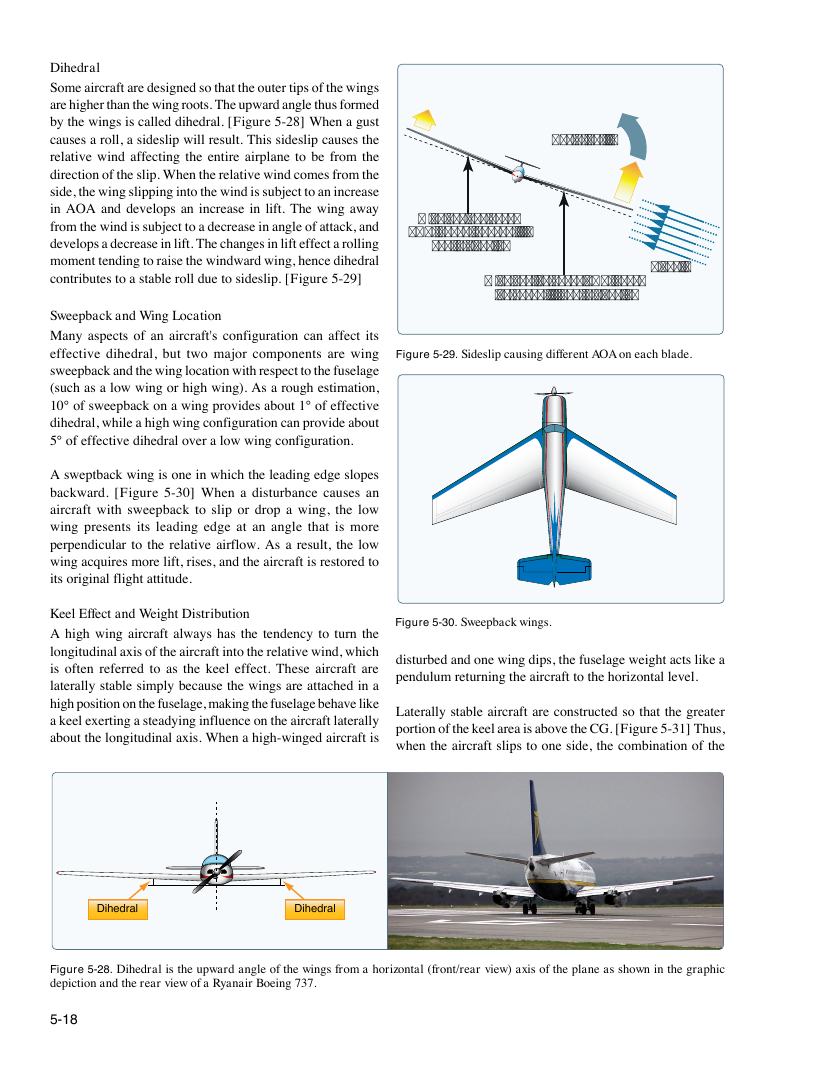
by the wings is called dihedral. [Figure 5-28] When a gust
causes a roll, a sideslip will result. This sideslip causes the Restoring lift
relative wind affecting the entire airplane to be from the
direction of the slip. When the relative wind comes from the
side, the wing slipping into the wind is subject to an increase
in AOA and develops an increase in lift. The wing away
Wing has decreased
from the wind is subject to a decrease in angle of attack, and
AOA, hence reduced lift
develops a decrease in lift. The changes in lift effect a rolling
due to sideslip.
moment tending to raise the windward wing, hence dihedral
Sideslip
contributes to a stable roll due to sideslip. [Figure 5-29]
Wing has increased AOA, hence
increased lift due to sideslip.
Sweepback and Wing Location
Many aspects of an aircraft's configuration can affect its
effective dihedral, but two major components are wing Figure 5-29. Sideslip causing different AOA on each blade.
sweepback and the wing location with respect to the fuselage
(such as a low wing or high wing). As a rough estimation,
10° of sweepback on a wing provides about 1° of effective
dihedral, while a high wing configuration can provide about
5° of effective dihedral over a low wing configuration.
A sweptback wing is one in which the leading edge slopes
backward. [Figure 5-30] When a disturbance causes an
aircraft with sweepback to slip or drop a wing, the low
wing presents its leading edge at an angle that is more
perpendicular to the relative airflow. As a result, the low
wing acquires more lift, rises, and the aircraft is restored to
its original flight attitude.
Keel Effect and Weight Distribution
Figure 5-30. Sweepback wings.
A high wing aircraft always has the tendency to turn the
longitudinal axis of the aircraft into the relative wind, which
disturbed and one wing dips, the fuselage weight acts like a
is often referred to as the keel effect. These aircraft are
pendulum returning the aircraft to the horizontal level.
laterally stable simply because the wings are attached in a
high position on the fuselage, making the fuselage behave like
Laterally stable aircraft are constructed so that the greater
a keel exerting a steadying influence on the aircraft laterally
portion of the keel area is above the CG. [Figure 5-31] Thus,
about the longitudinal axis. When a high-winged aircraft is
when the aircraft slips to one side, the combination of the
Dihedral Dihedral
Figure 5-28. Dihedral is the upward angle of the wings from a horizontal (front/rear view) axis of the plane as shown in the graphic
depiction and the rear view of a Ryanair Boeing 737.
5-18