FAA-H-8083-25C · Source PDF page 132
Aerodynamics of Flight
Load Factors · PHAK page 5-35
Searchable transcription
5
4
3
2
1
0
0 1 2 3 4 5 6 7 8 20 40 60 80 100 120 140 160 180 200 220 240 260
5-35
V
detareleccanu
ot
V
noitarelecca
fo
oitaR
s
s
deeps
llats
detareleccanU
load factor. This means that an aircraft with a normal This speed is called the “design maneuvering speed” (V ),
A
unaccelerated stalling speed of 50 knots can be stalled at 100 which is the speed below which you can move a single
knots by inducing a load factor of 4 Gs. If it were possible flight control, one time, to its full deflection, for one axis
for this aircraft to withstand a load factor of nine, it could of airplane rotation only (pitch, roll or yaw), in smooth
be stalled at a speed of 150 knots. A pilot should be aware air, without risk of damage to the airplane. V must be
A
of the following: entered in the FAA-approved Airplane Flight Manual/
Pilot’s Operating Handbook (AFM/POH) of all recently
• The danger of inadvertently stalling the aircraft by
designed airplanes. For older general aviation airplanes,
increasing the load factor, as in a steep turn or spiral;
this speed is approximately 1.7 times the normal stalling
• When intentionally stalling an aircraft above its
speed. Thus, an older airplane that normally stalls at 60
design maneuvering speed, a tremendous load factor
knots must never be stalled at above 102 knots (60 knots ×
is imposed.
1.7 = 102 knots). An airplane with a normal stalling speed
of 60 knots stalled at 102 knots undergoes a load factor
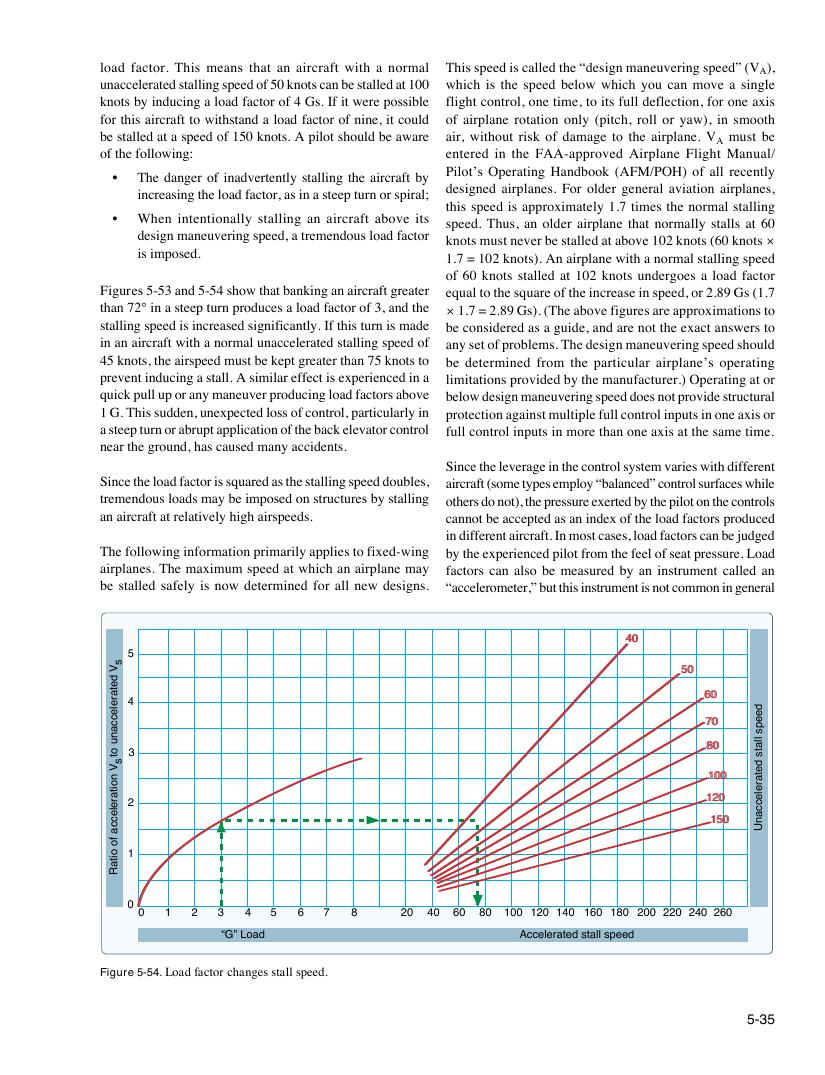
Figures 5-53 and 5-54 show that banking an aircraft greater equal to the square of the increase in speed, or 2.89 Gs (1.7
than 72° in a steep turn produces a load factor of 3, and the × 1.7 = 2.89 Gs). (The above figures are approximations to
stalling speed is increased significantly. If this turn is made be considered as a guide, and are not the exact answers to
in an aircraft with a normal unaccelerated stalling speed of any set of problems. The design maneuvering speed should
45 knots, the airspeed must be kept greater than 75 knots to be determined from the particular airplane’s operating
prevent inducing a stall. A similar effect is experienced in a limitations provided by the manufacturer.) Operating at or
quick pull up or any maneuver producing load factors above below design maneuvering speed does not provide structural
1 G. This sudden, unexpected loss of control, particularly in protection against multiple full control inputs in one axis or
a steep turn or abrupt application of the back elevator control full control inputs in more than one axis at the same time.
near the ground, has caused many accidents.
Since the leverage in the control system varies with different
Since the load factor is squared as the stalling speed doubles, aircraft (some types employ “balanced” control surfaces while
tremendous loads may be imposed on structures by stalling others do not), the pressure exerted by the pilot on the controls
an aircraft at relatively high airspeeds. cannot be accepted as an index of the load factors produced
in different aircraft. In most cases, load factors can be judged
The following information primarily applies to fixed-wing by the experienced pilot from the feel of seat pressure. Load
airplanes. The maximum speed at which an airplane may factors can also be measured by an instrument called an
be stalled safely is now determined for all new designs. “accelerometer,” but this instrument is not common in general
4400
5500
6600
7700
8800
110000
112200
115500
“G” Load Accelerated stall speed
Figure 5-54. Load factor changes stall speed.