FAA-H-8083-25C · Source PDF page 135
Aerodynamics of Flight
Load Factors · PHAK page 5-38
Searchable transcription
7
6
5
4
3
2
1
0
–1
–2
–3
20 40 60 80 100 120 140 160 180 200 220 240
5-38
rotcaf
daoL
Structural damage
Caution range
Indicated airspeed (mph)
Structural
failure
Maneuvering speed
Accelerated
stall
Normal operating range
Normal stall speed
Level flight at 1 G
Structural Damage
Never
exceed
speed
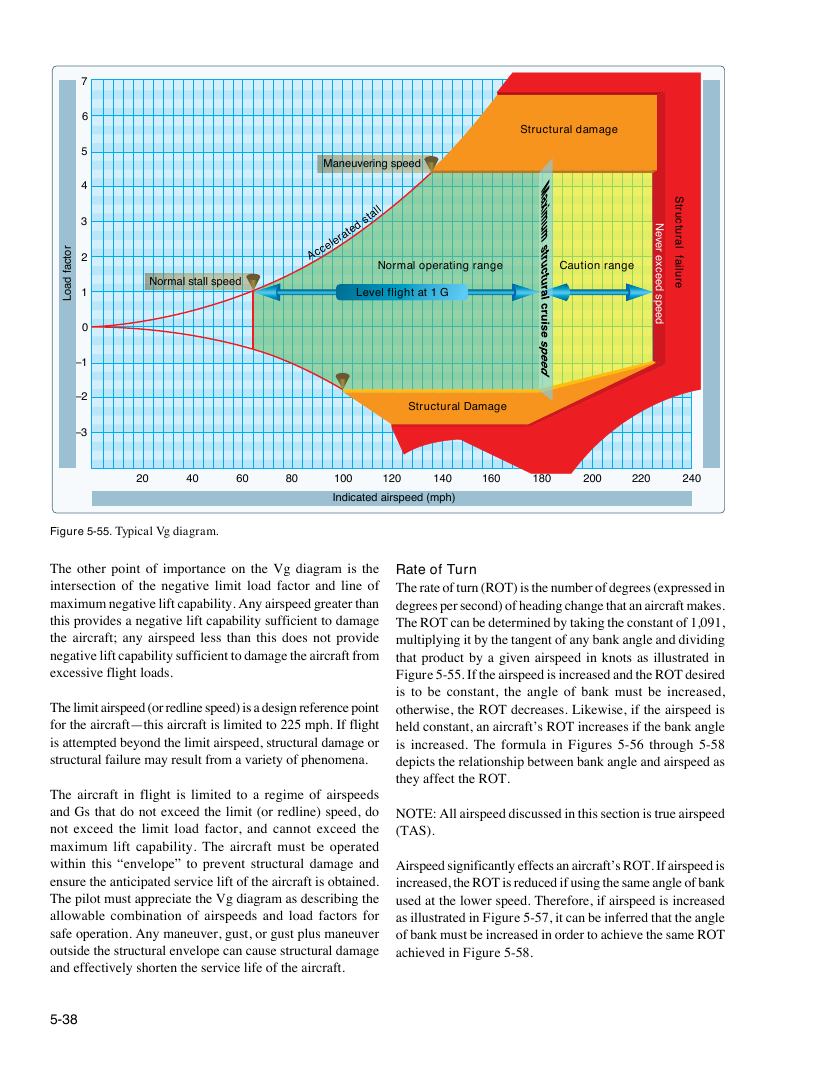
Figure 5-55. Typical Vg diagram.
The other point of importance on the Vg diagram is the Rate of Turn
intersection of the negative limit load factor and line of The rate of turn (ROT) is the number of degrees (expressed in
maximum negative lift capability. Any airspeed greater than degrees per second) of heading change that an aircraft makes.
this provides a negative lift capability sufficient to damage The ROT can be determined by taking the constant of 1,091,
the aircraft; any airspeed less than this does not provide multiplying it by the tangent of any bank angle and dividing
negative lift capability sufficient to damage the aircraft from that product by a given airspeed in knots as illustrated in
excessive flight loads. Figure 5-55. If the airspeed is increased and the ROT desired
is to be constant, the angle of bank must be increased,
The limit airspeed (or redline speed) is a design reference point otherwise, the ROT decreases. Likewise, if the airspeed is
for the aircraft—this aircraft is limited to 225 mph. If flight held constant, an aircraft’s ROT increases if the bank angle
is attempted beyond the limit airspeed, structural damage or is increased. The formula in Figures 5-56 through 5-58
structural failure may result from a variety of phenomena. depicts the relationship between bank angle and airspeed as
they affect the ROT.
The aircraft in flight is limited to a regime of airspeeds
and Gs that do not exceed the limit (or redline) speed, do NOTE: All airspeed discussed in this section is true airspeed
not exceed the limit load factor, and cannot exceed the (TAS).
maximum lift capability. The aircraft must be operated
within this “envelope” to prevent structural damage and Airspeed significantly effects an aircraft’s ROT. If airspeed is
ensure the anticipated service lift of the aircraft is obtained. increased, the ROT is reduced if using the same angle of bank
The pilot must appreciate the Vg diagram as describing the used at the lower speed. Therefore, if airspeed is increased
allowable combination of airspeeds and load factors for as illustrated in Figure 5-57, it can be inferred that the angle
safe operation. Any maneuver, gust, or gust plus maneuver of bank must be increased in order to achieve the same ROT
outside the structural envelope can cause structural damage achieved in Figure 5-58.
and effectively shorten the service life of the aircraft.