FAA-H-8083-25C · Source PDF page 136
Aerodynamics of Flight
Load Factors · PHAK page 5-39
Searchable transcription
1,091 x tangent of the bank angle Example Suppose we wanted to know what bank angle
ROT = would give us a rate of turn of 5.25° per second
airspeed (in knots)
at 240 knots. A slight rearrangement of the formula
Example The rate of turn for an aircraft in a would indicate it will take a 49° angle of bank to
coordinated turn of 30° and traveling at achieve the same ROT used at the lower airspeed
120 knots would have a ROT as follows. of 120 knots.
1,091 x tangent of 30° 1,091 x tangent of X
ROT = ROT (5.25) =
120 knots 240 knots
1,091 x 0.5773 (tangent of 30°) 240 x 5.25 = 1,091 x tangent of X
ROT =
120 knots 240 x 5.25
= tangent of X
1,091
ROT = 5.25 degrees per second 1.1549 = tangent of X
49° = X
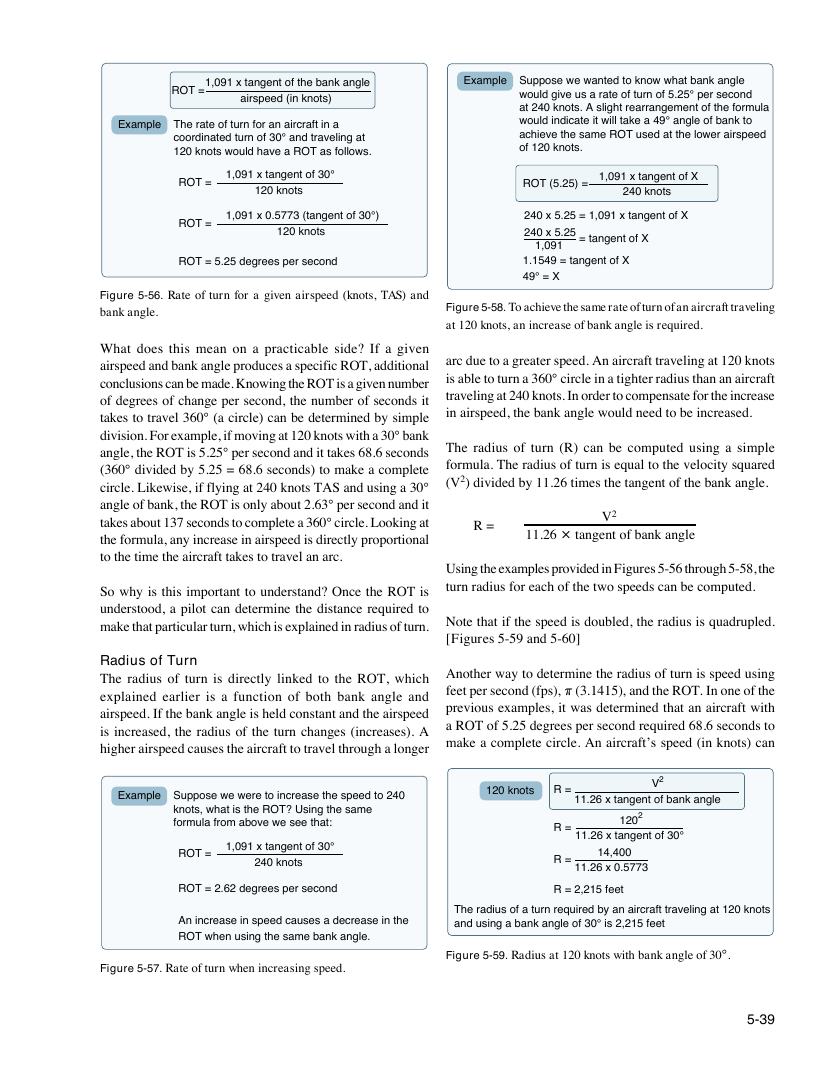
Figure 5-56. Rate of turn for a given airspeed (knots, TAS) and
bank angle. Figure 5-58. To achieve the same rate of turn of an aircraft traveling
at 120 knots, an increase of bank angle is required.
What does this mean on a practicable side? If a given
arc due to a greater speed. An aircraft traveling at 120 knots
airspeed and bank angle produces a specific ROT, additional
is able to turn a 360° circle in a tighter radius than an aircraft
conclusions can be made. Knowing the ROT is a given number
traveling at 240 knots. In order to compensate for the increase
of degrees of change per second, the number of seconds it
in airspeed, the bank angle would need to be increased.
takes to travel 360° (a circle) can be determined by simple
division. For example, if moving at 120 knots with a 30° bank
The radius of turn (R) can be computed using a simple
angle, the ROT is 5.25° per second and it takes 68.6 seconds
formula. The radius of turn is equal to the velocity squared
(360° divided by 5.25 = 68.6 seconds) to make a complete
(V2) divided by 11.26 times the tangent of the bank angle.
circle. Likewise, if flying at 240 knots TAS and using a 30°
angle of bank, the ROT is only about 2.63° per second and it
V2
takes about 137 seconds to complete a 360° circle. Looking at R =
11.26 × tangent of bank angle
the formula, any increase in airspeed is directly proportional
to the time the aircraft takes to travel an arc.
Using the examples provided in Figures 5-56 through 5-58, the
turn radius for each of the two speeds can be computed.
So why is this important to understand? Once the ROT is
understood, a pilot can determine the distance required to
Note that if the speed is doubled, the radius is quadrupled.
make that particular turn, which is explained in radius of turn.
[Figures 5-59 and 5-60]
Radius of Turn
Another way to determine the radius of turn is speed using
The radius of turn is directly linked to the ROT, which
feet per second (fps), π (3.1415), and the ROT. In one of the
explained earlier is a function of both bank angle and
previous examples, it was determined that an aircraft with
airspeed. If the bank angle is held constant and the airspeed
a ROT of 5.25 degrees per second required 68.6 seconds to
is increased, the radius of the turn changes (increases). A
make a complete circle. An aircraft’s speed (in knots) can
higher airspeed causes the aircraft to travel through a longer
120 knots R =
V2
Example Suppose we were to increase the speed to 240 11.26 x tangent of bank angle
knots, what is the ROT? Using the same
formula from above we see that:
1202
R =
11.26 x tangent of 30°
1,091 x tangent of 30°
ROT = 14,400
240 knots R =
11.26 x 0.5773
ROT = 2.62 degrees per second R = 2,215 feet
The radius of a turn required by an aircraft traveling at 120 knots
An increase in speed causes a decrease in the and using a bank angle of 30° is 2,215 feet
ROT when using the same bank angle.
Figure 5-59. Radius at 120 knots with bank angle of 30°.
Figure 5-57. Rate of turn when increasing speed.
5-39