FAA-H-8083-25C · Source PDF page 103
Aerodynamics of Flight
Parasite Drag · PHAK page 5-6
Searchable transcription
lift. Figure 5-6 depicts the L/D by the lowest portion of drag is the easiest to reduce when designing an aircraft. The
MAX
the blue line labeled “total drag.” The configuration of an solution is to streamline as many of the parts as possible.
aircraft has a great effect on the L/D.
Interference Drag
Drag Interference drag comes from the intersection of airstreams
Drag is the force that resists movement of an aircraft through that creates eddy currents, turbulence, or restricts smooth
the air. There are two basic types: parasite drag and induced airflow. For example, the intersection of the wing and the
drag. The first is called parasite because it in no way functions fuselage at the wing root has significant interference drag.
to aid flight, while the second, induced drag, is a result of an Air flowing around the fuselage collides with air flowing over
airfoil developing lift. the wing, merging into a current of air different from the two
original currents. The most interference drag is observed when
Parasite Drag two surfaces meet at perpendicular angles. Fairings are used
Parasite drag is comprised of all the forces that work to slow to reduce this tendency. If a jet fighter carries two identical
an aircraft’s movement. As the term parasite implies, it is the wing tanks, the overall drag is greater than the sum of the
drag that is not associated with the production of lift. This individual tanks because both of these create and generate
includes the displacement of the air by the aircraft, turbulence interference drag. Fairings and distance between lifting
generated in the airstream, or a hindrance of air moving over surfaces and external components (such as radar antennas
the surface of the aircraft and airfoil. There are three types of hung from wings) reduce interference drag. [Figure 5-8]
parasite drag: form drag, interference drag, and skin friction.
Skin Friction Drag
Form Drag Skin friction drag is the aerodynamic resistance due to the
Form drag is the portion of parasite drag generated by the contact of moving air with the surface of an aircraft. Every
aircraft due to its shape and airflow around it. Examples include surface, no matter how apparently smooth, has a rough,
the engine cowlings, antennas, and the aerodynamic shape of ragged surface when viewed under a microscope. The air
other components. When the air has to separate to move around molecules, which come in direct contact with the surface of
a moving aircraft and its components, it eventually rejoins the wing, are virtually motionless. Each layer of molecules
after passing the body. How quickly and smoothly it rejoins is above the surface moves slightly faster until the molecules
representative of the resistance that it creates, which requires are moving at the velocity of the air moving around the
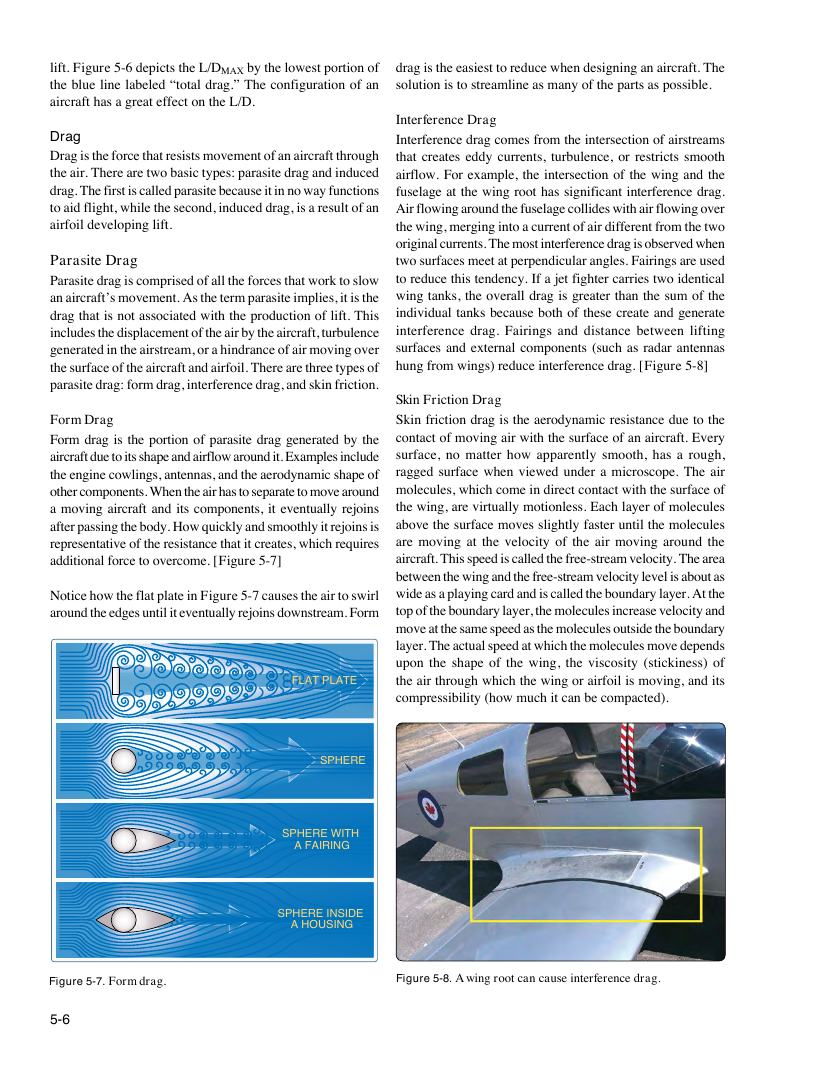
additional force to overcome. [Figure 5-7] aircraft. This speed is called the free-stream velocity. The area
between the wing and the free-stream velocity level is about as
Notice how the flat plate in Figure 5-7 causes the air to swirl wide as a playing card and is called the boundary layer. At the
around the edges until it eventually rejoins downstream. Form top of the boundary layer, the molecules increase velocity and
move at the same speed as the molecules outside the boundary
layer. The actual speed at which the molecules move depends
upon the shape of the wing, the viscosity (stickiness) of
FLAT PLATE the air through which the wing or airfoil is moving, and its
compressibility (how much it can be compacted).
SPHERE
SPHERE WITH
A FAIRING
SPHERE INSIDE
A HOUSING
Figure 5-7. Form drag. Figure 5-8. A wing root can cause interference drag.
5-6