FAA-H-8083-25C · Source PDF page 106
Aerodynamics of Flight
Wingtip Vortices · PHAK page 5-9
Searchable transcription
V
o r t
e x
vortices lead to a particularly dangerous hazard to flight,
wake turbulence.
Avoiding Wake Turbulence
Wingtip vortices are greatest when the generating aircraft is
“heavy, clean, and slow.” This condition is most commonly
encountered during approaches or departures because an
aircraft’s AOA is at the highest to produce the lift necessary
to land or take off. To minimize the chances of flying through
an aircraft’s wake turbulence:
• Avoid flying through another aircraft’s flight path.
• Rotate prior to the point at which the preceding aircraft
rotated when taking off behind another aircraft.
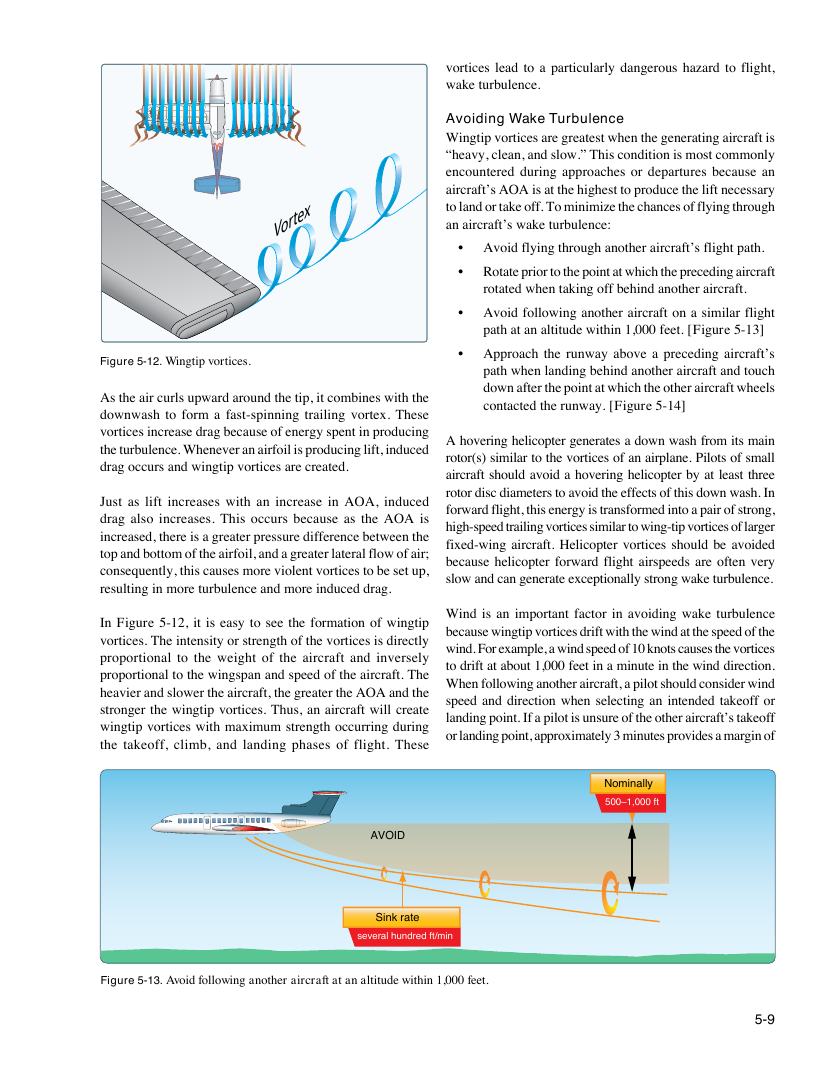
• Avoid following another aircraft on a similar flight
path at an altitude within 1,000 feet. [Figure 5-13]
• Approach the runway above a preceding aircraft’s
Figure 5-12. Wingtip vortices.
path when landing behind another aircraft and touch
down after the point at which the other aircraft wheels
As the air curls upward around the tip, it combines with the
contacted the runway. [Figure 5-14]
downwash to form a fast-spinning trailing vortex. These
vortices increase drag because of energy spent in producing
A hovering helicopter generates a down wash from its main
the turbulence. Whenever an airfoil is producing lift, induced
rotor(s) similar to the vortices of an airplane. Pilots of small
drag occurs and wingtip vortices are created.
aircraft should avoid a hovering helicopter by at least three
rotor disc diameters to avoid the effects of this down wash. In
Just as lift increases with an increase in AOA, induced
forward flight, this energy is transformed into a pair of strong,
drag also increases. This occurs because as the AOA is
high-speed trailing vortices similar to wing-tip vortices of larger
increased, there is a greater pressure difference between the
fixed-wing aircraft. Helicopter vortices should be avoided
top and bottom of the airfoil, and a greater lateral flow of air;
because helicopter forward flight airspeeds are often very
consequently, this causes more violent vortices to be set up,
slow and can generate exceptionally strong wake turbulence.
resulting in more turbulence and more induced drag.
Wind is an important factor in avoiding wake turbulence
In Figure 5-12, it is easy to see the formation of wingtip
because wingtip vortices drift with the wind at the speed of the
vortices. The intensity or strength of the vortices is directly
wind. For example, a wind speed of 10 knots causes the vortices
proportional to the weight of the aircraft and inversely
to drift at about 1,000 feet in a minute in the wind direction.
proportional to the wingspan and speed of the aircraft. The
When following another aircraft, a pilot should consider wind
heavier and slower the aircraft, the greater the AOA and the
speed and direction when selecting an intended takeoff or
stronger the wingtip vortices. Thus, an aircraft will create
landing point. If a pilot is unsure of the other aircraft’s takeoff
wingtip vortices with maximum strength occurring during
or landing point, approximately 3 minutes provides a margin of
the takeoff, climb, and landing phases of flight. These
Nominally
500–1,000 ft
AVOID
Sink rate
several hundred ft/min
Figure 5-13. Avoid following another aircraft at an altitude within 1,000 feet.