FAA-H-8083-25C · Source PDF page 105
Aerodynamics of Flight
Wingtip Vortices · PHAK page 5-8
Searchable transcription
Weight
Gravity is the pulling force that tends to draw all bodies to
the center of the earth. The CG may be considered as a point
at which all the weight of the aircraft is concentrated. If the
aircraft were supported at its exact CG, it would balance in
any attitude. It will be noted that CG is of major importance in
an aircraft, for its position has a great bearing upon stability.
The allowable location of the CG is determined by the general
design of each particular aircraft. The designers determine
how far the center of pressure (CP) will travel. It is important
to understand that an aircraft’s weight is concentrated at the
CG and the aerodynamic forces of lift occur at the CP. When
the CG is forward of the CP, there is a natural tendency for the
aircraft to want to pitch nose down. If the CP is forward of
the CG, a nose up pitching moment is created. Therefore,
designers fix the aft limit of the CG forward of the CP for the
corresponding flight speed in order to retain flight equilibrium.
Weight has a definite relationship to lift. This relationship
is simple, but important in understanding the aerodynamics
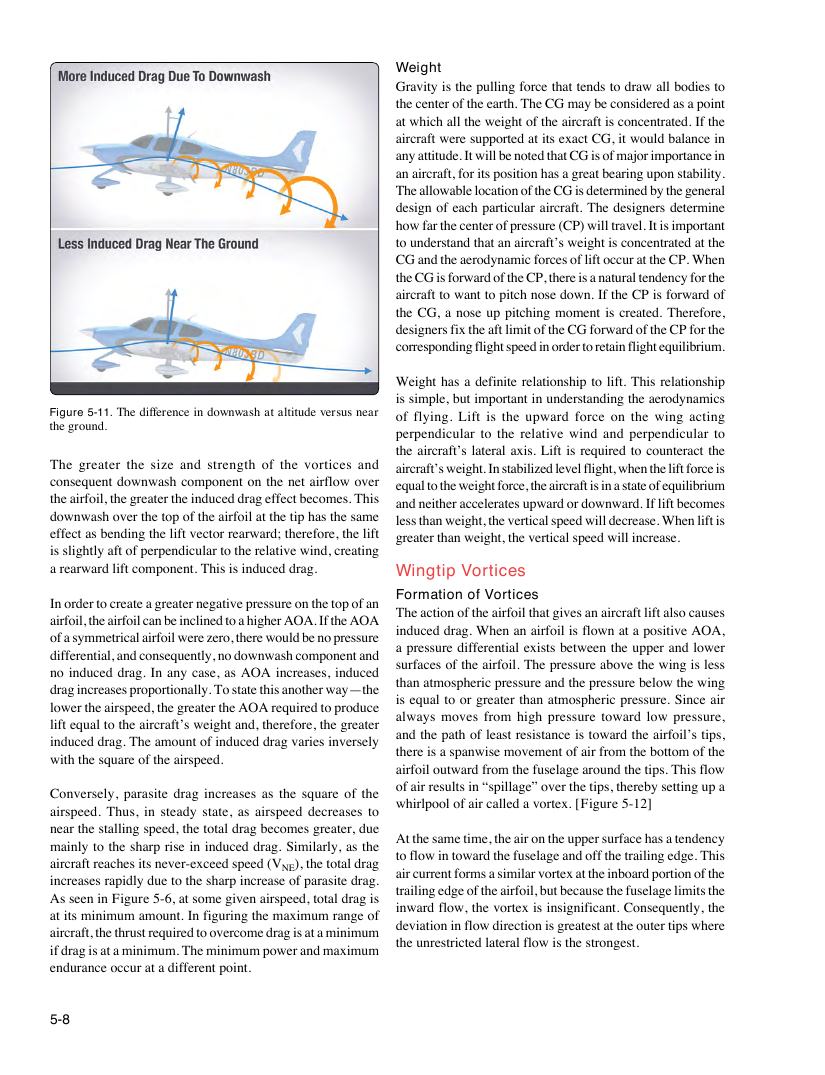
Figure 5-11. The difference in downwash at altitude versus near of flying. Lift is the upward force on the wing acting
the ground.
perpendicular to the relative wind and perpendicular to
the aircraft’s lateral axis. Lift is required to counteract the
The greater the size and strength of the vortices and
aircraft’s weight. In stabilized level flight, when the lift force is
consequent downwash component on the net airflow over
equal to the weight force, the aircraft is in a state of equilibrium
the airfoil, the greater the induced drag effect becomes. This
and neither accelerates upward or downward. If lift becomes
downwash over the top of the airfoil at the tip has the same
less than weight, the vertical speed will decrease. When lift is
effect as bending the lift vector rearward; therefore, the lift
greater than weight, the vertical speed will increase.
is slightly aft of perpendicular to the relative wind, creating
a rearward lift component. This is induced drag. Wingtip Vortices
Formation of Vortices
In order to create a greater negative pressure on the top of an
The action of the airfoil that gives an aircraft lift also causes
airfoil, the airfoil can be inclined to a higher AOA. If the AOA
induced drag. When an airfoil is flown at a positive AOA,
of a symmetrical airfoil were zero, there would be no pressure
a pressure differential exists between the upper and lower
differential, and consequently, no downwash component and
surfaces of the airfoil. The pressure above the wing is less
no induced drag. In any case, as AOA increases, induced
than atmospheric pressure and the pressure below the wing
drag increases proportionally. To state this another way—the
is equal to or greater than atmospheric pressure. Since air
lower the airspeed, the greater the AOA required to produce
always moves from high pressure toward low pressure,
lift equal to the aircraft’s weight and, therefore, the greater
and the path of least resistance is toward the airfoil’s tips,
induced drag. The amount of induced drag varies inversely
there is a spanwise movement of air from the bottom of the
with the square of the airspeed.
airfoil outward from the fuselage around the tips. This flow
of air results in “spillage” over the tips, thereby setting up a
Conversely, parasite drag increases as the square of the
whirlpool of air called a vortex. [Figure 5-12]
airspeed. Thus, in steady state, as airspeed decreases to
near the stalling speed, the total drag becomes greater, due
At the same time, the air on the upper surface has a tendency
mainly to the sharp rise in induced drag. Similarly, as the
to flow in toward the fuselage and off the trailing edge. This
aircraft reaches its never-exceed speed (V ), the total drag
NE air current forms a similar vortex at the inboard portion of the
increases rapidly due to the sharp increase of parasite drag.
trailing edge of the airfoil, but because the fuselage limits the
As seen in Figure 5-6, at some given airspeed, total drag is
inward flow, the vortex is insignificant. Consequently, the
at its minimum amount. In figuring the maximum range of
deviation in flow direction is greatest at the outer tips where
aircraft, the thrust required to overcome drag is at a minimum
the unrestricted lateral flow is the strongest.
if drag is at a minimum. The minimum power and maximum
endurance occur at a different point.
5-8