FAA-H-8083-25C · Source PDF page 164
Aircraft Systems
Aircraft Systems · PHAK page 7-4
Searchable transcription
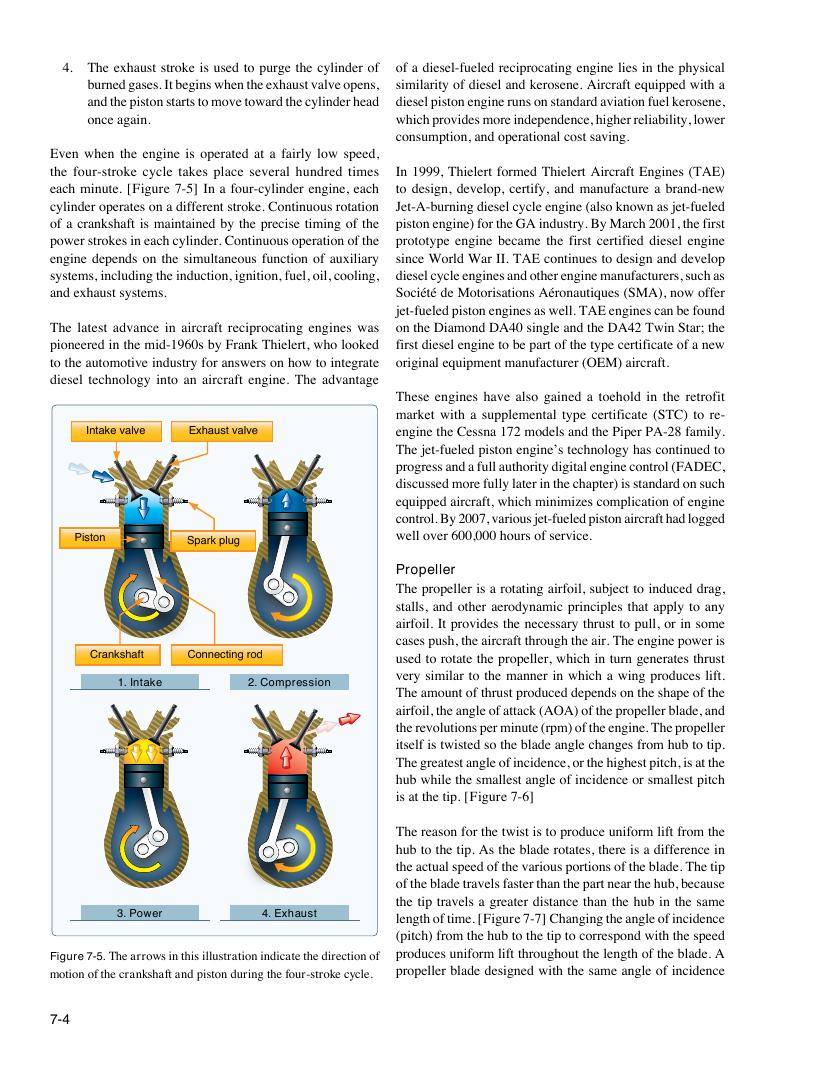
4. The exhaust stroke is used to purge the cylinder of of a diesel-fueled reciprocating engine lies in the physical
burned gases. It begins when the exhaust valve opens, similarity of diesel and kerosene. Aircraft equipped with a
and the piston starts to move toward the cylinder head diesel piston engine runs on standard aviation fuel kerosene,
once again. which provides more independence, higher reliability, lower
consumption, and operational cost saving.
Even when the engine is operated at a fairly low speed,
the four-stroke cycle takes place several hundred times In 1999, Thielert formed Thielert Aircraft Engines (TAE)
each minute. [Figure 7-5] In a four-cylinder engine, each to design, develop, certify, and manufacture a brand-new
cylinder operates on a different stroke. Continuous rotation Jet-A-burning diesel cycle engine (also known as jet-fueled
of a crankshaft is maintained by the precise timing of the piston engine) for the GA industry. By March 2001, the first
power strokes in each cylinder. Continuous operation of the prototype engine became the first certified diesel engine
engine depends on the simultaneous function of auxiliary since World War II. TAE continues to design and develop
systems, including the induction, ignition, fuel, oil, cooling, diesel cycle engines and other engine manufacturers, such as
and exhaust systems. Société de Motorisations Aéronautiques (SMA), now offer
jet-fueled piston engines as well. TAE engines can be found
The latest advance in aircraft reciprocating engines was on the Diamond DA40 single and the DA42 Twin Star; the
pioneered in the mid-1960s by Frank Thielert, who looked first diesel engine to be part of the type certificate of a new
to the automotive industry for answers on how to integrate original equipment manufacturer (OEM) aircraft.
diesel technology into an aircraft engine. The advantage
These engines have also gained a toehold in the retrofit
market with a supplemental type certificate (STC) to re-
Intake valve Exhaust valve engine the Cessna 172 models and the Piper PA-28 family.
The jet-fueled piston engine’s technology has continued to
progress and a full authority digital engine control (FADEC,
discussed more fully later in the chapter) is standard on such
equipped aircraft, which minimizes complication of engine
control. By 2007, various jet-fueled piston aircraft had logged
Piston Spark plug well over 600,000 hours of service.
Propeller
The propeller is a rotating airfoil, subject to induced drag,
stalls, and other aerodynamic principles that apply to any
airfoil. It provides the necessary thrust to pull, or in some
cases push, the aircraft through the air. The engine power is
Crankshaft Connecting rod used to rotate the propeller, which in turn generates thrust
very similar to the manner in which a wing produces lift.
1. Intake 2. Compression
The amount of thrust produced depends on the shape of the
airfoil, the angle of attack (AOA) of the propeller blade, and
the revolutions per minute (rpm) of the engine. The propeller
itself is twisted so the blade angle changes from hub to tip.
The greatest angle of incidence, or the highest pitch, is at the
hub while the smallest angle of incidence or smallest pitch
is at the tip. [Figure 7-6]
The reason for the twist is to produce uniform lift from the
hub to the tip. As the blade rotates, there is a difference in
the actual speed of the various portions of the blade. The tip
of the blade travels faster than the part near the hub, because
the tip travels a greater distance than the hub in the same
3. Power 4. Exhaust length of time. [Figure 7-7] Changing the angle of incidence
(pitch) from the hub to the tip to correspond with the speed
Figure 7-5. The arrows in this illustration indicate the direction of produces uniform lift throughout the length of the blade. A
motion of the crankshaft and piston during the four-stroke cycle. propeller blade designed with the same angle of incidence
7-4