FAA-H-8083-25C · Source PDF page 171
Aircraft Systems
Carburetor Air Temperature Gauge · PHAK page 7-11
Searchable transcription
Since the use of carburetor heat tends to reduce the output Celsius and Fahrenheit. It provides the outside or ambient
of the engine and to increase the operating temperature, air temperature for calculating true airspeed and is useful in
carburetor heat should not be used when full power is required detecting potential icing conditions.
(as during takeoff) or during normal engine operation, except
to check for the presence of, or to remove, carburetor ice. Fuel Injection Systems
In a fuel injection system, the fuel is injected directly into
Carburetor Air Temperature Gauge the cylinders, or just ahead of the intake valve. The air
Some aircraft are equipped with a carburetor air temperature intake for the fuel injection system is similar to that used
gauge, which is useful in detecting potential icing conditions. in a carburetor system, with an alternate air source located
Usually, the face of the gauge is calibrated in degrees Celsius within the engine cowling. This source is used if the external
with a yellow arc indicating the carburetor air temperatures air source is obstructed. The alternate air source is usually
where icing may occur. This yellow arc typically ranges operated automatically, with a backup manual system that
between –15 °C and +5 °C (5 °F and 41 °F). If the air can be used if the automatic feature malfunctions.
temperature and moisture content of the air are such that
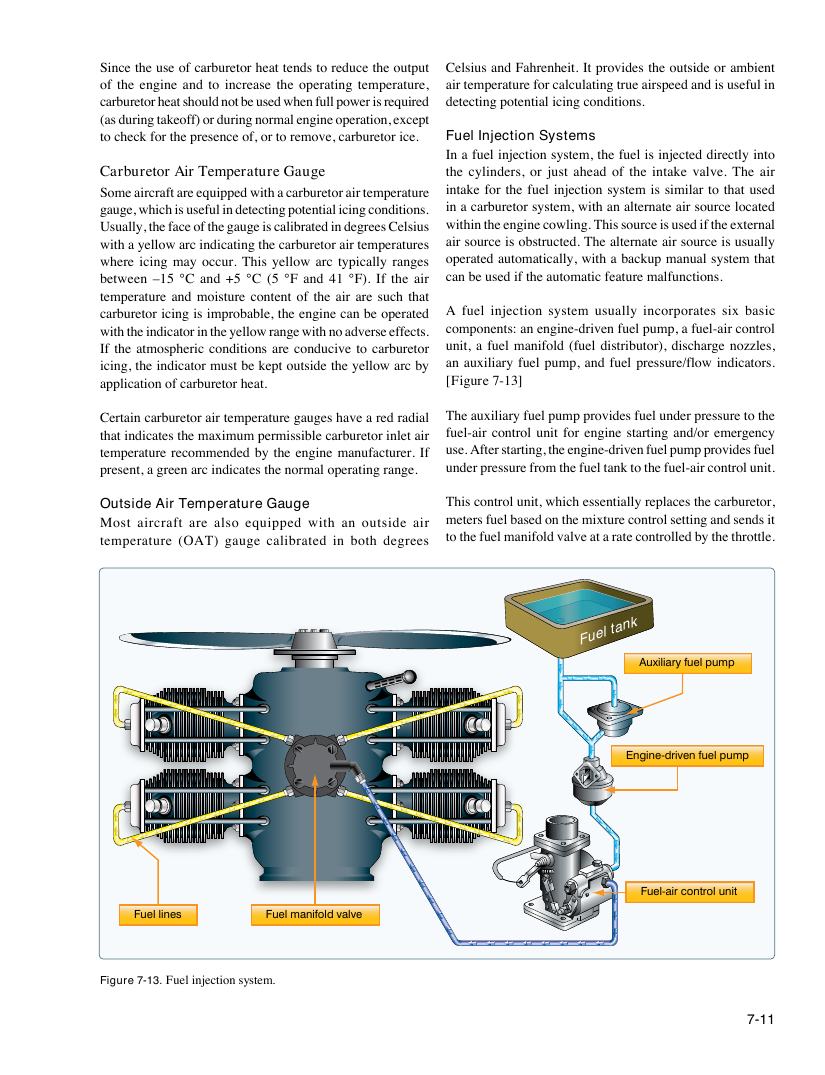
carburetor icing is improbable, the engine can be operated A fuel injection system usually incorporates six basic
with the indicator in the yellow range with no adverse effects. components: an engine-driven fuel pump, a fuel-air control
If the atmospheric conditions are conducive to carburetor unit, a fuel manifold (fuel distributor), discharge nozzles,
icing, the indicator must be kept outside the yellow arc by an auxiliary fuel pump, and fuel pressure/flow indicators.
application of carburetor heat. [Figure 7-13]
Certain carburetor air temperature gauges have a red radial The auxiliary fuel pump provides fuel under pressure to the
that indicates the maximum permissible carburetor inlet air fuel-air control unit for engine starting and/or emergency
temperature recommended by the engine manufacturer. If use. After starting, the engine-driven fuel pump provides fuel
present, a green arc indicates the normal operating range. under pressure from the fuel tank to the fuel-air control unit.
Outside Air Temperature Gauge This control unit, which essentially replaces the carburetor,
Most aircraft are also equipped with an outside air meters fuel based on the mixture control setting and sends it
temperature (OAT) gauge calibrated in both degrees to the fuel manifold valve at a rate controlled by the throttle.
Fuel
tank
Auxiliary fuel pump
Engine-driven fuel pump
Fuel-air control unit
Fuel lines Fuel manifold valve
Figure 7-13. Fuel injection system.
7-11