FAA-H-8083-25C · Source PDF page 170
Aircraft Systems
Carburetor Heat · PHAK page 7-10
Searchable transcription
ytidimuh
evitaleR
Celsius degrees) (Remember there are 180 Fahrenheit degrees presence. If detected, full carburetor heat should be applied
from freezing to boiling versus 100 degrees for the Celsius immediately, and it should be left in the ON position until
scale.) Therefore, an outside air temperature of 100 F (38 C), the pilot is certain that all the ice has been removed. If ice
a temperature drop of an absolute 70 F degrees (38.89 Celsius is present, applying partial heat or leaving heat on for an
degrees) results in an air temperature in the carburetor of 30 insufficient time might aggravate the situation. In extreme
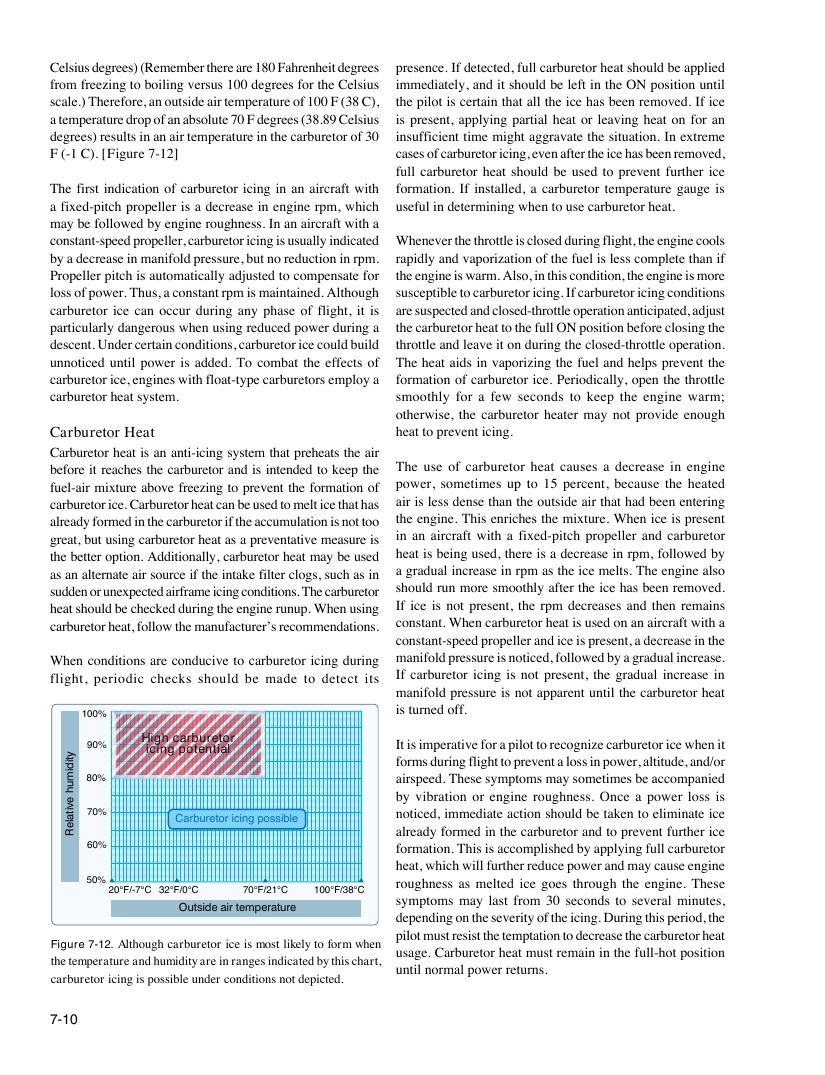
F (-1 C). [Figure 7-12] cases of carburetor icing, even after the ice has been removed,
full carburetor heat should be used to prevent further ice
The first indication of carburetor icing in an aircraft with formation. If installed, a carburetor temperature gauge is
a fixed-pitch propeller is a decrease in engine rpm, which useful in determining when to use carburetor heat.
may be followed by engine roughness. In an aircraft with a
constant-speed propeller, carburetor icing is usually indicated Whenever the throttle is closed during flight, the engine cools
by a decrease in manifold pressure, but no reduction in rpm. rapidly and vaporization of the fuel is less complete than if
Propeller pitch is automatically adjusted to compensate for the engine is warm. Also, in this condition, the engine is more
loss of power. Thus, a constant rpm is maintained. Although susceptible to carburetor icing. If carburetor icing conditions
carburetor ice can occur during any phase of flight, it is are suspected and closed-throttle operation anticipated, adjust
particularly dangerous when using reduced power during a the carburetor heat to the full ON position before closing the
descent. Under certain conditions, carburetor ice could build throttle and leave it on during the closed-throttle operation.
unnoticed until power is added. To combat the effects of The heat aids in vaporizing the fuel and helps prevent the
carburetor ice, engines with float-type carburetors employ a formation of carburetor ice. Periodically, open the throttle
carburetor heat system. smoothly for a few seconds to keep the engine warm;
otherwise, the carburetor heater may not provide enough
Carburetor Heat heat to prevent icing.
Carburetor heat is an anti-icing system that preheats the air
before it reaches the carburetor and is intended to keep the The use of carburetor heat causes a decrease in engine
fuel-air mixture above freezing to prevent the formation of power, sometimes up to 15 percent, because the heated
carburetor ice. Carburetor heat can be used to melt ice that has air is less dense than the outside air that had been entering
already formed in the carburetor if the accumulation is not too the engine. This enriches the mixture. When ice is present
great, but using carburetor heat as a preventative measure is in an aircraft with a fixed-pitch propeller and carburetor
the better option. Additionally, carburetor heat may be used heat is being used, there is a decrease in rpm, followed by
as an alternate air source if the intake filter clogs, such as in a gradual increase in rpm as the ice melts. The engine also
sudden or unexpected airframe icing conditions. The carburetor should run more smoothly after the ice has been removed.
heat should be checked during the engine runup. When using If ice is not present, the rpm decreases and then remains
carburetor heat, follow the manufacturer’s recommendations. constant. When carburetor heat is used on an aircraft with a
constant-speed propeller and ice is present, a decrease in the
When conditions are conducive to carburetor icing during manifold pressure is noticed, followed by a gradual increase.
flight, periodic checks should be made to detect its If carburetor icing is not present, the gradual increase in
manifold pressure is not apparent until the carburetor heat
is turned off.
100%
High carburetor
90% icing potential It is imperative for a pilot to recognize carburetor ice when it
forms during flight to prevent a loss in power, altitude, and/or
80% airspeed. These symptoms may sometimes be accompanied
by vibration or engine roughness. Once a power loss is
70% noticed, immediate action should be taken to eliminate ice
Carburetor icing possible
already formed in the carburetor and to prevent further ice
60% formation. This is accomplished by applying full carburetor
heat, which will further reduce power and may cause engine
50% roughness as melted ice goes through the engine. These
20°F/-7°C 32°F/0°C 70°F/21°C 100°F/38°C
symptoms may last from 30 seconds to several minutes,
Outside air temperature
depending on the severity of the icing. During this period, the
pilot must resist the temptation to decrease the carburetor heat
Figure 7-12. Although carburetor ice is most likely to form when
usage. Carburetor heat must remain in the full-hot position
the temperature and humidity are in ranges indicated by this chart,
until normal power returns.
carburetor icing is possible under conditions not depicted.