FAA-H-8083-25C · Source PDF page 201
Aircraft Systems
Chapter Summary · PHAK page 7-41
Searchable transcription
as a weeping wing. The weeping-wing design uses small inboard and the outboard sections. The boots are imbedded
holes located in the leading edge of the wing to prevent with electrical wires that carry current for heating the
the formation and build-up of ice. An antifreeze solution propeller. The prop anti-ice system can be monitored for
is pumped to the leading edge and weeps out through the proper operation by monitoring the prop anti-ice ammeter.
holes. Additionally, the weeping wing is capable of deicing During the preflight inspection, check the propeller boots for
an aircraft. When ice has accumulated on the leading edges, proper operation. If a boot fails to heat one blade, an unequal
application of the antifreeze solution chemically breaks down blade loading can result and may cause severe propeller
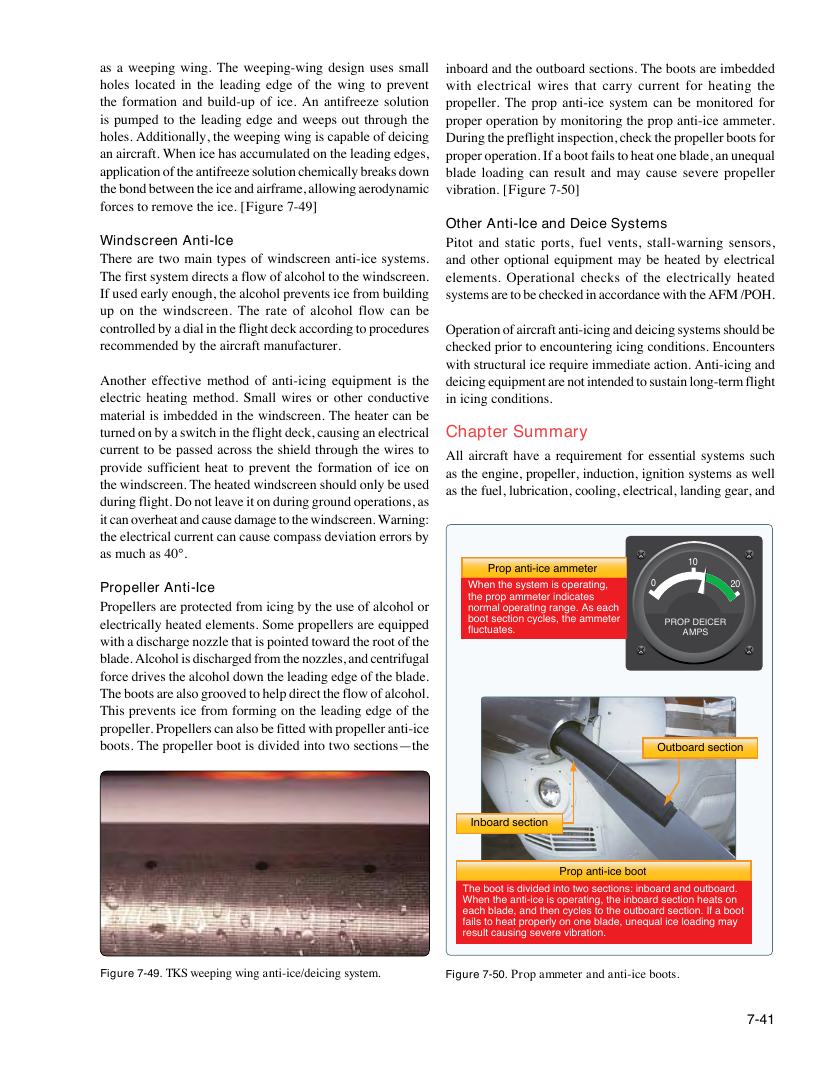
the bond between the ice and airframe, allowing aerodynamic vibration. [Figure 7-50]
forces to remove the ice. [Figure 7-49]
Other Anti-Ice and Deice Systems
Windscreen Anti-Ice Pitot and static ports, fuel vents, stall-warning sensors,
There are two main types of windscreen anti-ice systems. and other optional equipment may be heated by electrical
The first system directs a flow of alcohol to the windscreen. elements. Operational checks of the electrically heated
If used early enough, the alcohol prevents ice from building systems are to be checked in accordance with the AFM /POH.
up on the windscreen. The rate of alcohol flow can be
controlled by a dial in the flight deck according to procedures Operation of aircraft anti-icing and deicing systems should be
recommended by the aircraft manufacturer. checked prior to encountering icing conditions. Encounters
with structural ice require immediate action. Anti-icing and
Another effective method of anti-icing equipment is the deicing equipment are not intended to sustain long-term flight
electric heating method. Small wires or other conductive in icing conditions.
material is imbedded in the windscreen. The heater can be
turned on by a switch in the flight deck, causing an electrical Chapter Summary
current to be passed across the shield through the wires to
All aircraft have a requirement for essential systems such
provide sufficient heat to prevent the formation of ice on
as the engine, propeller, induction, ignition systems as well
the windscreen. The heated windscreen should only be used
as the fuel, lubrication, cooling, electrical, landing gear, and
during flight. Do not leave it on during ground operations, as
it can overheat and cause damage to the windscreen. Warning:
the electrical current can cause compass deviation errors by
as much as 40°.
10
Prop anti-ice ammeter
Propeller Anti-Ice When the system is operating, 0 20
the prop ammeter indicates
Propellers are protected from icing by the use of alcohol or normal operating range. As each
electrically heated elements. Some propellers are equipped boot section cycles, the ammeter PROP DEICER
fluctuates. AMPS
with a discharge nozzle that is pointed toward the root of the
blade. Alcohol is discharged from the nozzles, and centrifugal
force drives the alcohol down the leading edge of the blade.
The boots are also grooved to help direct the flow of alcohol.
This prevents ice from forming on the leading edge of the
propeller. Propellers can also be fitted with propeller anti-ice
boots. The propeller boot is divided into two sections—the Outboard section
Inboard section
Prop anti-ice boot
The boot is divided into two sections: inboard and outboard.
When the anti-ice is operating, the inboard section heats on
each blade, and then cycles to the outboard section. If a boot
fails to heat properly on one blade, unequal ice loading may
result causing severe vibration.
Figure 7-49. TKS weeping wing anti-ice/deicing system. Figure 7-50. Prop ammeter and anti-ice boots.
7-41