FAA-H-8083-25C · Source PDF page 168
Aircraft Systems
Propeller Overspeed in Piston Engine Aircraft · PHAK page 7-8
Searchable transcription
Two types of induction systems are commonly used in small fuel to flow through a main fuel jet located at the throat. The
aircraft engines: fuel then flows into the airstream where it is mixed with the
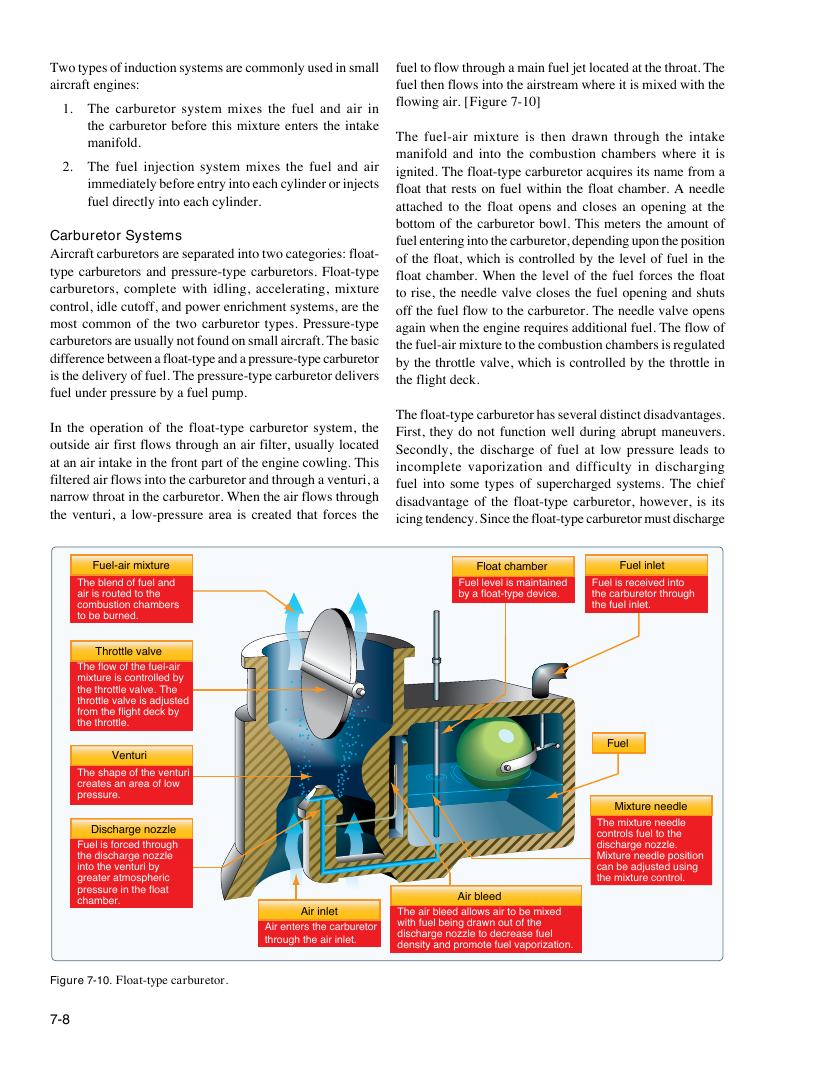
flowing air. [Figure 7-10]
1. The carburetor system mixes the fuel and air in
the carburetor before this mixture enters the intake
The fuel-air mixture is then drawn through the intake
manifold.
manifold and into the combustion chambers where it is
2. The fuel injection system mixes the fuel and air
ignited. The float-type carburetor acquires its name from a
immediately before entry into each cylinder or injects
float that rests on fuel within the float chamber. A needle
fuel directly into each cylinder.
attached to the float opens and closes an opening at the
bottom of the carburetor bowl. This meters the amount of
Carburetor Systems fuel entering into the carburetor, depending upon the position
Aircraft carburetors are separated into two categories: float- of the float, which is controlled by the level of fuel in the
type carburetors and pressure-type carburetors. Float-type float chamber. When the level of the fuel forces the float
carburetors, complete with idling, accelerating, mixture to rise, the needle valve closes the fuel opening and shuts
control, idle cutoff, and power enrichment systems, are the off the fuel flow to the carburetor. The needle valve opens
most common of the two carburetor types. Pressure-type again when the engine requires additional fuel. The flow of
carburetors are usually not found on small aircraft. The basic the fuel-air mixture to the combustion chambers is regulated
difference between a float-type and a pressure-type carburetor by the throttle valve, which is controlled by the throttle in
is the delivery of fuel. The pressure-type carburetor delivers the flight deck.
fuel under pressure by a fuel pump.
The float-type carburetor has several distinct disadvantages.
In the operation of the float-type carburetor system, the First, they do not function well during abrupt maneuvers.
outside air first flows through an air filter, usually located Secondly, the discharge of fuel at low pressure leads to
at an air intake in the front part of the engine cowling. This incomplete vaporization and difficulty in discharging
filtered air flows into the carburetor and through a venturi, a fuel into some types of supercharged systems. The chief
narrow throat in the carburetor. When the air flows through disadvantage of the float-type carburetor, however, is its
the venturi, a low-pressure area is created that forces the icing tendency. Since the float-type carburetor must discharge
Fuel-air mixture Float chamber Fuel inlet
The blend of fuel and Fuel level is maintained Fuel is received into
air is routed to the by a float-type device. the carburetor through
combustion chambers the fuel inlet.
to be burned.
Throttle valve
The flow of the fuel-air
mixture is controlled by
the throttle valve. The
throttle valve is adjusted
from the flight deck by
the throttle.
Fuel
Venturi
The shape of the venturi
creates an area of low
pressure.
Mixture needle
The mixture needle
Discharge nozzle
controls fuel to the
Fuel is forced through discharge nozzle.
the discharge nozzle Mixture needle position
into the venturi by can be adjusted using
greater atmospheric the mixture control.
pressure in the float
Air bleed
chamber.
Air inlet The air bleed allows air to be mixed
Air enters the carburetor with fuel being drawn out of the
discharge nozzle to decrease fuel
through the air inlet.
density and promote fuel vaporization.
Figure 7-10. Float-type carburetor.
7-8