FAA-H-8083-25C · Source PDF page 169
Aircraft Systems
Carburetor Icing · PHAK page 7-9
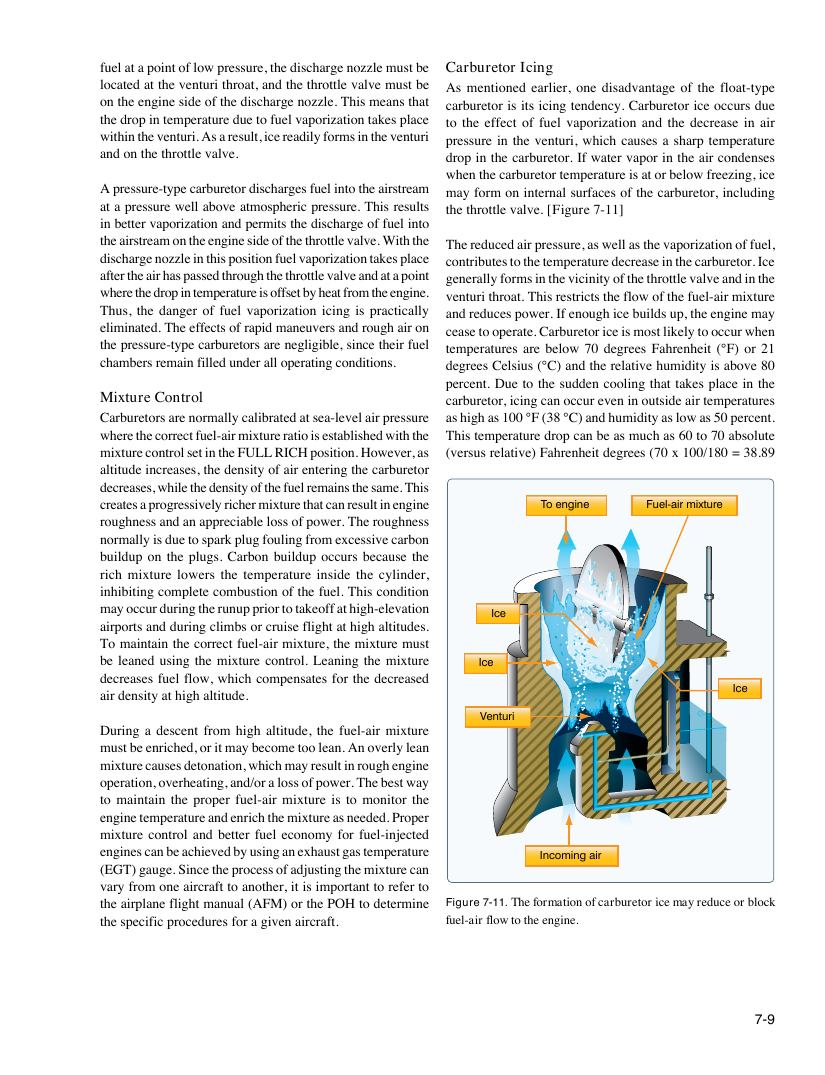
Searchable transcription
fuel at a point of low pressure, the discharge nozzle must be Carburetor Icing
located at the venturi throat, and the throttle valve must be As mentioned earlier, one disadvantage of the float-type
on the engine side of the discharge nozzle. This means that carburetor is its icing tendency. Carburetor ice occurs due
the drop in temperature due to fuel vaporization takes place to the effect of fuel vaporization and the decrease in air
within the venturi. As a result, ice readily forms in the venturi pressure in the venturi, which causes a sharp temperature
and on the throttle valve. drop in the carburetor. If water vapor in the air condenses
when the carburetor temperature is at or below freezing, ice
A pressure-type carburetor discharges fuel into the airstream may form on internal surfaces of the carburetor, including
at a pressure well above atmospheric pressure. This results the throttle valve. [Figure 7-11]
in better vaporization and permits the discharge of fuel into
the airstream on the engine side of the throttle valve. With the The reduced air pressure, as well as the vaporization of fuel,
discharge nozzle in this position fuel vaporization takes place contributes to the temperature decrease in the carburetor. Ice
after the air has passed through the throttle valve and at a point generally forms in the vicinity of the throttle valve and in the
where the drop in temperature is offset by heat from the engine. venturi throat. This restricts the flow of the fuel-air mixture
Thus, the danger of fuel vaporization icing is practically and reduces power. If enough ice builds up, the engine may
eliminated. The effects of rapid maneuvers and rough air on cease to operate. Carburetor ice is most likely to occur when
the pressure-type carburetors are negligible, since their fuel temperatures are below 70 degrees Fahrenheit (°F) or 21
chambers remain filled under all operating conditions. degrees Celsius (°C) and the relative humidity is above 80
percent. Due to the sudden cooling that takes place in the
Mixture Control carburetor, icing can occur even in outside air temperatures
Carburetors are normally calibrated at sea-level air pressure as high as 100 °F (38 °C) and humidity as low as 50 percent.
where the correct fuel-air mixture ratio is established with the This temperature drop can be as much as 60 to 70 absolute
mixture control set in the FULL RICH position. However, as (versus relative) Fahrenheit degrees (70 x 100/180 = 38.89
altitude increases, the density of air entering the carburetor
decreases, while the density of the fuel remains the same. This
creates a progressively richer mixture that can result in engine To engine Fuel-air mixture
roughness and an appreciable loss of power. The roughness
normally is due to spark plug fouling from excessive carbon
buildup on the plugs. Carbon buildup occurs because the
rich mixture lowers the temperature inside the cylinder,
inhibiting complete combustion of the fuel. This condition
may occur during the runup prior to takeoff at high-elevation
Ice
airports and during climbs or cruise flight at high altitudes.
To maintain the correct fuel-air mixture, the mixture must
be leaned using the mixture control. Leaning the mixture Ice
decreases fuel flow, which compensates for the decreased
Ice
air density at high altitude.
Venturi
During a descent from high altitude, the fuel-air mixture
must be enriched, or it may become too lean. An overly lean
mixture causes detonation, which may result in rough engine
operation, overheating, and/or a loss of power. The best way
to maintain the proper fuel-air mixture is to monitor the
engine temperature and enrich the mixture as needed. Proper
mixture control and better fuel economy for fuel-injected
engines can be achieved by using an exhaust gas temperature
Incoming air
(EGT) gauge. Since the process of adjusting the mixture can
vary from one aircraft to another, it is important to refer to
the airplane flight manual (AFM) or the POH to determine Figure 7-11. The formation of carburetor ice may reduce or block
the specific procedures for a given aircraft. fuel-air flow to the engine.
7-9