FAA-H-8083-25C · Source PDF page 174
Aircraft Systems
System Operation · PHAK page 7-14
Searchable transcription
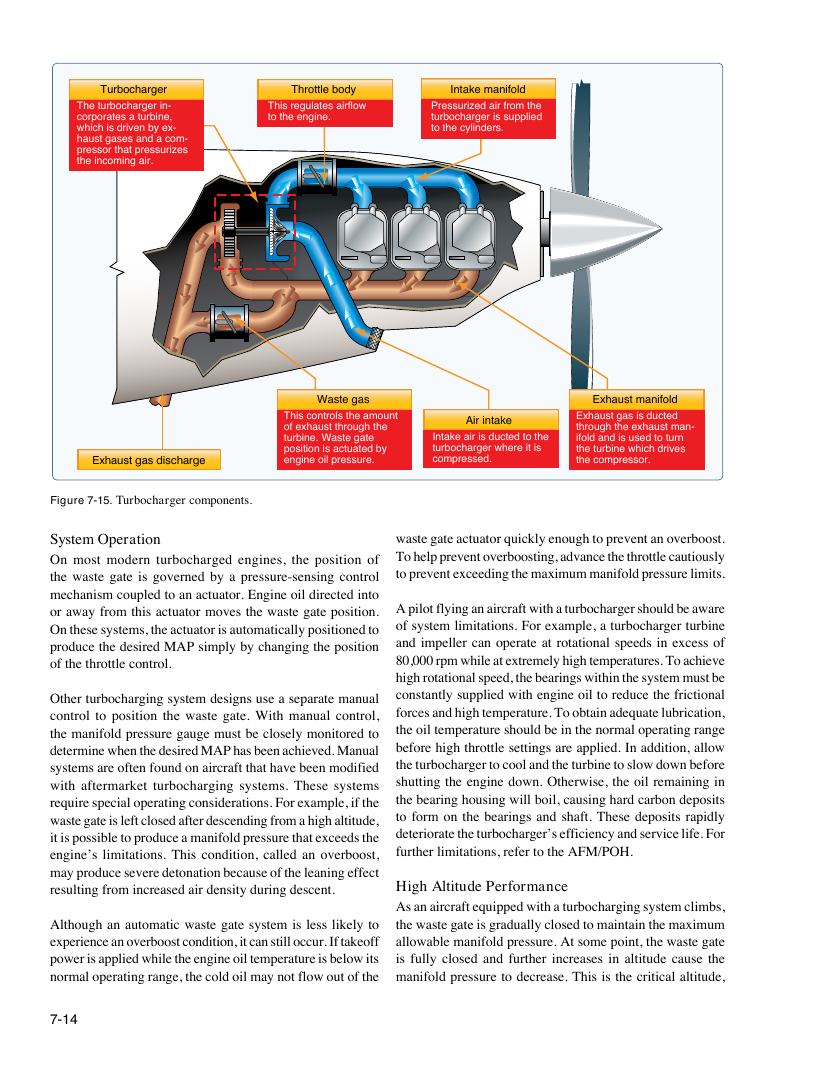
Turbocharger Throttle body Intake manifold
The turbocharger in- This regulates airflow Pressurized air from the
corporates a turbine, to the engine. turbocharger is supplied
which is driven by ex- to the cylinders.
haust gases and a com-
pressor that pressurizes
the incoming air.
Waste gas Exhaust manifold
This controls the amount Exhaust gas is ducted
Air intake
of exhaust through the through the exhaust man-
turbine. Waste gate Intake air is ducted to the ifold and is used to turn
position is actuated by turbocharger where it is the turbine which drives
Exhaust gas discharge engine oil pressure. compressed. the compressor.
Figure 7-15. Turbocharger components.
System Operation waste gate actuator quickly enough to prevent an overboost.
On most modern turbocharged engines, the position of To help prevent overboosting, advance the throttle cautiously
the waste gate is governed by a pressure-sensing control to prevent exceeding the maximum manifold pressure limits.
mechanism coupled to an actuator. Engine oil directed into
or away from this actuator moves the waste gate position. A pilot flying an aircraft with a turbocharger should be aware
On these systems, the actuator is automatically positioned to of system limitations. For example, a turbocharger turbine
produce the desired MAP simply by changing the position and impeller can operate at rotational speeds in excess of
of the throttle control. 80,000 rpm while at extremely high temperatures. To achieve
high rotational speed, the bearings within the system must be
Other turbocharging system designs use a separate manual constantly supplied with engine oil to reduce the frictional
control to position the waste gate. With manual control, forces and high temperature. To obtain adequate lubrication,
the manifold pressure gauge must be closely monitored to the oil temperature should be in the normal operating range
determine when the desired MAP has been achieved. Manual before high throttle settings are applied. In addition, allow
systems are often found on aircraft that have been modified the turbocharger to cool and the turbine to slow down before
with aftermarket turbocharging systems. These systems shutting the engine down. Otherwise, the oil remaining in
require special operating considerations. For example, if the the bearing housing will boil, causing hard carbon deposits
waste gate is left closed after descending from a high altitude, to form on the bearings and shaft. These deposits rapidly
it is possible to produce a manifold pressure that exceeds the deteriorate the turbocharger’s efficiency and service life. For
engine’s limitations. This condition, called an overboost, further limitations, refer to the AFM/POH.
may produce severe detonation because of the leaning effect
resulting from increased air density during descent. High Altitude Performance
As an aircraft equipped with a turbocharging system climbs,
Although an automatic waste gate system is less likely to the waste gate is gradually closed to maintain the maximum
experience an overboost condition, it can still occur. If takeoff allowable manifold pressure. At some point, the waste gate
power is applied while the engine oil temperature is below its is fully closed and further increases in altitude cause the
normal operating range, the cold oil may not flow out of the manifold pressure to decrease. This is the critical altitude,
7-14