FAA-H-8083-25C · Source PDF page 209
Flight Instruments
Principle of Operation · PHAK page 8-7
Searchable transcription
3. Absolute altitude—the vertical distance of an aircraft Vertical Speed Indicator (VSI)
above the terrain, or above ground level (AGL). The VSI, which is sometimes called a vertical velocity
indicator (VVI), indicates whether the aircraft is climbing,
4. Pressure altitude—the altitude indicated when
descending, or in level flight. The rate of climb or descent is
the altimeter setting window (barometric scale) is
indicated in feet per minute (fpm). If properly calibrated, the
adjusted to 29.92 "Hg. This is the altitude above
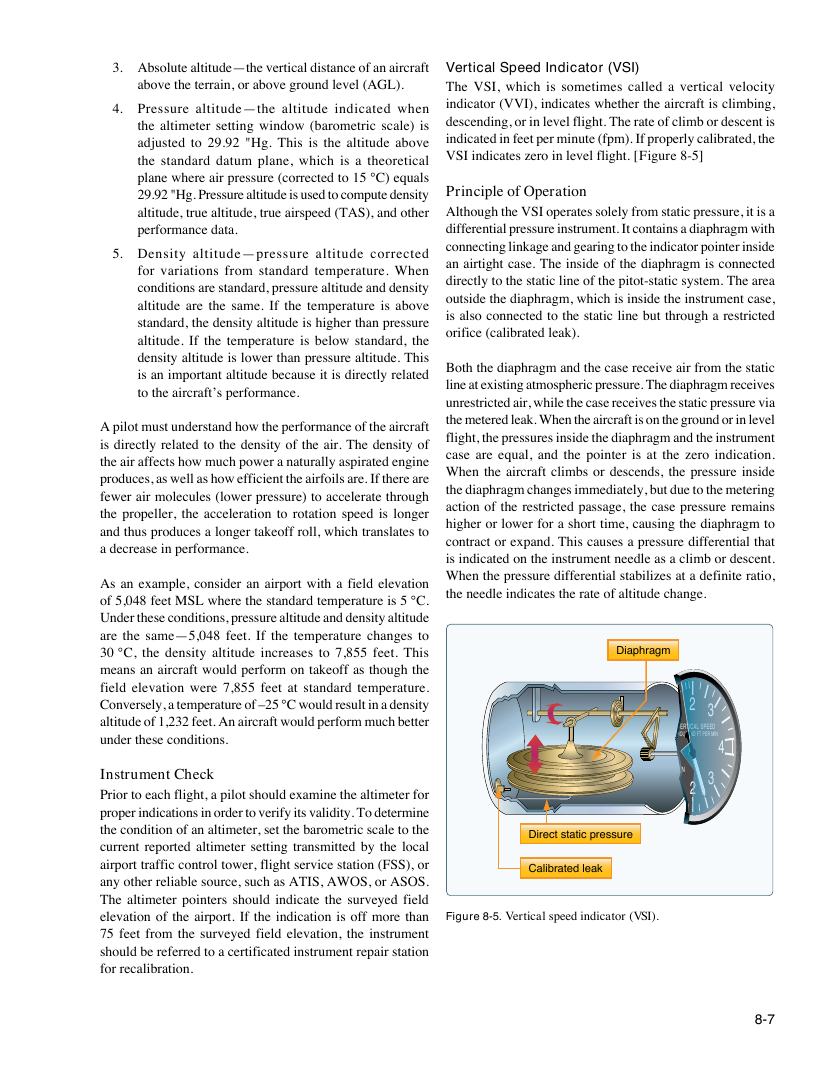
VSI indicates zero in level flight. [Figure 8-5]
the standard datum plane, which is a theoretical
plane where air pressure (corrected to 15 °C) equals
29.92 "Hg. Pressure altitude is used to compute density Principle of Operation
altitude, true altitude, true airspeed (TAS), and other Although the VSI operates solely from static pressure, it is a
performance data. differential pressure instrument. It contains a diaphragm with
connecting linkage and gearing to the indicator pointer inside
5. Density altitude—pressure altitude corrected
an airtight case. The inside of the diaphragm is connected
for variations from standard temperature. When
directly to the static line of the pitot-static system. The area
conditions are standard, pressure altitude and density
outside the diaphragm, which is inside the instrument case,
altitude are the same. If the temperature is above
is also connected to the static line but through a restricted
standard, the density altitude is higher than pressure
orifice (calibrated leak).
altitude. If the temperature is below standard, the
density altitude is lower than pressure altitude. This
Both the diaphragm and the case receive air from the static
is an important altitude because it is directly related
line at existing atmospheric pressure. The diaphragm receives
to the aircraft’s performance.
unrestricted air, while the case receives the static pressure via
the metered leak. When the aircraft is on the ground or in level
A pilot must understand how the performance of the aircraft
flight, the pressures inside the diaphragm and the instrument
is directly related to the density of the air. The density of
case are equal, and the pointer is at the zero indication.
the air affects how much power a naturally aspirated engine
When the aircraft climbs or descends, the pressure inside
produces, as well as how efficient the airfoils are. If there are
the diaphragm changes immediately, but due to the metering
fewer air molecules (lower pressure) to accelerate through
action of the restricted passage, the case pressure remains
the propeller, the acceleration to rotation speed is longer
higher or lower for a short time, causing the diaphragm to
and thus produces a longer takeoff roll, which translates to
contract or expand. This causes a pressure differential that
a decrease in performance.
is indicated on the instrument needle as a climb or descent.
When the pressure differential stabilizes at a definite ratio,
As an example, consider an airport with a field elevation
the needle indicates the rate of altitude change.
of 5,048 feet MSL where the standard temperature is 5 °C.
Under these conditions, pressure altitude and density altitude
are the same—5,048 feet. If the temperature changes to
30 °C, the density altitude increases to 7,855 feet. This Diaphragm
means an aircraft would perform on takeoff as though the
field elevation were 7,855 feet at standard temperature.
Conversely, a temperature of –25 °C would result in a density 2
I 3
altitude of 1,232 feet. An aircraft would perform much better
VERTICAL SPEED
under these conditions. UPTHOUSAND FT PER MIN
0 4
Instrument Check IDOWN 3
2
Prior to each flight, a pilot should examine the altimeter for
proper indications in order to verify its validity. To determine
the condition of an altimeter, set the barometric scale to the
Direct static pressure
current reported altimeter setting transmitted by the local
airport traffic control tower, flight service station (FSS), or
Calibrated leak
any other reliable source, such as ATIS, AWOS, or ASOS.
The altimeter pointers should indicate the surveyed field
elevation of the airport. If the indication is off more than Figure 8-5. Vertical speed indicator (VSI).
75 feet from the surveyed field elevation, the instrument
should be referred to a certificated instrument repair station
for recalibration.
8-7