FAA-H-8083-25C · Source PDF page 250
Weight and Balance
Control · PHAK page 10-6
Searchable transcription
the imaginary point at which all the weight is concentrated.
To provide the necessary balance between longitudinal
Datum
stability and elevator control, the CG is usually located 100"
slightly forward of the center of lift. This loading condition
causes a nose-down tendency in flight, which is desirable
during flight at a high AOA and slow speeds.
50
lb
As mentioned earlier, a safe zone within which the balance
point (CG) must fall is called the CG range. The extremities
Fulcrum
of the range are called the forward CG limits and aft CG
Moment = 5,000 in-lb
limits. These limits are usually specified in inches, along the
Wt x Arm = Moment
longitudinal axis of the airplane, measured from a reference (lb) x (in) = (in-lb)
Note: The datum is assumed to be
point called a datum reference. The datum is an arbitrary located at the fulcrum. 50 x 100 = 5,000
point, established by aircraft designers that may vary in
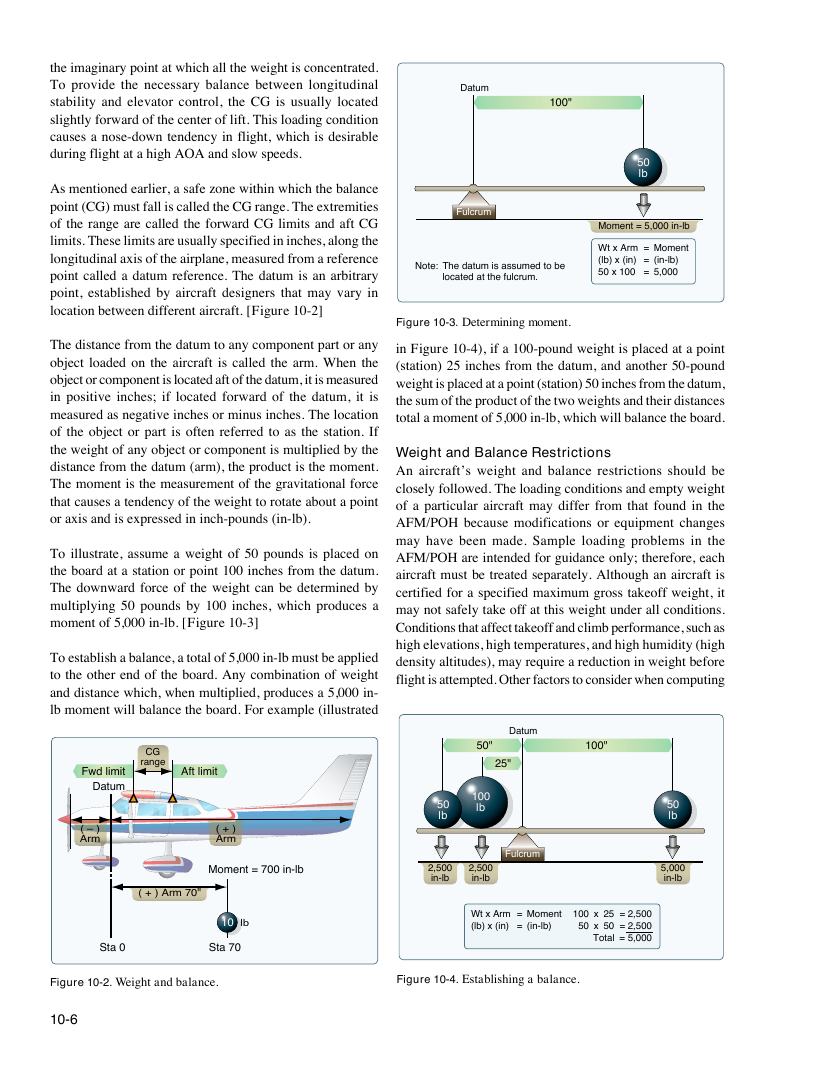
location between different aircraft. [Figure 10-2]
Figure 10-3. Determining moment.
The distance from the datum to any component part or any in Figure 10-4), if a 100-pound weight is placed at a point
object loaded on the aircraft is called the arm. When the (station) 25 inches from the datum, and another 50-pound
object or component is located aft of the datum, it is measured weight is placed at a point (station) 50 inches from the datum,
in positive inches; if located forward of the datum, it is the sum of the product of the two weights and their distances
measured as negative inches or minus inches. The location total a moment of 5,000 in-lb, which will balance the board.
of the object or part is often referred to as the station. If
the weight of any object or component is multiplied by the
Weight and Balance Restrictions
distance from the datum (arm), the product is the moment.
An aircraft’s weight and balance restrictions should be
The moment is the measurement of the gravitational force
closely followed. The loading conditions and empty weight
that causes a tendency of the weight to rotate about a point
of a particular aircraft may differ from that found in the
or axis and is expressed in inch-pounds (in-lb).
AFM/POH because modifications or equipment changes
may have been made. Sample loading problems in the
To illustrate, assume a weight of 50 pounds is placed on
AFM/POH are intended for guidance only; therefore, each
the board at a station or point 100 inches from the datum.
aircraft must be treated separately. Although an aircraft is
The downward force of the weight can be determined by
certified for a specified maximum gross takeoff weight, it
multiplying 50 pounds by 100 inches, which produces a
may not safely take off at this weight under all conditions.
moment of 5,000 in-lb. [Figure 10-3]
Conditions that affect takeoff and climb performance, such as
high elevations, high temperatures, and high humidity (high
To establish a balance, a total of 5,000 in-lb must be applied
density altitudes), may require a reduction in weight before
to the other end of the board. Any combination of weight
flight is attempted. Other factors to consider when computing
and distance which, when multiplied, produces a 5,000 in-
lb moment will balance the board. For example (illustrated
Datum
50" 100"
CG
range 25"
Fwd limit Aft limit
Datum
100
50 lb 50
lb lb
( – ) ( + )
Arm Arm
Fulcrum
Moment = 700 in-lb 2,500 2,500 5,000
in-lb in-lb in-lb
( + ) Arm 70"
Wt x Arm = Moment 100 x 25 = 2,500
10 lb (lb) x (in) = (in-lb) 50 x 50 = 2,500
Total = 5,000
Sta 0 Sta 70
Figure 10-2. Weight and balance. Figure 10-4. Establishing a balance.
10-6