FAA-H-8083-25C · Source PDF page 251
Weight and Balance
Determining Loaded Weight and CG · PHAK page 10-7
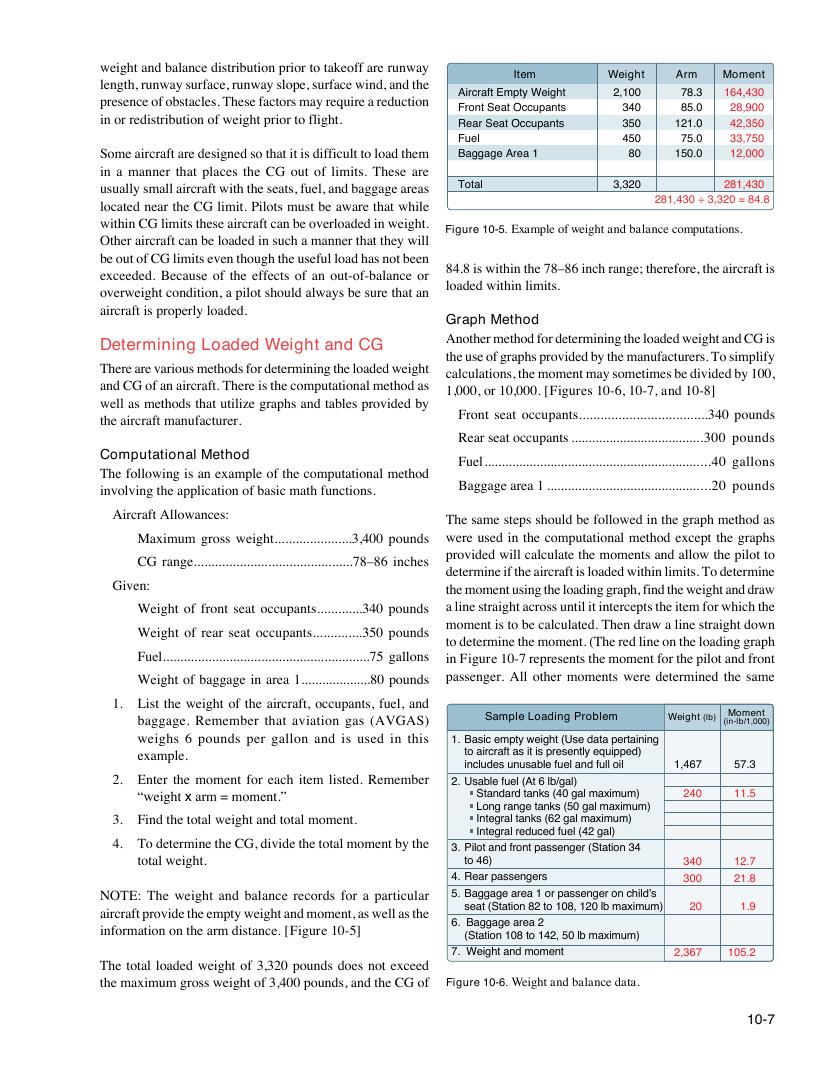
Searchable transcription
weight and balance distribution prior to takeoff are runway
Item Weight Arm Moment
length, runway surface, runway slope, surface wind, and the
Aircraft Empty Weight 2,100 78.3 164,430
presence of obstacles. These factors may require a reduction
Front Seat Occupants 340 85.0 28,900
in or redistribution of weight prior to flight.
Rear Seat Occupants 350 121.0 42,350
Fuel 450 75.0 33,750
Some aircraft are designed so that it is difficult to load them Baggage Area 1 80 150.0 12,000
in a manner that places the CG out of limits. These are
usually small aircraft with the seats, fuel, and baggage areas Total 3,320 281,430
281,430 ÷ 3,320 = 84.8
located near the CG limit. Pilots must be aware that while
within CG limits these aircraft can be overloaded in weight.
Figure 10-5. Example of weight and balance computations.
Other aircraft can be loaded in such a manner that they will
be out of CG limits even though the useful load has not been
84.8 is within the 78–86 inch range; therefore, the aircraft is
exceeded. Because of the effects of an out-of-balance or
loaded within limits.
overweight condition, a pilot should always be sure that an
aircraft is properly loaded.
Graph Method
Another method for determining the loaded weight and CG is
Determining Loaded Weight and CG
the use of graphs provided by the manufacturers. To simplify
There are various methods for determining the loaded weight
calculations, the moment may sometimes be divided by 100,
and CG of an aircraft. There is the computational method as
1,000, or 10,000. [Figures 10-6, 10-7, and 10-8]
well as methods that utilize graphs and tables provided by
Front seat occupants....................................340 pounds
the aircraft manufacturer.
Rear seat occupants ......................................300 pounds
Computational Method
Fuel .................................................................40 gallons
The following is an example of the computational method
Baggage area 1 ...............................................20 pounds
involving the application of basic math functions.
Aircraft Allowances:
The same steps should be followed in the graph method as
Maximum gross weight......................3,400 pounds were used in the computational method except the graphs
provided will calculate the moments and allow the pilot to
CG range.............................................78–86 inches
determine if the aircraft is loaded within limits. To determine
Given: the moment using the loading graph, find the weight and draw
Weight of front seat occupants.............340 pounds a line straight across until it intercepts the item for which the
moment is to be calculated. Then draw a line straight down
Weight of rear seat occupants..............350 pounds
to determine the moment. (The red line on the loading graph
Fuel...........................................................75 gallons in Figure 10-7 represents the moment for the pilot and front
Weight of baggage in area 1....................80 pounds passenger. All other moments were determined the same
1. List the weight of the aircraft, occupants, fuel, and
baggage. Remember that aviation gas (AVGAS) Sample Loading Problem Weight (lb) Moment
(in-lb/1,000)
weighs 6 pounds per gallon and is used in this 1. Basic empty weight (Use data pertaining
example. to aircraft as it is presently equipped)
includes unusable fuel and full oil 1,467 57.3
2. Enter the moment for each item listed. Remember 2. Usable fuel (At 6 lb/gal)
“weight x arm = moment.” Standard tanks (40 gal maximum) 240 11.5
Long range tanks (50 gal maximum)
3. Find the total weight and total moment. Integral tanks (62 gal maximum)
Integral reduced fuel (42 gal)
4. To determine the CG, divide the total moment by the
3. Pilot and front passenger (Station 34
total weight. to 46) 340 12.7
4. Rear passengers 300 21.8
NOTE: The weight and balance records for a particular 5. Baggage area 1 or passenger on child’s
seat (Station 82 to 108, 120 lb maximum) 20 1.9
aircraft provide the empty weight and moment, as well as the
6. Baggage area 2
information on the arm distance. [Figure 10-5]
(Station 108 to 142, 50 lb maximum)
7. Weight and moment 2,367 105.2
The total loaded weight of 3,320 pounds does not exceed
the maximum gross weight of 3,400 pounds, and the CG of Figure 10-6. Weight and balance data.
10-7