FAA-H-8083-25C · Source PDF page 264
Aircraft Performance
Climb Performance Factors · PHAK page 11-8
Searchable transcription
rewoP
Velocity (TAS)
rewoP
to 1,500 feet in 30 seconds but covers 6,000 feet across the to minimize the weight, since it has such a marked effect on
ground. Note that both ROC and AOC maximum climb the factors pertaining to performance.
profiles use the aircraft’s maximum throttle setting. Any
differences between max ROC and max AOC lie primarily A change in an aircraft’s weight produces a twofold effect
in the velocity (airspeed) and AOA combination the aircraft on climb performance. First, a change in weight changes the
manual specifies. [Figure 11-7] drag and the power required. This alters the reserve power
available, which in turn, affects both the climb angle and
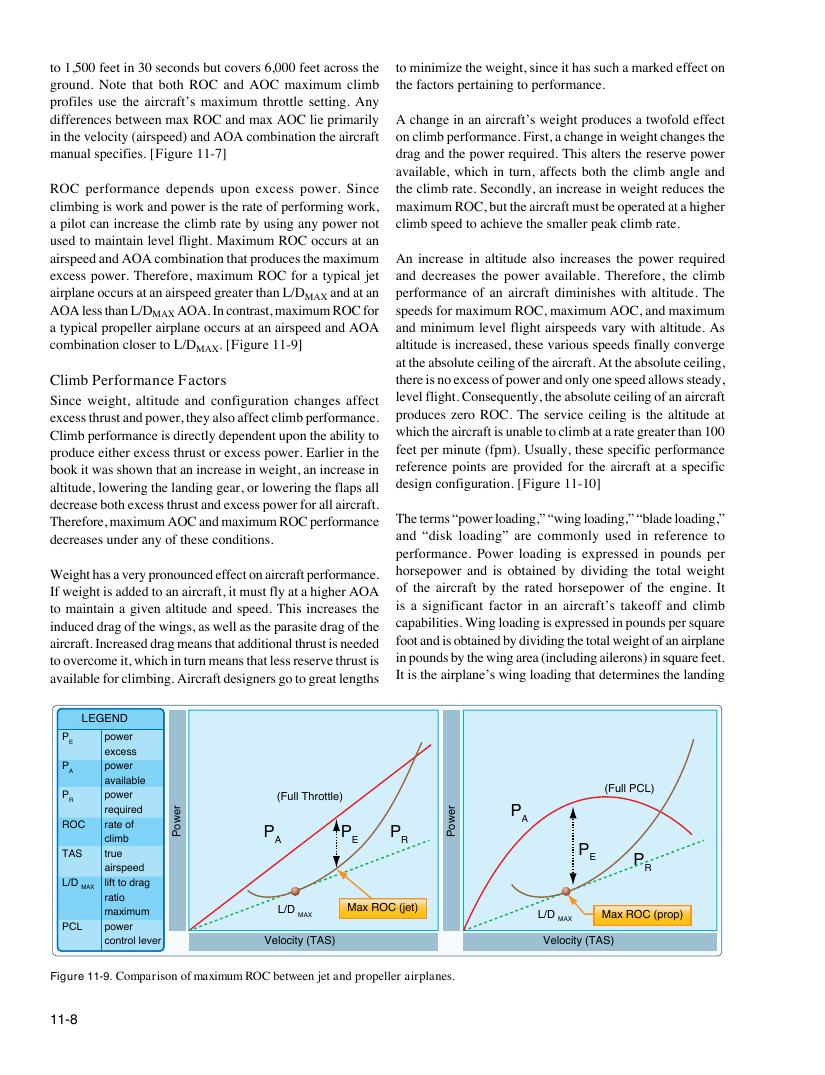
ROC performance depends upon excess power. Since the climb rate. Secondly, an increase in weight reduces the
climbing is work and power is the rate of performing work, maximum ROC, but the aircraft must be operated at a higher
a pilot can increase the climb rate by using any power not climb speed to achieve the smaller peak climb rate.
used to maintain level flight. Maximum ROC occurs at an
airspeed and AOA combination that produces the maximum An increase in altitude also increases the power required
excess power. Therefore, maximum ROC for a typical jet and decreases the power available. Therefore, the climb
airplane occurs at an airspeed greater than L/D and at an performance of an aircraft diminishes with altitude. The
MAX
AOA less than L/D AOA. In contrast, maximum ROC for speeds for maximum ROC, maximum AOC, and maximum
MAX
a typical propeller airplane occurs at an airspeed and AOA and minimum level flight airspeeds vary with altitude. As
combination closer to L/D . [Figure 11-9] altitude is increased, these various speeds finally converge
MAX
at the absolute ceiling of the aircraft. At the absolute ceiling,
Climb Performance Factors there is no excess of power and only one speed allows steady,
Since weight, altitude and configuration changes affect level flight. Consequently, the absolute ceiling of an aircraft
excess thrust and power, they also affect climb performance. produces zero ROC. The service ceiling is the altitude at
Climb performance is directly dependent upon the ability to which the aircraft is unable to climb at a rate greater than 100
produce either excess thrust or excess power. Earlier in the feet per minute (fpm). Usually, these specific performance
book it was shown that an increase in weight, an increase in reference points are provided for the aircraft at a specific
altitude, lowering the landing gear, or lowering the flaps all design configuration. [Figure 11-10]
decrease both excess thrust and excess power for all aircraft.
Therefore, maximum AOC and maximum ROC performance The terms “power loading,” “wing loading,” “blade loading,”
decreases under any of these conditions. and “disk loading” are commonly used in reference to
performance. Power loading is expressed in pounds per
Weight has a very pronounced effect on aircraft performance. horsepower and is obtained by dividing the total weight
If weight is added to an aircraft, it must fly at a higher AOA of the aircraft by the rated horsepower of the engine. It
to maintain a given altitude and speed. This increases the is a significant factor in an aircraft’s takeoff and climb
induced drag of the wings, as well as the parasite drag of the capabilities. Wing loading is expressed in pounds per square
aircraft. Increased drag means that additional thrust is needed foot and is obtained by dividing the total weight of an airplane
to overcome it, which in turn means that less reserve thrust is in pounds by the wing area (including ailerons) in square feet.
available for climbing. Aircraft designers go to great lengths It is the airplane’s wing loading that determines the landing
LEGEND
P power
E
excess
P power
A
available
(Full PCL)
P power (Full Throttle)
R
required P
A
ROC rate of
P P P
climb A E R
P
TAS true E P
airspeed R
L/D lift to drag
MAX
ratio
maximum L/D MAX Max ROC (jet) L/D Max ROC (prop)
MAX
PCL power
control lever Velocity (TAS)
Figure 11-9. Comparison of maximum ROC between jet and propeller airplanes.