FAA-H-8083-25C · Source PDF page 267
Aircraft Performance
Climb Performance Factors · PHAK page 11-11
Searchable transcription
deriuqer
rewoP
The variations of speed and power required must be specific fuel consumption for values of brake horsepower
monitored by the pilot as part of the cruise control procedure below the maximum cruise power rating of the engine that
to maintain the L/D . When the aircraft’s fuel weight is a is the lean range of engine operation. Thus, an increase in
MAX
small part of the gross weight and the aircraft’s range is small, altitude produces a decrease in specific range only when the
the cruise control procedure can be simplified to essentially increased power requirement exceeds the maximum cruise
maintaining a constant speed and power setting throughout power rating of the engine. One advantage of supercharging
the time of cruise flight. However, a long-range aircraft has a is that the cruise power may be maintained at high altitude,
fuel weight that is a considerable part of the gross weight, and and the aircraft may achieve the range at high altitude with
cruise control procedures must employ scheduled airspeed the corresponding increase in TAS. The principal differences
and power changes to maintain optimum range conditions. in the high altitude cruise and low altitude cruise are the TAS
and climb fuel requirements.
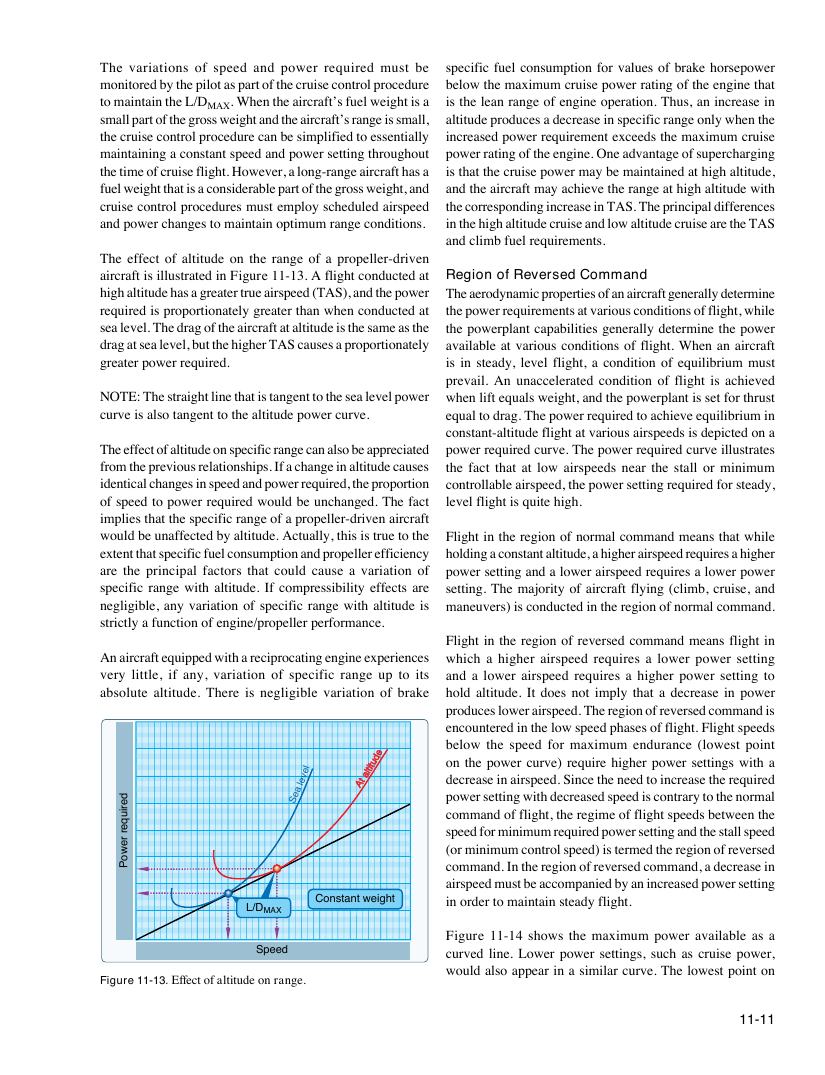
The effect of altitude on the range of a propeller-driven
aircraft is illustrated in Figure 11-13. A flight conducted at Region of Reversed Command
high altitude has a greater true airspeed (TAS), and the power The aerodynamic properties of an aircraft generally determine
required is proportionately greater than when conducted at the power requirements at various conditions of flight, while
sea level. The drag of the aircraft at altitude is the same as the the powerplant capabilities generally determine the power
drag at sea level, but the higher TAS causes a proportionately available at various conditions of flight. When an aircraft
greater power required. is in steady, level flight, a condition of equilibrium must
prevail. An unaccelerated condition of flight is achieved
NOTE: The straight line that is tangent to the sea level power when lift equals weight, and the powerplant is set for thrust
curve is also tangent to the altitude power curve. equal to drag. The power required to achieve equilibrium in
constant-altitude flight at various airspeeds is depicted on a
The effect of altitude on specific range can also be appreciated power required curve. The power required curve illustrates
from the previous relationships. If a change in altitude causes the fact that at low airspeeds near the stall or minimum
identical changes in speed and power required, the proportion controllable airspeed, the power setting required for steady,
of speed to power required would be unchanged. The fact level flight is quite high.
implies that the specific range of a propeller-driven aircraft
would be unaffected by altitude. Actually, this is true to the Flight in the region of normal command means that while
extent that specific fuel consumption and propeller efficiency holding a constant altitude, a higher airspeed requires a higher
are the principal factors that could cause a variation of power setting and a lower airspeed requires a lower power
specific range with altitude. If compressibility effects are setting. The majority of aircraft flying (climb, cruise, and
negligible, any variation of specific range with altitude is maneuvers) is conducted in the region of normal command.
strictly a function of engine/propeller performance.
Flight in the region of reversed command means flight in
An aircraft equipped with a reciprocating engine experiences which a higher airspeed requires a lower power setting
very little, if any, variation of specific range up to its and a lower airspeed requires a higher power setting to
absolute altitude. There is negligible variation of brake hold altitude. It does not imply that a decrease in power
produces lower airspeed. The region of reversed command is
encountered in the low speed phases of flight. Flight speeds
below the speed for maximum endurance (lowest point
e
u d on the power curve) require higher power settings with a
a
l
e v
el
At
altit
decrease in airspeed. Since the need to increase the required
e power setting with decreased speed is contrary to the normal S
command of flight, the regime of flight speeds between the
speed for minimum required power setting and the stall speed
(or minimum control speed) is termed the region of reversed
command. In the region of reversed command, a decrease in
airspeed must be accompanied by an increased power setting
Constant weight in order to maintain steady flight.
L/D
MAX
Figure 11-14 shows the maximum power available as a
Speed curved line. Lower power settings, such as cruise power,
would also appear in a similar curve. The lowest point on
Figure 11-13. Effect of altitude on range.