FAA-H-8083-25C · Source PDF page 268
Aircraft Performance
Takeoff and Landing Performance · PHAK page 11-12
Searchable transcription
gnittes
rewoP
Takeoff and landing performance is a condition of
accelerated and decelerated motion. For instance, during
takeoff an aircraft starts at zero speed and accelerates to
Maximum power
available the takeoff speed to become airborne. During landing, the
aircraft touches down at the landing speed and decelerates
R re e v g e io rs n e o d f Excess power uir e d to zero speed. The important factors of takeoff or landing
command e q performance are:
er r
Po w • The takeoff or landing speed is generally a function
of the stall speed or minimum flying speed.
• The rate of acceleration/deceleration during the
takeoff or landing roll. The speed (acceleration and
Best endurance speed
deceleration) experienced by any object varies directly
with the imbalance of force and inversely with the
Speed
mass of the object. An airplane on the runway moving
at 75 knots has four times the energy it has traveling
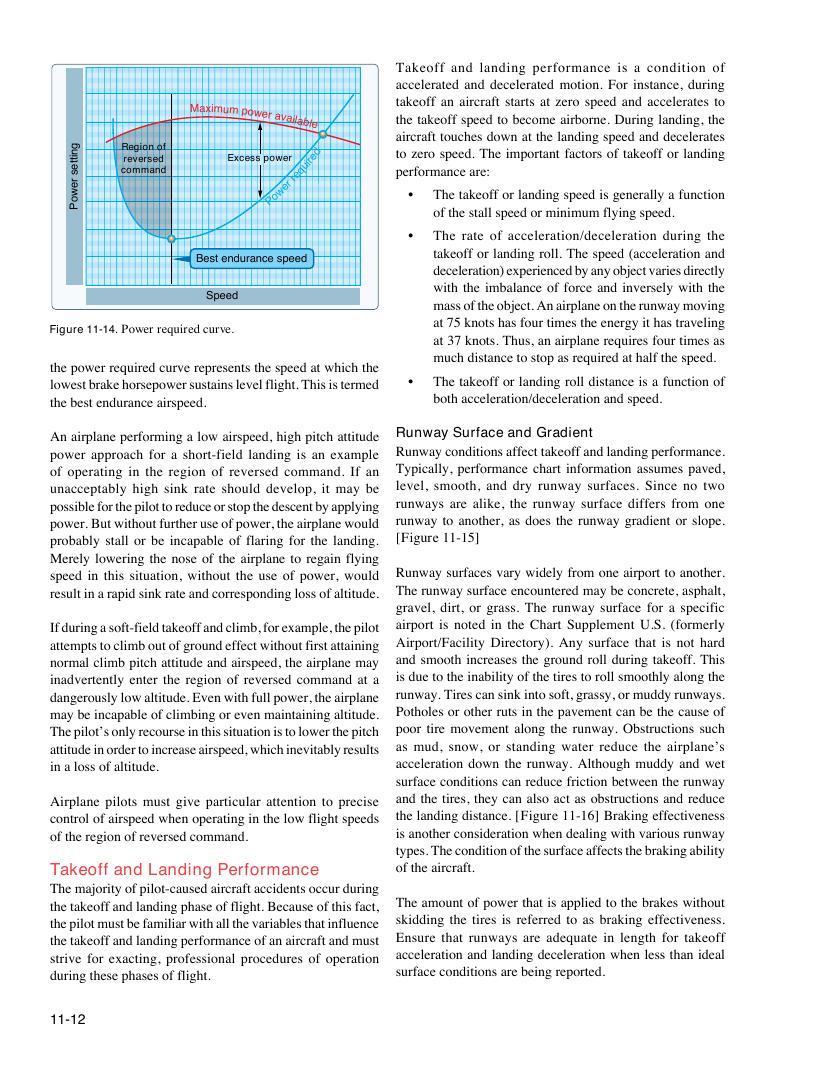
Figure 11-14. Power required curve.
at 37 knots. Thus, an airplane requires four times as
much distance to stop as required at half the speed.
the power required curve represents the speed at which the
lowest brake horsepower sustains level flight. This is termed • The takeoff or landing roll distance is a function of
the best endurance airspeed. both acceleration/deceleration and speed.
An airplane performing a low airspeed, high pitch attitude Runway Surface and Gradient
power approach for a short-field landing is an example Runway conditions affect takeoff and landing performance.
of operating in the region of reversed command. If an Typically, performance chart information assumes paved,
unacceptably high sink rate should develop, it may be level, smooth, and dry runway surfaces. Since no two
possible for the pilot to reduce or stop the descent by applying runways are alike, the runway surface differs from one
power. But without further use of power, the airplane would runway to another, as does the runway gradient or slope.
probably stall or be incapable of flaring for the landing. [Figure 11-15]
Merely lowering the nose of the airplane to regain flying
speed in this situation, without the use of power, would Runway surfaces vary widely from one airport to another.
result in a rapid sink rate and corresponding loss of altitude. The runway surface encountered may be concrete, asphalt,
gravel, dirt, or grass. The runway surface for a specific
If during a soft-field takeoff and climb, for example, the pilot airport is noted in the Chart Supplement U.S. (formerly
attempts to climb out of ground effect without first attaining Airport/Facility Directory). Any surface that is not hard
normal climb pitch attitude and airspeed, the airplane may and smooth increases the ground roll during takeoff. This
inadvertently enter the region of reversed command at a is due to the inability of the tires to roll smoothly along the
dangerously low altitude. Even with full power, the airplane runway. Tires can sink into soft, grassy, or muddy runways.
may be incapable of climbing or even maintaining altitude. Potholes or other ruts in the pavement can be the cause of
The pilot’s only recourse in this situation is to lower the pitch poor tire movement along the runway. Obstructions such
attitude in order to increase airspeed, which inevitably results as mud, snow, or standing water reduce the airplane’s
in a loss of altitude. acceleration down the runway. Although muddy and wet
surface conditions can reduce friction between the runway
Airplane pilots must give particular attention to precise and the tires, they can also act as obstructions and reduce
control of airspeed when operating in the low flight speeds the landing distance. [Figure 11-16] Braking effectiveness
of the region of reversed command. is another consideration when dealing with various runway
types. The condition of the surface affects the braking ability
Takeoff and Landing Performance of the aircraft.
The majority of pilot-caused aircraft accidents occur during
the takeoff and landing phase of flight. Because of this fact, The amount of power that is applied to the brakes without
the pilot must be familiar with all the variables that influence skidding the tires is referred to as braking effectiveness.
the takeoff and landing performance of an aircraft and must Ensure that runways are adequate in length for takeoff
strive for exacting, professional procedures of operation acceleration and landing deceleration when less than ideal
during these phases of flight. surface conditions are being reported.