FAA-H-8083-25C · Source PDF page 259
Aircraft Performance
Density Altitude · PHAK page 11-3
Searchable transcription
Pressure Temperature
Altitude (ft)
("Hg) (°C) (°F)
0 29.92 15.0 59.0
1,000 28.86 13.0 55.4
2,000 27.82 11.0 51.9
3,000 26.82 9.1 48.3
4,000 25.84 7.1 44.7
5,000 24.89 5.1 41.2
6,000 23.98 3.1 37.6
7,000 23.09 1.1 34.0
8,000 22.22 −0.9 30.5
9,000 21.38 −2.8 26.9
10,000 20.57 −4.8 23.3
11,000 19.79 −6.8 19.8
12,000 19.02 −8.8 16.2
13,000 18.29 −10.8 12.6
14,000 17.57 −12.7 9.1
15,000 16.88 −14.7 5.5
16,000 16.21 −16.7 1.9
Altimeter Altitude
17,000 15.56 −18.7 −1.6
setting correction
18,000 14.94 −20.7 −5.2
28.0 1,824
19,000 14.33 −22.6 −8.8
28.1 1,727
20,000 13.74 −24.6 −12.3
28.2 1,630
28.3 1,533
Figure 11-2. Properties of standard atmosphere.
28.4 1,436
28.5 1,340
28.6 1,244
28.7 1,148
28.8 1,053
28.9 957
29.0 863
29.1 768
29.2 673
29.3 579
29.4 485
29.5 392
29.6 298
29.7 205
29.8 112
29.9 20
29.92 0
30.0 −73
30.1 −165
30.2 −257
30.3 −348
30.4 −440
30.5 −531
30.6 −622
30.7 −712
30.8 −803
30.9 −893
31.0 −983
11-3
ddA
tcartbuS
Method for Determining
Pressure Altitude Alternate Method for Determining
Pressure Altitude
To field
elevation
To get
pressure altitude
From field
elevation
level
aes
si
noitavele
dleiF
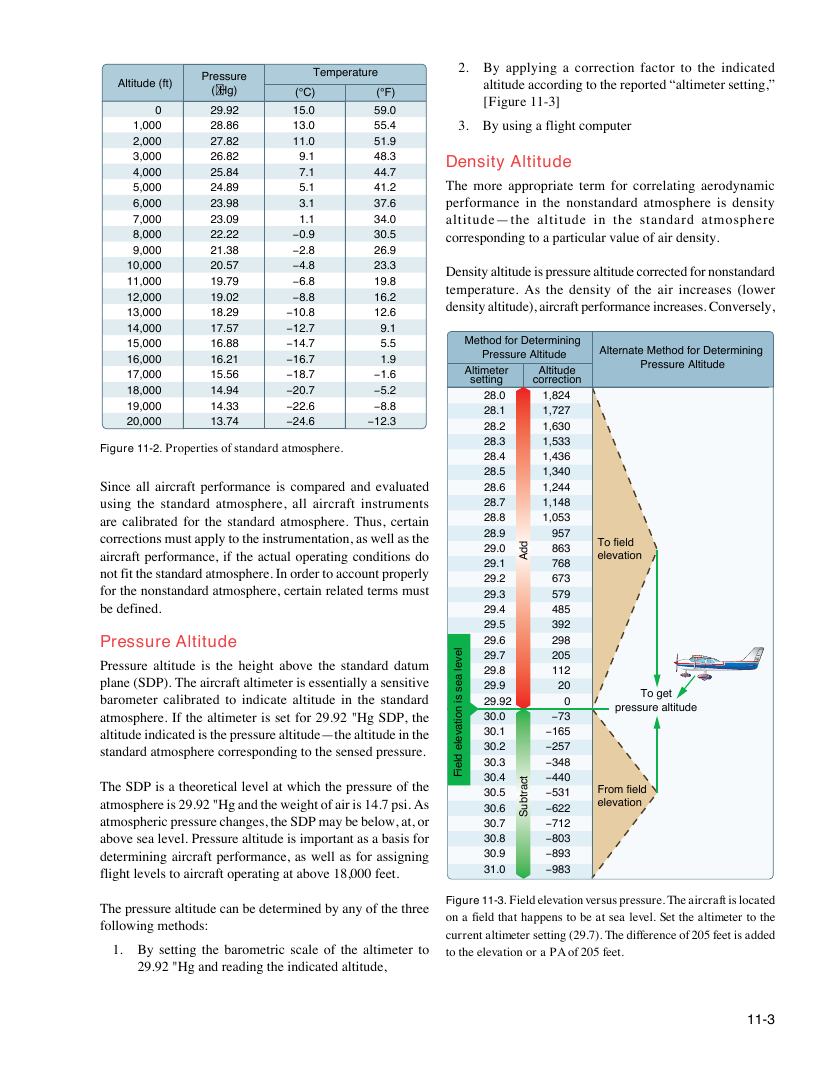
2. By applying a correction factor to the indicated
altitude according to the reported “altimeter setting,”
[Figure 11-3]
3. By using a flight computer
Density Altitude
The more appropriate term for correlating aerodynamic
performance in the nonstandard atmosphere is density
altitude—the altitude in the standard atmosphere
corresponding to a particular value of air density.
Density altitude is pressure altitude corrected for nonstandard
temperature. As the density of the air increases (lower
density altitude), aircraft performance increases. Conversely,
Since all aircraft performance is compared and evaluated
using the standard atmosphere, all aircraft instruments
are calibrated for the standard atmosphere. Thus, certain
corrections must apply to the instrumentation, as well as the
aircraft performance, if the actual operating conditions do
not fit the standard atmosphere. In order to account properly
for the nonstandard atmosphere, certain related terms must
be defined.
Pressure Altitude
Pressure altitude is the height above the standard datum
plane (SDP). The aircraft altimeter is essentially a sensitive
barometer calibrated to indicate altitude in the standard
atmosphere. If the altimeter is set for 29.92 "Hg SDP, the
altitude indicated is the pressure altitude—the altitude in the
standard atmosphere corresponding to the sensed pressure.
The SDP is a theoretical level at which the pressure of the
atmosphere is 29.92 "Hg and the weight of air is 14.7 psi. As
atmospheric pressure changes, the SDP may be below, at, or
above sea level. Pressure altitude is important as a basis for
determining aircraft performance, as well as for assigning
flight levels to aircraft operating at above 18,000 feet.
Figure 11-3. Field elevation versus pressure. The aircraft is located
The pressure altitude can be determined by any of the three
on a field that happens to be at sea level. Set the altimeter to the
following methods:
current altimeter setting (29.7). The difference of 205 feet is added
1. By setting the barometric scale of the altimeter to to the elevation or a PA of 205 feet.
29.92 "Hg and reading the indicated altitude,