FAA-H-8083-25C · Source PDF page 258
Aircraft Performance
Structure of the Atmosphere · PHAK page 11-2
Searchable transcription
It must be emphasized that the manufacturers’ information exerted by the weight of the atmosphere is approximately 14.7
and data furnished in the AFM/POH is not standardized. pounds per square inch (psi). The density of air has significant
Some provide the data in tabular form, while others use effects on the aircraft’s performance. As air becomes less
graphs. In addition, the performance data may be presented dense, it reduces:
on the basis of standard atmospheric conditions, pressure
• Power, because the engine takes in less air
altitude, or density altitude. The performance information in
• Thrust, because the propeller is less efficient in thin air
the AFM/POH has little or no value unless the user recognizes
those variations and makes the necessary adjustments. • Lift, because the thin air exerts less force on the airfoils
To be able to make practical use of the aircraft’s capabilities The pressure of the atmosphere may vary with time but more
and limitations, it is essential to understand the significance importantly, it varies with altitude and temperature. Due to
of the operational data. The pilot must be cognizant of the the changing atmospheric pressure, a standard reference
basis for the performance data, as well as the meanings of was developed. The standard atmosphere at sea level has
the various terms used in expressing performance capabilities a surface temperature of 59 degrees Fahrenheit (°F) or 15
and limitations. degrees Celsius (°C) and a surface pressure of 29.92 inches
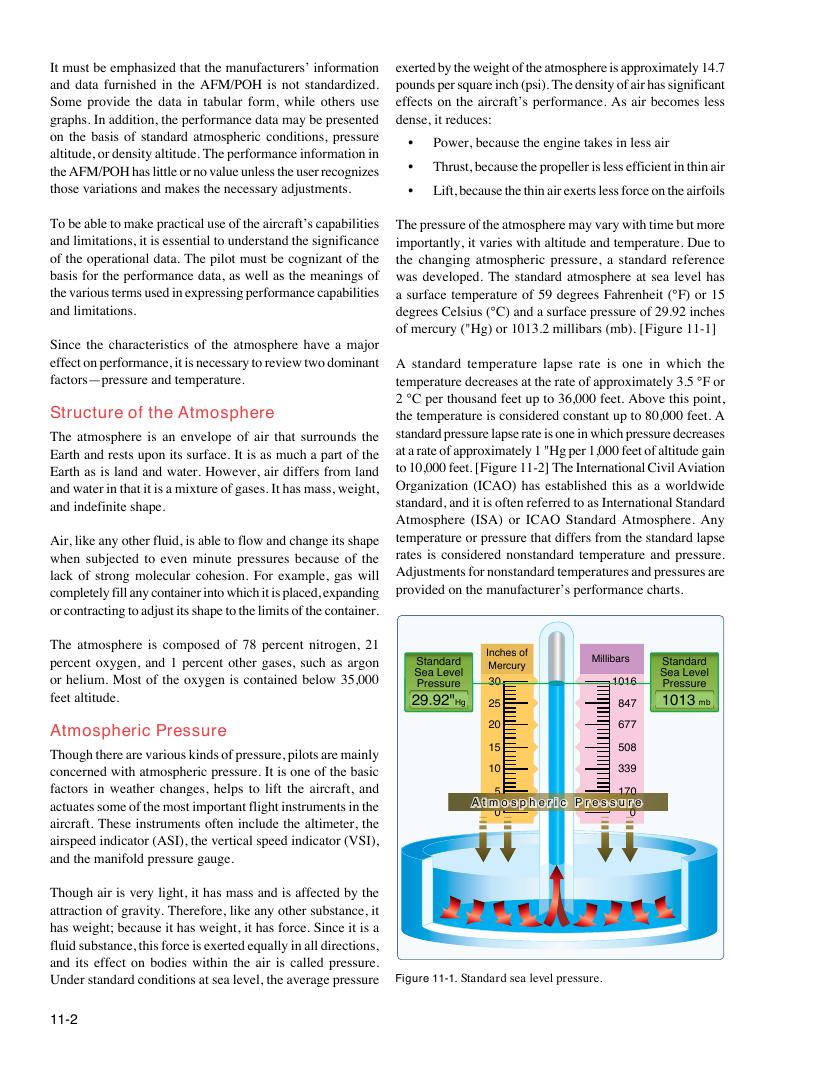
of mercury ("Hg) or 1013.2 millibars (mb). [Figure 11-1]
Since the characteristics of the atmosphere have a major
effect on performance, it is necessary to review two dominant A standard temperature lapse rate is one in which the
factors—pressure and temperature. temperature decreases at the rate of approximately 3.5 °F or
2 °C per thousand feet up to 36,000 feet. Above this point,
Structure of the Atmosphere the temperature is considered constant up to 80,000 feet. A
The atmosphere is an envelope of air that surrounds the standard pressure lapse rate is one in which pressure decreases
Earth and rests upon its surface. It is as much a part of the at a rate of approximately 1 "Hg per 1,000 feet of altitude gain
Earth as is land and water. However, air differs from land to 10,000 feet. [Figure 11-2] The International Civil Aviation
and water in that it is a mixture of gases. It has mass, weight, Organization (ICAO) has established this as a worldwide
and indefinite shape. standard, and it is often referred to as International Standard
Atmosphere (ISA) or ICAO Standard Atmosphere. Any
Air, like any other fluid, is able to flow and change its shape temperature or pressure that differs from the standard lapse
when subjected to even minute pressures because of the rates is considered nonstandard temperature and pressure.
lack of strong molecular cohesion. For example, gas will Adjustments for nonstandard temperatures and pressures are
completely fill any container into which it is placed, expanding provided on the manufacturer’s performance charts.
or contracting to adjust its shape to the limits of the container.
The atmosphere is composed of 78 percent nitrogen, 21
Inches of
percent oxygen, and 1 percent other gases, such as argon Standard Millibars Standard
Mercury
Sea Level Sea Level
or helium. Most of the oxygen is contained below 35,000 Pressure 30 1016 Pressure
feet altitude. 29.92" 1013
Hg 25 847 mb
20 677
Atmospheric Pressure
15 508
Though there are various kinds of pressure, pilots are mainly
concerned with atmospheric pressure. It is one of the basic 10 339
factors in weather changes, helps to lift the aircraft, and
5 170
actuates some of the most important flight instruments in the Atmospheric Pressure
0 0
aircraft. These instruments often include the altimeter, the
airspeed indicator (ASI), the vertical speed indicator (VSI),
and the manifold pressure gauge.
Though air is very light, it has mass and is affected by the
attraction of gravity. Therefore, like any other substance, it
has weight; because it has weight, it has force. Since it is a
fluid substance, this force is exerted equally in all directions,
and its effect on bodies within the air is called pressure.
Under standard conditions at sea level, the average pressure Figure 11-1. Standard sea level pressure.
11-2